Earned secure attachment is an attachment classification identified through the Adult Attachment Interview (AAI) in which a person coherently describes difficult early relationships without becoming disorganized or dismissive. Approximately 8 to 20 percent of the general population across studies meets criteria for earned security (Filosa, Sharp, Gori, and Musetti, 2024). If you're asking how long this takes, your nervous system is already doing something remarkable—seeking evidence that change is possible. Understanding the timeline matters because it replaces vague reassurance with a realistic roadmap.
"How long will this take?" is the question most people ask after learning that attachment patterns can change. The honest answer is complex. No single timeline fits everyone, and the process is non-linear—security can be gained and, under stress, temporarily lost. But research now offers concrete milestones at days, weeks, months, and years that replace the generic "it depends" answer found everywhere else. This article maps those milestones so you can track where you are without measuring yourself against an impossible standard.
Key takeaway: No fixed timeline exists for earned secure attachment, but research provides concrete milestones. Security priming effects emerge within days, emotionally focused therapy produces measurable shifts in approximately 19 to 21 sessions, and stable attachment reclassification typically takes two to four or more years. Approximately 8 to 20 percent of the general population achieves earned security through reflective capacity, emotional tolerance, narrative coherence, and corrective relational experiences.
What Does "Earned Secure" Actually Mean—and How Is It Measured?
Earned secure attachment describes people who experienced adversity in childhood yet developed coherent narratives about those experiences as adults. It is measured through the Adult Attachment Interview (AAI), a structured clinical interview that assesses how you talk about your early relationships—not just what happened, but how organized, balanced, and reflective your account is.
The distinction between earned secure and continuous secure is about origin, not outcome. Continuous secure individuals had consistently responsive caregiving from infancy. Earned secure individuals did not—but they developed the same narrative coherence later, through reflective work and corrective relationships. Both groups function comparably in adult relationships.
One common misconception is that every earned-secure person had a uniformly terrible childhood. Roisman and colleagues (2002), in a 23-year longitudinal study, found that retrospectively defined earned-secures were not more likely to have been anxiously attached in infancy and had often encountered supportive maternal parenting despite reporting negative childhood narratives. The picture is more nuanced than "bad childhood, later healing."
The 8 to 20 percent prevalence of earned security across studies (Filosa et al., 2024) means this is neither rare nor universal. In one study of 272 women, 14 percent were classified as earned secure, compared to 46 percent continuously secure and 30 percent insecure. For a deeper exploration of the concept itself, see What Does Earned Secure Attachment Mean?.
Narrative Coherence Check (for all insecure attachment styles)
- Write 3 to 4 sentences about a difficult childhood memory
- Read what you wrote and notice: Did you minimize ("it wasn't that bad") or become flooded with emotion?
- Can you describe what happened AND reflect on how it affected you in the same paragraph?
- Try rewriting the same memory with one sentence of reflection added: "Looking back, I can see that this taught me to..."
- Notice the difference between the first and second version
This mirrors what the AAI assesses. Narrative coherence is the core marker of earned security, and practicing it builds the reflective muscle that the AAI measures. You are not trying to produce a "correct" answer—you are training yourself to hold both the pain and the perspective simultaneously.
What Does the Research Say About Timelines for Earning Security?
The research consistently frames earned security as a process measured in years, not months—but within that broader timeline, measurable shifts begin much sooner than most people expect. What matters is understanding that different markers of progress operate on different timescales.
Here are the research-backed milestones, organized from shortest to longest:
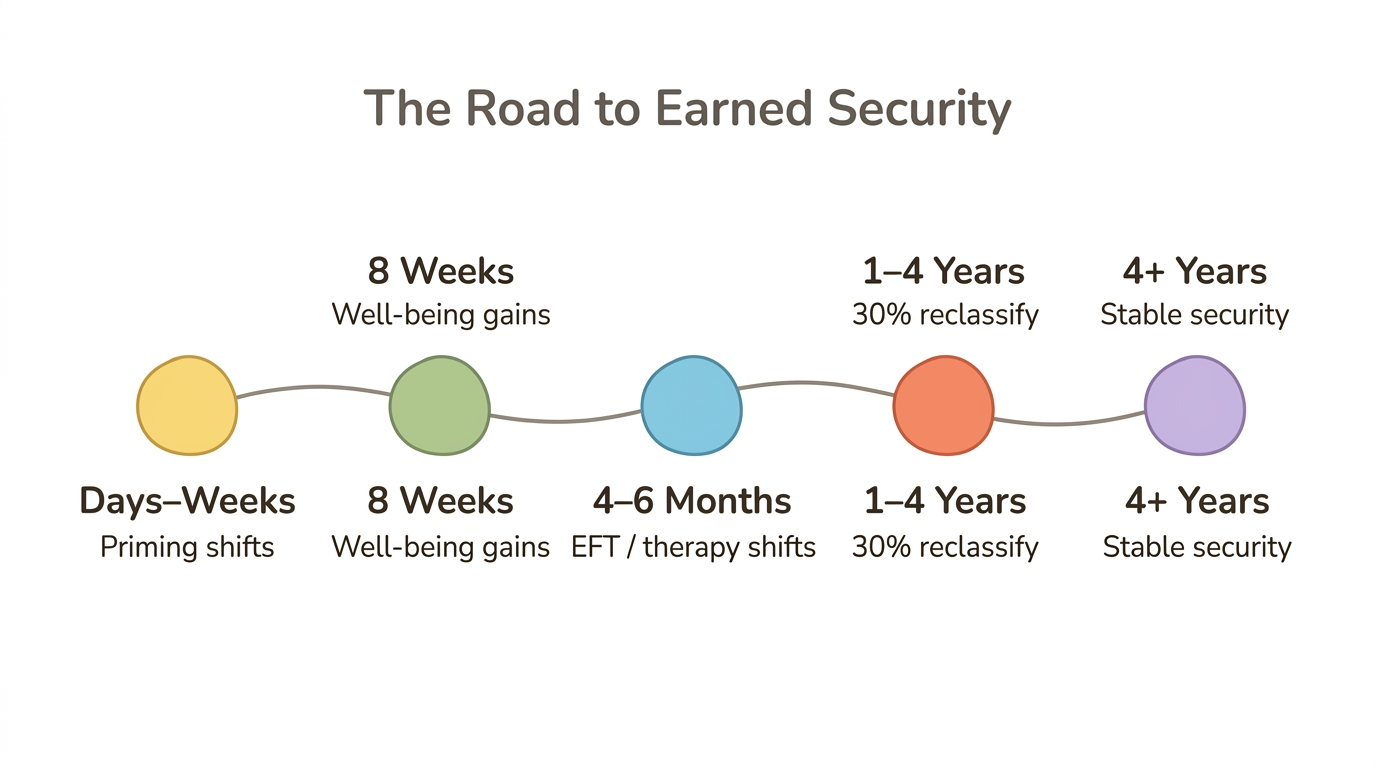
- Days to weeks — Security priming produces measurable shifts in relationship expectations and reduced attachment anxiety after just three sessions over three days (Carnelley and Rowe, 2007)
- Eight weeks — Repeated priming yields significant improvements in well-being, with reduced anxiety and stress measured at two-month follow-up
- Four to six months — Emotionally Focused Therapy produces measurable decreases in attachment avoidance across 19 to 21 sessions; weekly security priming maintains elevated security for up to one month after the final session
- One to four years — Approximately 30 percent of people shift attachment classification over this period (Kirkpatrick and Hazan); therapeutic gains consolidate through consistent practice
- Four or more years — Stable reclassification; earned security becomes a default orientation rather than a conscious effort
These milestones are not a ladder you climb in order. The process is non-linear. Waters, Merrick, Treboux, and colleagues (2000) found 72 percent stability in secure versus insecure classification over 20 years in a sample of 50 participants—but also that 44 percent changed attachment classification when negative life events occurred, compared to 22 percent without such events. Security can be gained and, under significant stress, temporarily disrupted.
This is not a failure. Your nervous system is not a light switch that flips once and stays. Earning security means your baseline gradually shifts, even when individual moments still activate old patterns. For related data on attachment change timelines, see How Long Does It Take to Change Your Attachment Style?—though earned security is a specific AAI construct, distinct from self-reported attachment style shifts.
Timeline Anchoring Journal (for all insecure attachment styles)
- Each week, write one sentence about a relational moment where you responded differently than your old pattern would predict
- Date each entry—even if the "different response" was small ("I waited 10 minutes before texting back instead of immediately")
- After three months, read your entries chronologically from first to last
- Notice patterns: Are the moments becoming more frequent? Are the "different responses" becoming larger?
Earned security develops so gradually that progress is invisible without documentation. Your nervous system rewires through thousands of small moments, not a single breakthrough. This exercise makes the non-linear trajectory tangible—so you can see the shift your body is too close to notice.
What Are the Four Building Blocks of Earned Security?
Earned security develops through four interconnected capacities that research identifies across multiple studies: reflective capacity, emotional tolerance, narrative coherence, and corrective relational experiences (Dansby Olufowote et al., 2019). These are concrete skills, not abstract concepts—and different attachment styles struggle with different ones.
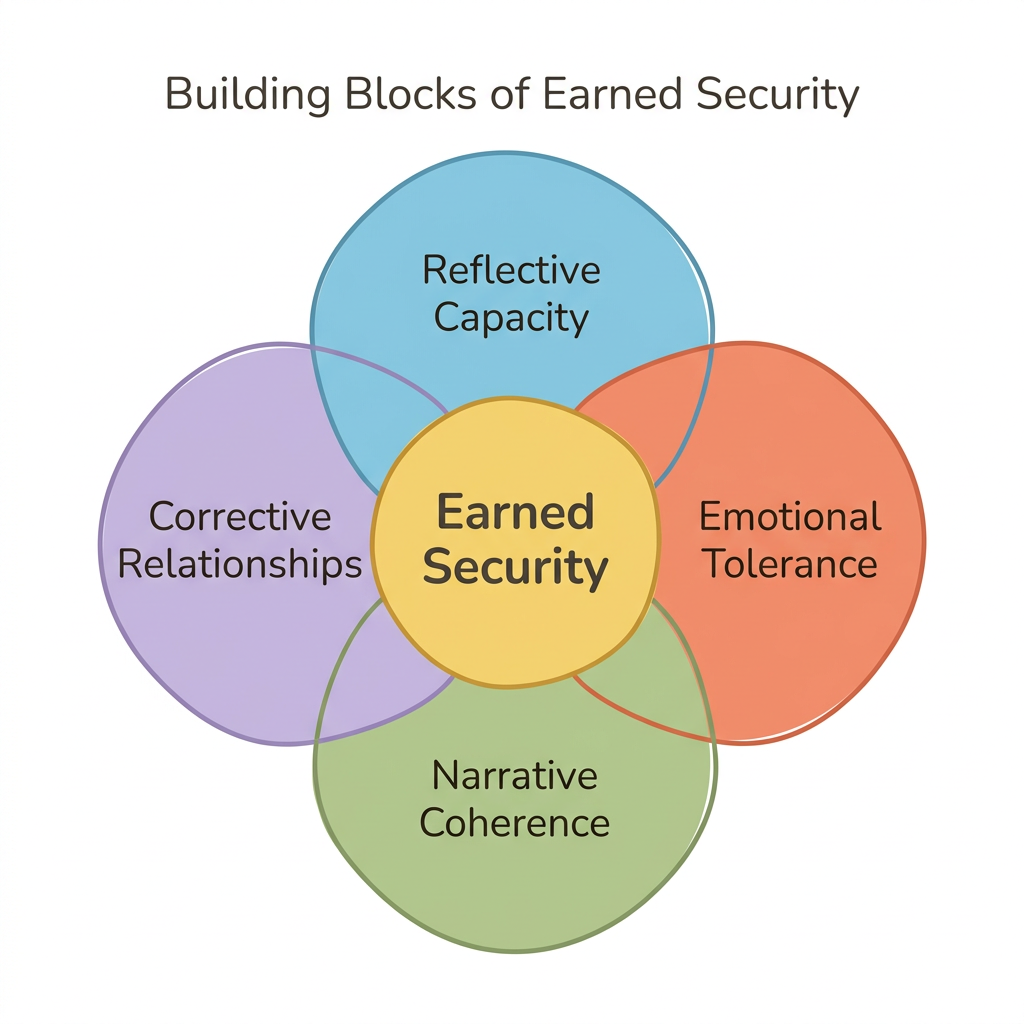
Reflective Capacity
Fonagy and colleagues (1997) found that reflective functioning played a "particularly significant role" in establishing infant security when mothers had experienced childhood deprivation—meaning your ability to reflect on your own patterns directly shapes whether the next generation inherits them. Reflective capacity is this ability to mentalize about your own and others' internal states, to wonder why someone behaved as they did rather than just reacting to what they did.
If you have anxious attachment, you may already reflect frequently—but your reflections tend to loop rather than resolve. Avoidant attachment often involves minimal self-reflection about relational needs. Disorganized attachment can produce contradictory reflections that don't integrate into a coherent picture.
Emotional Tolerance
What does it actually feel like to sit with abandonment fear for 90 seconds without reaching for your phone? Emotional tolerance means experiencing primary emotions—grief, fear, anger, longing—without avoidance or dysregulation. This is different from emotional intensity. Someone with anxious attachment may feel intensely but cannot tolerate the feeling long enough to process it—the intensity moves into protest behavior instead. Someone with avoidant attachment may appear calm but is suppressing the emotion entirely.
Narrative Coherence
Of the four building blocks, narrative coherence is the one the AAI directly measures—and the one that distinguishes earned secure from insecure classifications regardless of what actually happened in childhood. It is the ability to tell your attachment story in an organized, balanced way. You can acknowledge pain without drowning in it. You can describe your caregivers' limitations without either idealizing them or vilifying them.
Corrective Relational Experiences
No amount of individual insight substitutes for the experience of being consistently met by another person. A partner who stays present when you push away. A therapist who holds steady when you test. A friend who shows up repeatedly. These experiences gradually overwrite the implicit expectation that relationships are dangerous—not through words, but through repetition.
Emotional Tolerance Body Scan (especially for avoidant attachment)
- When a difficult attachment emotion arises—abandonment fear, engulfment panic, shame—pause before doing anything
- Locate the feeling in your body: tight chest, hollow stomach, buzzing skin, clenched jaw
- Name the sensation aloud or silently: "tightness in my chest"
- Set a timer for 90 seconds and stay with the sensation without fixing, analyzing, or numbing
- When the timer ends, notice what happened to the sensation's intensity—did it shift, peak, soften, or move?
This exercise targets avoidant attachment specifically because emotional tolerance is the primary growth edge for deactivating patterns. Fonagy's research demonstrates that reflective functioning requires bodily emotional awareness—you cannot mentalize about feelings you refuse to let yourself feel. Ninety seconds is the approximate duration of an emotional wave, and practicing this teaches your nervous system that feelings peak and pass without destroying you.
What Speeds Up or Slows Down Earning Security?
The timeline for earned security varies significantly based on identifiable factors. Understanding what accelerates and decelerates the process helps you set realistic expectations for your specific situation rather than measuring yourself against an average that may not apply.
Accelerators
Alternative attachment figures are one of the strongest predictors. In one study, 64 percent of earned-secure individuals reported an important supportive adult figure during childhood—primarily grandparents, but also teachers, coaches, and extended family members. If you had someone who made you feel safe, even inconsistently, your nervous system already has a template for security to build on.
Other accelerators include therapy with an attachment-informed clinician, a consistently secure romantic partner, regular security priming practice, and mindfulness meditation. Carnelley and Rowe (2007) demonstrated that security priming—deliberately visualizing a safe attachment figure—produces measurable effects that are particularly effective for insecure individuals according to a systematic review of repeated priming studies.
Decelerators
If your starting point is disorganized attachment, the timeline is typically longer—and that is not a reflection of effort or motivation. Disorganized attachment involves contradictory internal working models, wanting closeness and fearing it simultaneously, which means the work has more layers to move through. For more on why, see Why Is Disorganized Attachment So Hard to Heal? and How Long Does It Take to Heal Disorganized Attachment?.
Other decelerators include trauma severity and complexity, concurrent mental health conditions such as PTSD or depression, ongoing relationships that reinforce insecure patterns, and avoidance of emotional processing. Waters and colleagues (2000) found that negative life events could disrupt previously stable security—meaning that earning security in the context of ongoing instability is like building a house in a storm.
Secure Base Inventory (for all insecure attachment styles)
- List every person across your life who made you feel safe, seen, or soothed—even briefly or imperfectly
- Include grandparents, teachers, coaches, therapists, friends, partners, mentors
- For each person, write one specific moment when they made you feel safe: what happened, what they said or did, how your body responded
- Read through the completed list and notice: your history contains more safety than the "I never had any of this" narrative suggests
The 64 percent statistic reveals that earned security often builds on relational seeds already planted, not from zero. This exercise counteracts the narrative that you have to start from nothing—a belief that stalls progress for many insecurely attached people. Recognizing your existing secure base experiences gives your nervous system evidence that safety is already partially learned.
What Is Happening in Your Brain as You Earn Security?
Your brain is literally building new neural circuitry during the earned security process, and the timeline reflects how long that construction takes. Specific neurobiological changes—not generic "neuroplasticity"—underpin the shift.
Research using fMRI shows that secure attachment activates the striatum and ventral tegmental area (VTA)—reward circuitry—in response to positive social feedback. Avoidant attachment shows reduced activation in these same reward areas. Anxious attachment correlates positively with left amygdala response to angry faces. Earning security involves training your brain's reward system to register connection as safe rather than threatening.
The neurochemistry is equally specific. A single intranasal dose of oxytocin produced a significant increase in experienced attachment security in insecure adults in one study. Secure mothers showed decreased cortisol after attachment-related interactions—confirming a buffering effect of attachment security at the neuroendocrine level. In related research, 73 percent of participants showed oxytocin increase paired with cortisol decrease during attachment-related interactions.
Weekly therapy sessions and daily practices help sustain these new neural pathways because neural pathway consolidation requires repetition. Psychotherapy, mindfulness, and consistent social support promote adaptive changes in neural circuitry. Each secure interaction is a repetition that strengthens the new wiring—which is why the timeline is measured in years, not weeks. Your brain needs thousands of reps. For more on the neurobiology, see How Does Attachment Style Affect Your Nervous System? and Can You Heal Your Nervous System from Attachment Trauma?.
Co-Regulation Micro-Dose (especially for avoidant attachment)
- Spend two minutes in physical proximity with a safe person—partner, friend, family member, or pet
- Bring deliberate attention to how your body responds to their presence
- Notice: Does your breathing slow? Does your jaw unclench? Does your chest soften or expand? Does warmth enter your hands?
- If you notice your body bracing or pulling away, that is information—not failure. Name it silently: "My body is protecting me"
- Practice daily, with the same person when possible
This exercise targets avoidant attachment because avoidant patterns involve exclusive self-regulation—your nervous system learned that depending on others for calm was unreliable, so it stopped reaching for co-regulation entirely. The oxytocin research shows that the secure attachment neurochemical response can be activated and strengthened through repeated practice. Each micro-dose is a rep for your nervous system, gradually rebuilding the co-regulation pathway your brain deprioritized.
Can You Earn Secure Attachment Without Therapy?
Yes—but the path is typically slower and works best for certain starting points. Corrective relational experiences do not require a therapist. The 64 percent of earned-secure individuals who reported a supportive alternative adult figure achieved coherence through relationships, not clinical settings.
Security priming as daily practice offers the strongest evidence for self-directed work. Carnelley and Rowe (2007) demonstrated measurable effects from just three priming sessions over three days. A four-month longitudinal study showed that weekly security priming maintained elevated security with effects lasting up to one month after the final session. An eight-week repeated priming study found significant improvements in well-being with reductions in anxiety and stress at two-month follow-up. A systematic review confirmed that repeated priming is particularly effective for insecure individuals.
That said, Guina (2016) published the only clinical case report of earned-secure attachment achieved through therapy—a woman with childhood trauma, avoidant attachment, and avoidant personality disorder who reached remission through long-term psychodynamic psychotherapy. The therapeutic relationship itself serves as a corrective experience in ways that are difficult to replicate independently. A therapist who remains consistent, attuned, and unshaken by your attachment patterns provides a relational experience most insecurely attached people have never had.
Your nervous system learned its patterns in relationship, and it rewires most efficiently in relationship. Self-directed practices lay groundwork. Safe relationships—whether with a therapist, partner, or close friend—do the deeper work.
Disorganized attachment, in particular, typically benefits from professional support because the dissociative and contradictory internal working models involved are difficult to recognize and work with alone. For options, see Can Therapy Change Your Attachment Style? and How to Develop Secure Attachment as an Adult.
Daily Security Prime (for all insecure attachment styles—particularly effective for insecure individuals per systematic review)
- Set aside three minutes in a quiet place
- Close your eyes and visualize a person who made you feel unconditionally safe and accepted
- Recall specific sensory details: their voice, a specific moment together, how your body felt near them
- If no such person exists in your history, use a fictional character, spiritual figure, or imagined ideal caregiver—your brain responds to the visualization regardless
- Stay with the felt sense of safety for the full three minutes, returning to the sensory details when your mind wanders
- Practice daily for eight weeks, matching the research protocol
Carnelley and Rowe's repeated priming protocol is the strongest evidence that self-directed practice can shift attachment patterns outside of therapy. This exercise replicates that protocol. The mechanism works because your brain does not fully distinguish between vividly imagined and actual relational experiences—repeated visualization gradually updates your implicit expectations about whether relationships are safe.
How Do You Know If You Are Making Progress?
Progress toward earned security shows up in specific, observable changes—not a dramatic personality transformation. Since most people will not take the formal AAI, here are seven concrete markers drawn from the research.
Earned security means coherence, not perfection. Roisman and colleagues (2002) found that earned-secure individuals show residual depressive symptomatology despite their coherent narratives. Progress does not mean never struggling. It means your relationship to the struggle has changed.
Seven markers of earned secure progress:
- Descriptions of painful childhood experiences come with less minimizing and less flooding—both responses soften over time
- Attachment triggers still fire, but recovery time shortens from hours or days to minutes or hours
- You can identify what you are feeling while you are feeling it, not only in retrospect
- Asking for help or reassurance no longer spirals into shame or self-contempt
- When a partner needs space, the discomfort is tolerable without interpreting it as rejection or abandonment
- Old patterns still arise, but a new observer part notices them and chooses a different response—even sometimes, even imperfectly
- Compassion for your caregivers' limitations coexists with clear-eyed recognition of the harm those limitations caused
Notice that none of these markers involve the absence of difficulty. Earned security means resilience, not the absence of struggle. Your window of tolerance expands—you can hold more emotional intensity without collapsing into hyperactivation or shutting down into deactivation. The feelings still come. What changes is what you do with them.
Fonagy's reflective functioning scale runs from negative one to nine—a wide spectrum with many gradations. Moving from a two to a four might not feel dramatic from the inside, but it represents a meaningful shift in how you process relational experience. You do not rewire attachment in a single insight. You rewire it by noticing 10 percent earlier, responding 10 percent differently, 10 percent more often.
When Should You Seek Professional Support?
Your nervous system learned its protective patterns for good reason—they kept you safe when your environment was unpredictable or threatening. Recognizing that you might need help updating those patterns is itself a sign of reflective capacity, not weakness.
Self-directed work is valuable and evidence-based. And certain situations call for professional support:
- Disorganized or fearful-avoidant attachment as your primary pattern—the contradictory internal working models involved are difficult to recognize and modify alone. See Can Disorganized Attachment Be Healed? for what the research shows.
- History of relational trauma, abuse, or neglect
- Dissociative symptoms—feeling disconnected from your body, losing time, or feeling unreal during relational stress
- Concurrent mental health conditions such as PTSD, depression, or personality disorders
- Repeated relationship patterns that persist despite genuine insight and effort
The therapeutic relationship itself is a corrective experience—and for some people, it is the first consistently safe relationship they have ever had. Guina (2016) documented how long-term psychodynamic therapy produced earned security and avoidant personality disorder remission in a single published case study.
Evidence-based modalities for attachment work include Emotionally Focused Therapy for couples (19 to 21 sessions on average), psychodynamic therapy for individual earned security work, IFS for attachment-related parts work, and EMDR for trauma processing. A good starting point is finding a clinician who understands attachment theory and can serve as a stable, attuning presence—not just someone who assigns homework.
| Dimension | Earned Secure | Continuous Secure |
|---|---|---|
| Early caregiving | Inconsistent, neglectful, or traumatic | Consistently responsive and attuned |
| AAI narrative style | Coherent despite difficult content | Coherent with generally positive content |
| Prevalence | Approximately 8 to 20 percent of general population | Approximately 36 to 46 percent of general population |
| Relationship functioning | Comparable to continuous secure | Baseline secure functioning |
| Residual effects | May show higher depressive symptoms | Lower baseline distress |
| Key developmental factor | Corrective relational experiences and reflective capacity | Consistent early attunement |
| How it is measured | AAI classification—narrative coherence despite adversity | AAI classification—narrative coherence with positive history |
| Neurobiology | Reward circuitry rebuilt through repeated secure experiences | Reward circuitry established in infancy |
Frequently Asked Questions
How long does it take to develop earned secure attachment?
No single timeline fits everyone, but research offers concrete milestones. Security priming effects emerge within days (Carnelley and Rowe, 2007). Emotionally Focused Therapy produces measurable shifts in 19 to 21 sessions. Stable attachment reclassification typically takes two to four or more years. The process depends on starting attachment style, trauma severity, and consistency of corrective relational experiences.
What are the stages of earned secure attachment?
Research identifies four core elements that develop progressively: reflective capacity, emotional tolerance for experiencing feelings without avoidance, narrative coherence for telling your story in a balanced and organized way, and corrective relational experiences (Dansby Olufowote et al., 2019). These develop in parallel rather than in a strict sequence.
Can you earn secure attachment without therapy?
Yes. Sixty-four percent of earned-secure individuals reported a supportive alternative adult figure rather than a therapist. Security priming research shows self-directed daily practice produces measurable effects. However, disorganized attachment and complex trauma typically benefit from professional support because the therapeutic relationship itself functions as a corrective attachment experience.
Is earned secure attachment the same as continuous secure?
Both produce coherent narratives on the Adult Attachment Interview and show comparable relationship functioning. The difference is origin: continuous secures had consistent early caregiving, while earned secures overcame adversity through reflective capacity and corrective relationships. Roisman and colleagues (2002) found earned secures may show slightly higher residual depressive symptoms despite equivalent relational competence.
How do I know if I have earned secure attachment?
Formal assessment requires the Adult Attachment Interview. Informally, earned security shows as the ability to discuss difficult childhood experiences with balance and reflection, comfort with both intimacy and independence, shortened recovery time after attachment triggers, and compassion for your caregivers' limitations without excusing harm.
Can a relationship change your attachment style?
Yes. Corrective relational experiences are one of the four core elements of earned security. Research shows approximately 30 percent of people change attachment classification over four years (Kirkpatrick and Hazan), and a consistently secure romantic partner can serve as a secure base that facilitates the shift. Relationships alone rarely suffice without reflective capacity development.
What is the difference between earned secure and continuous secure attachment?
Continuous secure individuals had responsive caregiving from infancy and developed coherent attachment narratives naturally. Earned secure individuals experienced adversity—neglect, inconsistency, or trauma—but later developed equivalent narrative coherence through reflective capacity and corrective experiences. Both function similarly in adult relationships, though earned secures may retain higher baseline stress reactivity.
Does earned secure attachment mean you will never feel triggered again?
No. Roisman and colleagues (2002) found earned-secure individuals show residual depressive symptomatology despite coherent narratives. Earned security means you can recognize triggers, tolerate the emotional response, and choose a regulated response—not that triggers disappear entirely. Earned security reflects resilience and coherence rather than the absence of struggle.
Want to Go Deeper?
Meadow includes a structured assessment to help you understand your specific attachment patterns, followed by a 66-day program of daily practices designed to build earned security.
Start your free week →References
Foundational Works
- Main, M., & Goldwyn, R. (1984). Predicting rejection of the infant from mother's representation of her own experience: Implications for the abused-abusing intergenerational cycle. Child Abuse & Neglect, 8(2), 203–217.
- Bowlby, J. (1988). A Secure Base: Parent-Child Attachment and Healthy Human Development. Basic Books.
- Waters, E., Merrick, S., Treboux, D., Crowell, J., & Albersheim, L. (2000). Attachment security in infancy and early adulthood: A twenty-year longitudinal study. Child Development, 71(3), 684–689.
Research Studies
- Filosa, M., Sharp, C., Gori, A., & Musetti, A. (2024). Earned security of attachment: A comprehensive scoping review. Psychological Reports. Advance online publication.
- Roisman, G. I., Padrón, E., Sroufe, L. A., & Egeland, B. (2002). Earned-secure attachment status in retrospect and prospect. Development and Psychopathology, 14(3), 551–571.
- Dansby Olufowote, R. A., Fife, S. T., Schleiden, C., & Whiting, J. B. (2019). How can I become more secure? A grounded theory of earning security. Journal of Marital and Family Therapy, 46(3), 489–506.
- Fonagy, P., Steele, H., Steele, M., Moran, G. S., & Higgitt, A. C. (1997). Reflective-functioning manual, version 5, for application to Adult Attachment Interviews. Psychoanalytic Inquiry, 17, 35–52.
- Carnelley, K. B., & Rowe, A. C. (2007). Repeated priming of attachment security influences later views of self and relationships. Personal Relationships, 14(2), 307–320.
- Gillath, O., Karantzas, G. C., & Selcuk, E. (2018). A net of friends: Investigating friendship by integrating attachment theory and social network analysis. Journal of Research in Personality, 76, 87–99.
- Konrath, S. H., Chopik, W. J., Hsing, C. K., & O'Brien, E. (2014). Changes in adult attachment styles in American college students over time: A meta-analysis. Personality and Social Psychology Review, 18(4), 326–348.
Clinical and Applied Sources
- Guina, J. (2016). The talking cure of avoidant personality disorder: Remission through earned-secure attachment. American Journal of Psychotherapy, 70(3), 233–250.
- Wiebe, S. A., & Johnson, S. M. (2016). A review of the research in emotionally focused therapy for couples. Family Process, 55(3), 390–407.
- Vrticka, P., Andersson, F., Grandjean, D., Sander, D., & Vuilleumier, P. (2008). Individual attachment style modulates human amygdala and striatum activation during social appraisal. PLOS ONE, 3(8), e2868.
- Buchheim, A., Heinrichs, M., George, C., Pokorny, D., Koops, E., Henningsen, P., O'Connor, M.-F., & Gündel, H. (2009). Oxytocin enhances the experience of attachment security. Psychoneuroendocrinology, 34(9), 1417–1422.
- Apter-Danon, G., & Candilis-Huisman, D. (2016). Cortisol response to the Adult Attachment Interview and attachment security in mothers. Frontiers in Human Neuroscience, 10, 627.
This article is for educational purposes only and is not a substitute for professional mental health care. If you are experiencing significant distress related to attachment patterns, please consult a licensed mental health professional. The Meadow Clinical Team includes licensed therapists specializing in attachment theory who reviewed this content for clinical accuracy.