Attachment style change is a measurable shift along two continuous dimensions—attachment anxiety and attachment avoidance—rather than a sudden categorical flip from one style to another. A four-year prospective study of 177 adults found that 30 percent changed their attachment classification over that period, while 70 percent remained stable (Kirkpatrick and Hazan, 1994).
If you've identified your attachment style and started doing the inner work, you probably want a straight answer: when does this get easier? This article gives you research-grounded timelines rather than vague reassurances. The honest truth is that change is nonlinear—but both small daily practices and larger therapeutic work have solid evidence behind them, and knowing what to expect makes the process less disorienting. If you're still wondering whether change is possible at all, our article on whether your attachment style can change over time covers that foundation.
Key takeaway: Research shows approximately 30 percent of adults naturally shift attachment style within four years. Intentional change follows a different timeline: security priming produces measurable shifts in three to six weeks, Emotionally Focused Therapy works within eight to twenty sessions, and deeper integration typically takes one to two years. The timeline varies by attachment style, consistency of practice, and relationship support.
What Does the Research Say About How Long Attachment Styles Take to Change?
Attachment styles are moderately stable but far from fixed. The best available evidence shows that change happens on a timescale of months to years, depending on the pathway. Several longitudinal studies paint a consistent picture.
Fraley's (2002) meta-analysis calculated a test-retest stability of r = .54 over ten years in adults—meaning attachment patterns explain only about 29 percent of future attachment variance. That leaves significant room for change. Pinquart, Feußner, and Ahnert (2013) found similar stability coefficients of r = .53 to .55 after age six in their meta-analytic review.
Shorter-term data is even more encouraging. Cozzarelli et al. (2003) found that 30 to 40 percent of adults shifted attachment classification within just five to eight months. Not all of those shifts stuck permanently, but they demonstrate that attachment patterns are more fluid than many people assume.
What about the really long view? Chopik, Edelstein, and Grimm (2019) tracked attachment patterns across a 59-year span and found that attachment anxiety declines across the lifespan, particularly after midlife, while attachment avoidance decreases more linearly. Being in a relationship predicted lower levels of both anxiety and avoidance over time.
These numbers tell you something your nervous system may not believe yet: you are not locked in. The pattern you carry is real, but it is not permanent.
Attachment Timeline Mapping (for all attachment styles)
- List your significant relationships chronologically—romantic, friendships, family
- Note which attachment behaviors showed up in each (clinging, withdrawing, push-pull, feeling safe)
- Identify where shifts already occurred naturally—moments you responded differently than expected
- Name what was different in relationships where you felt more secure
This works across all attachment styles because it reveals change you've already experienced. When your nervous system insists "I've always been this way," concrete evidence of past shifts interrupts that belief. Recognizing existing flexibility builds motivation for intentional change.
Why Do Some People Change Faster Than Others?
The speed of attachment change depends more on how you engage with your experiences than on the experiences themselves. Some people shift after a single meaningful relationship. Others cycle through similar dynamics for decades. Research helps explain why.
If you feel like change is taking longer for you than for others, that frustration makes sense. Davila, Burge, and Hammen (1997) followed 155 women from high school graduation through two years post-graduation and found that susceptibility to attachment change is partly an individual difference. People with more adverse early experiences showed greater fluctuation—their styles shifted more, but not always in a secure direction.
The meaning you assign to events matters more than what objectively happened. Davila and Sargent (2003) demonstrated that how people interpret interpersonal losses predicted attachment changes far more than the features of those losses themselves. Two people can go through the same breakup and emerge with opposite attachment shifts, depending on the sense they make of it.
Perhaps the most actionable finding comes from Hudson and Fraley (2015), who ran two randomized experiments with a 16-week intensive longitudinal design. People who set specific goals to change and created implementation intentions—concrete "if-then" behavioral plans—achieved measurable personality change over those 16 weeks. Wanting to change wasn't enough. Having a plan was what made the difference.
Five factors that accelerate attachment change:
- Set specific behavioral goals with concrete "if-then" plans—not just awareness or desire to be different
- A consistently responsive relationship partner who doesn't confirm your worst expectations
- If you can find an attachment-informed therapist, their ability to hold space for activation without reinforcing old patterns makes a significant difference
- Daily security priming practices that gradually shift your baseline felt-security
- When you understand why you developed these patterns—through reflective functioning—the meaning you make of your history accelerates change
Implementation Intention Builder (for all styles, especially anxious attachment)
- Identify one specific attachment behavior you want to change (for example, checking your phone repeatedly after sending a text)
- Write a specific statement: "When [trigger], I will [new response] instead of [old pattern]"—for example, "When I notice the urge to check whether they've read my message, I will place my phone in another room and do a 2-minute body scan instead of refreshing the screen"
- Close your eyes and mentally rehearse the scenario three times, feeling the trigger arise and practicing the new response
- Practice for two weeks before evaluating whether the trigger-response link is shifting
This targets anxious attachment's hyperactivation cycle specifically because implementation intentions interrupt the automatic trigger-to-protest-behavior chain. Instead of your nervous system running the old program unchecked, you insert a conscious choice point. Hudson and Fraley's research showed this approach produces volitional change over 16 weeks.
Do Different Attachment Styles Change at Different Rates?
Yes—anxious, avoidant, and disorganized attachment appear to follow distinct change trajectories. The research suggests different styles respond to different interventions at different speeds, which makes sense given that each style involves distinct neural and behavioral patterns.
Anxious attachment may be the most responsive to targeted intervention. The Gillath et al. (2022) meta-analysis of 120 studies (N = 18,949) found that security priming is most effective for anxiously attached individuals, with an overall effect size of d = 0.51. Repeated priming over just three weeks increased self-esteem, positive mood, and compassion. If you carry an anxious attachment pattern, daily security priming may be your fastest on-ramp to felt change.
Avoidant attachment responds well to structured intimacy exercises. A study of 70 couples in the lab and 67 couples in a home diary study found that avoidantly attached participants who completed intimacy-building exercises—similar to the "36 questions" format plus partner yoga—reported higher relationship quality immediately and showed decreased attachment avoidance at one-month follow-up. Chopik et al. (2019) also found that avoidance declines linearly across the lifespan, suggesting that accumulated relationship experience gradually softens avoidant defenses. For a deeper look at avoidant-specific healing timelines, see our article on whether avoidant attachment can be healed.
Disorganized or fearful-avoidant attachment typically takes longer. The dual activation of both approach and avoidance systems creates a more complex pattern to untangle. Your nervous system simultaneously reaches for connection and braces for danger—a contradiction that generic self-help exercises aren't designed to address. Professional support, particularly therapies that work with the body's trauma responses, tends to be most effective here.
Style-Specific Daily Practice Selector (choose your style)
For anxious attachment—5-Minute Security Visualization: Bring to mind someone who genuinely makes you feel safe. Picture their face, hear their voice, remember a specific moment of feeling seen by them. Notice where in your body you register that safety. Stay with that sensation for a full five minutes. This directly counters the hyperactivation cycle by teaching your nervous system that security can come from within, not only from external reassurance.
For avoidant attachment—One Daily Micro-Vulnerability: Share one genuine feeling with someone you trust today. It can be small: "That frustrated me" or "I actually appreciated that." Notice the urge to withdraw, minimize, or change the subject—and stay present for 30 more seconds beyond that urge. This targets the deactivating strategy at its root. Each moment of staying present after the urge to pull away builds a new template for your nervous system.
For disorganized attachment—Bilateral Tapping Ground: Cross your arms over your chest. Alternately tap your right then left shoulder at a slow, steady pace. While tapping, name three things you can see, three you can hear, and three you can physically feel. Continue for 60 seconds. Bilateral stimulation engages both hemispheres, which helps integrate the competing approach-avoid signals that characterize disorganized attachment. This creates a window of dual awareness rather than the all-or-nothing activation your nervous system defaults to.
What Happens in Your Brain When Your Attachment Style Changes?
Attachment change involves measurable reorganization of neural circuits—particularly the connections between your prefrontal cortex and amygdala. This reorganization doesn't happen overnight, but it does happen, and understanding the neuroscience helps explain why consistent practice matters more than occasional breakthroughs.
Feldman (2017) documented how dopamine-oxytocin crosstalk reorganizes neural networks during bond formation. These two neurochemical systems maintain brain plasticity through precisely timed pulsatile release, and during the formation of new attachment bonds, they develop tighter coordination that literally reshapes how your brain processes social information. For a detailed exploration of how attachment patterns live in your body, see our article on how attachment style affects your nervous system.
Your amygdala—the brain's threat detection center—is directly shaped by your attachment history. Research on insecure attachment in infancy shows it predicts greater amygdala volumes in early adulthood, with disorganized attachment linked to the largest increases. A bigger, more reactive amygdala means faster, stronger threat responses to intimacy cues. The encouraging finding is that mindfulness-based stress reduction has been shown to reduce amygdala volume alongside anxiety—evidence that the brain's threat circuitry can be resculpted.
Cortisol plays a critical role in how your prefrontal cortex communicates with your amygdala. Chronic stress remodels the hippocampus, amygdala, and prefrontal cortex, but research shows that cognitive reappraisal—the ability to consciously reframe emotional experiences—strengthens prefrontal regulatory activity and reduces amygdala activation. Security priming changes neural processing at a measurable level: an fMRI study demonstrated that security priming altered attentional disengagement patterns in anxiously attached individuals, showing that even brief interventions register in brain activity.
The key insight: neural pathway reorganization takes months of repeated experience, not a single moment of insight. Each time you practice a new response—each security priming session, each moment of staying present instead of withdrawing, each breath through activation rather than reacting—you strengthen the same prefrontal-amygdala circuit that therapy and secure relationships build over time.
Vagal Tone Reset (for all styles, especially disorganized attachment)
- Place one hand on your chest and one on your belly
- Exhale slowly for six counts through pursed lips—the extended exhale activates your parasympathetic nervous system
- On your next inhale, gently hum at a comfortable pitch—the vibration stimulates the vagus nerve where it passes through your throat
- Continue this cycle—long exhale, humming inhale—for five rounds
- After the final round, pause and notice any shift from activation toward settling
This exercise directly trains the prefrontal-amygdala circuit that attachment change depends on. The extended exhale signals safety to your autonomic nervous system, while vagal nerve stimulation strengthens the same regulatory pathway that a secure co-regulating relationship would build. For disorganized attachment specifically, this works because it offers a body-based anchor during the moments when your system oscillates between approach and freeze—giving you something concrete to return to rather than getting caught in the contradiction.
What Are the Phases of Attachment Style Change?
Attachment change typically moves through four overlapping phases: awareness, destabilization, new pattern practice, and integration. These phases aren't neat or linear—you'll move between them, revisit earlier ones during stress, and sometimes occupy two phases simultaneously. That messiness is normal.
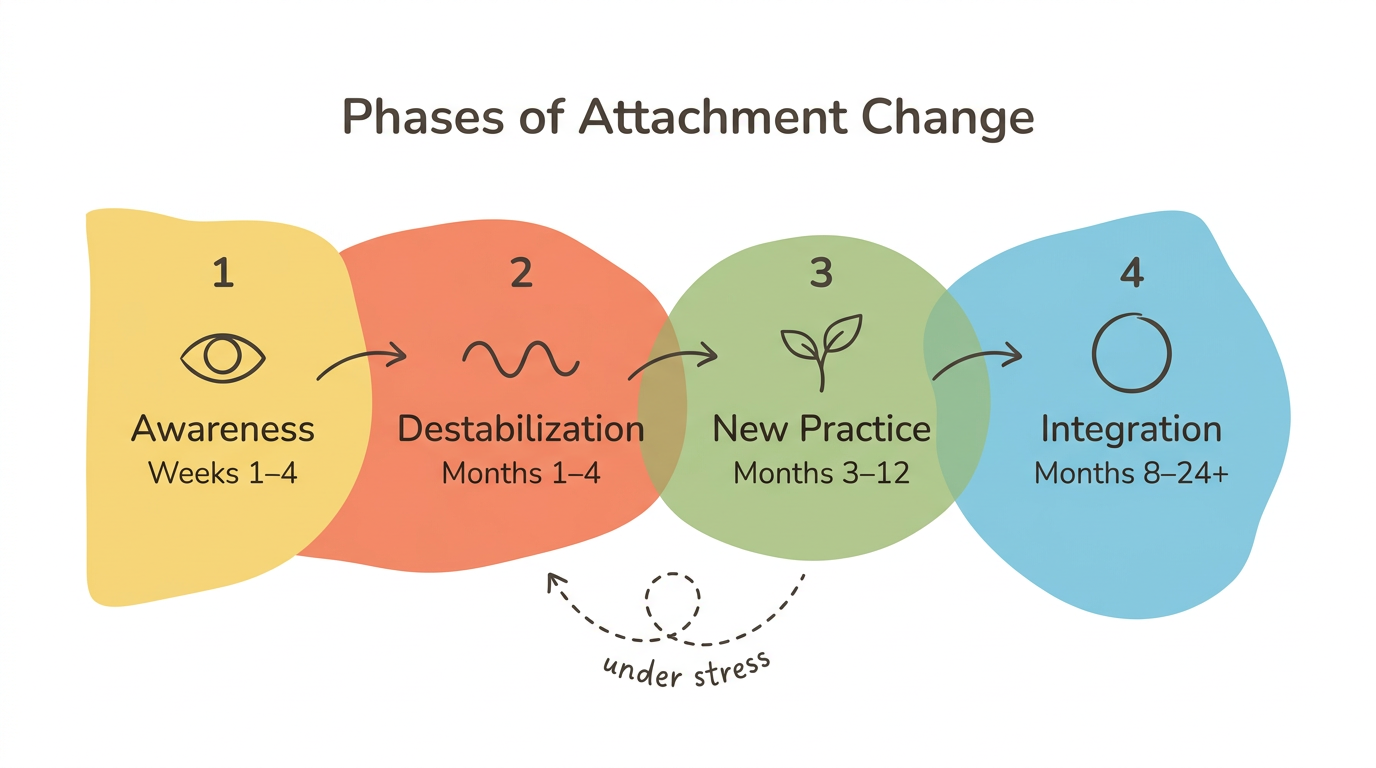
Phase 1: Awareness (Weeks 1 to 4)
You start recognizing your patterns—often after the fact. "I did it again" becomes a familiar refrain. This phase can actually increase distress temporarily, because you now see dynamics you used to move through on autopilot. Your nervous system learned these responses for good reason, and becoming conscious of them can feel like losing a protective shield before you've built a new one.
Phase 2: Destabilization (Months 1 to 4)
Old strategies start feeling wrong, but new ones aren't automatic yet. You might catch yourself mid-pattern and freeze, unsure what to do instead. Destabilization is a sign of change, not failure. This is the phase where Fraley, Gillath, and Deboeck's (2021) finding about reversion to baseline is most relevant—their study of 4,920 adults found that while roughly half of significant life events caused immediate attachment shifts, only about 25 percent led to enduring changes. People tended to snap back to their prior trajectory. The antidote to reversion is deliberate, repeated practice rather than relying on circumstances to carry the change forward.
Phase 3: New Pattern Practice (Months 3 to 12)
Implementation intentions start becoming more automatic. Security priming effects compound. You notice your pattern before acting on it more often than after. The gap between trigger and response widens. Hudson and Fraley's (2015) research suggests measurable trait change within 16 weeks of intentional practice—and this phase is where that shift takes root.
Phase 4: Integration (Months 8 to 24 and Beyond)
New responses feel natural rather than effortful. Earned security consolidates. Roisman et al. (2002) followed participants for 23 years and found that earned-secures achieved relationship success indistinguishable from continuous-secures—without elevated internalizing distress. The new pattern becomes your new baseline, even if the old one can still surface under extreme stress.
Seven signs your attachment style is actually changing:
- You notice your pattern before acting on it, not just in retrospect
- When emotional activation hits, recovery takes hours instead of days
- Holding two feelings at once becomes possible: wanting closeness while tolerating uncertainty
- Your body calms faster after conflict, without needing external reassurance or withdrawal to regulate
- Where you once spiraled alone or shut down, you now find yourself reaching out for support
- You can name your needs without apologizing for having them or demanding they be met immediately
- Intimacy feels less like a threat to manage and more like something you can move toward
Phase Check-In Journal (for all attachment styles)
- Which phase description resonates most with where you are right now?
- Name one thing that feels different from three months ago—even something small
- What is the hardest part of the phase you're in?
- What would the next phase look like for you, specifically?
Repeat these four questions weekly for four weeks. This works across all attachment styles because it makes nonlinear progress visible. When change feels slow, your nervous system tends to collapse the timeline and conclude "nothing is different." Regular check-ins interrupt that distortion by creating a written record your anxious or avoidant brain can't argue with.
Which Therapies Change Attachment Style Fastest?
Emotionally Focused Therapy has the strongest evidence for attachment change, with effect sizes ranging from d = 0.93 to 2.09 in eight to twenty sessions. That makes it both the fastest and most well-supported therapeutic approach—though "fastest" still means months, not days. For a comprehensive look at how therapy facilitates attachment change, see our article on whether therapy can change your attachment style.
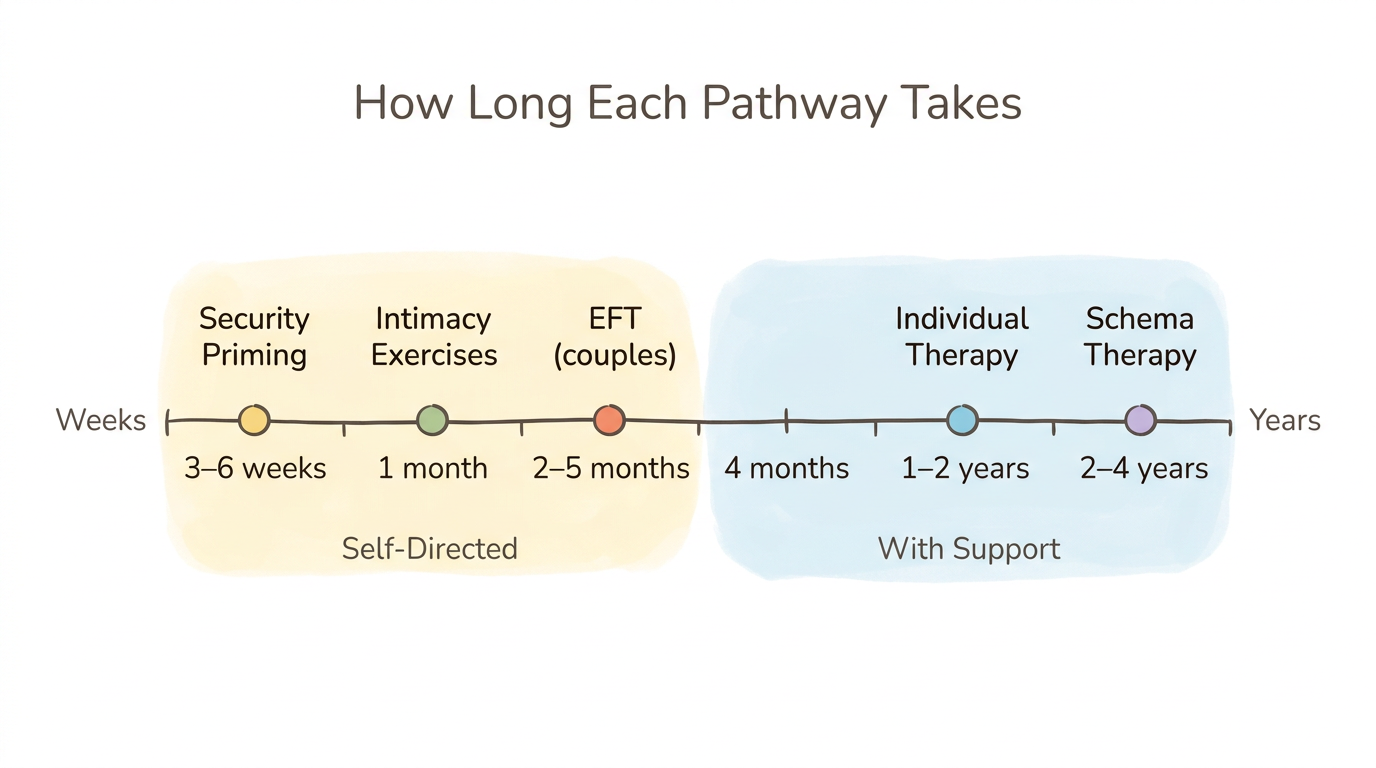
| Pathway | Typical Timeline | Evidence Strength | Best For | Key Finding |
|---|---|---|---|---|
| Security priming (daily) | 3–6 weeks for measurable shifts | Strong (d = 0.51, 120 studies) | Anxious attachment; self-directed | Cumulative effects on self-esteem, mood, compassion |
| Intimacy-building exercises | 1 month for reduced avoidance | Moderate (2 studies, approximately 137 couples) | Avoidant attachment; couples | Decreased avoidance at 1-month follow-up |
| EFT (couples) | 8–20 sessions (approximately 2–5 months) | Strong (d = 0.93–2.09) | Couples with insecure dynamics | Gains maintain and improve after therapy ends |
| Volitional goal-setting | 16 weeks for measurable change | Moderate (2 RCTs) | All styles; self-directed | Implementation intentions catalyze change |
| Individual attachment-focused therapy | 1–2 years weekly sessions | Clinical consensus | All styles; deeper pattern work | Matches earned security research timelines |
| Schema therapy | 2–4 years (2 sessions per week) | Strong (RCT for BPD) | Disorganized; complex trauma | 45 percent full recovery at 3 years |
| Secure relationship (no therapy) | Variable; years | Moderate (longitudinal) | All styles with responsive partner | Predicted lower anxiety and avoidance |
EFT effect sizes are remarkable. Johnson et al. (1999) and Beasley and Ager (2019) documented effect sizes up to d = 2.09—meaning couples who complete EFT show relationship improvements more than two standard deviations above untreated couples. Decreases in attachment avoidance were the strongest predictor of satisfaction gains at two-year follow-up, and gains maintained or even continued improving after therapy ended.
Schema therapy takes longer but goes deeper. Giesen-Bloo et al. (2006) found that among patients with borderline personality disorder receiving schema therapy twice weekly, 45 percent achieved full recovery at three years and 52 percent at four years. This slower timeline reflects the complexity of reorganizing early maladaptive schemas rooted in childhood attachment disruption.
Security priming represents the most accessible evidence-based tool, with a meta-analytic effect size of d = 0.51 across 120 studies and 18,949 participants (Gillath et al., 2022). Effects were largest for affect (d = 0.62), followed by cognition (d = 0.45) and behavior (d = 0.44). Repeated priming over three weeks produced cumulative gains in self-esteem, positive mood, and compassion.
Clinical consensus points to 1–2 years of weekly sessions for deep integration in individual attachment-focused therapy—a timeline consistent with the earned security research showing fundamental pattern reorganization over years rather than weeks.
Therapy Readiness Assessment (for all attachment styles)
- Rate your current attachment-related distress on a scale of 1 to 10
- Identify your primary attachment pattern and how it specifically impacts your daily life or closest relationship
- Consider whether you need help with a specific relationship dynamic (couples EFT may be the best fit) or with your overall pattern across relationships (individual attachment-focused therapy)
- Write down one question to ask a potential therapist: "How do you work with attachment patterns?" or "What does your approach look like for someone with [your style]?"
This exercise targets the common pattern—across all insecure styles—of wanting change but feeling overwhelmed by the therapy landscape. Anxious attachment may default to urgently choosing the first available therapist; avoidant attachment may research endlessly without committing. Matching modality to your actual need breaks both patterns.
Can You Change Your Attachment Style Without Therapy?
Yes—multiple non-therapeutic pathways have research support, though sustained intentional practice is what separates lasting change from temporary fluctuation. A supportive relationship, daily security priming, and structured self-directed work can all produce measurable shifts without a therapist's involvement.
Your nervous system developed its attachment pattern through relationships, and relationships remain one of the most powerful change agents. Chopik et al. (2019) found that secure relationships themselves drive change—being in a relationship predicted lower attachment anxiety and avoidance over time across a 59-year span. A consistently responsive partner provides what clinicians call a "corrective emotional experience," gradually updating your expectations about whether closeness is safe.
Security priming offers a self-directed alternative with strong evidence. Gillath et al.'s (2022) meta-analysis showed that even brief mental exercises—visualizing a secure figure, reading words associated with safety—shifted attachment-related affect, cognition, and behavior. Text-message "security boosters" maintained felt-security for up to two days after the final session. Repeated priming over three weeks produced cumulative gains that exceeded single-session effects.
Hudson and Fraley's (2015) volitional change research demonstrated that intentional goal-setting with implementation intentions produced measurable trait change over 16 weeks—no therapist required. The key ingredient was specificity: not "I want to be more secure" but "When my partner is quiet at dinner, I will ask one curious question instead of assuming they're upset with me."
Here's the critical caveat: Fraley, Gillath, and Deboeck (2021) found that only 25 percent of life events led to enduring shifts in attachment. People tended to revert to their baseline trajectory. This means that passively hoping a good relationship or life change will fix your attachment pattern is a gamble—the odds favor reversion. Sustained practice versus temporary fluctuation is the real distinction.
For disorganized attachment specifically, self-directed work has limits. Your nervous system learned to activate both approach and avoidance because that was the safest response available to you. That dual activation pattern—simultaneously wanting and fearing connection—benefits most from professional support that can work with both sides of the conflict simultaneously. If self-directed techniques feel destabilizing rather than grounding, that is useful information, not a personal failing.
For more self-directed strategies, our guides on how to develop secure attachment as an adult and how to self-soothe anxious attachment offer concrete daily practices.
30-Day Security Priming Protocol (especially effective for anxious attachment)
- Each morning, spend three minutes visualizing a person who represents safety—real or imagined. A kind teacher, a loving grandparent, a friend who never judges
- Focus on sensory details: the tone of their voice, their facial expression when they see you, the physical feeling of being genuinely welcomed
- Notice where in your body you register that safety—warmth in your chest, softening in your shoulders, a sense of settling
- Carry that body sensation into your first interaction of the day, letting it color how you greet someone
- Track daily in a simple journal: what you visualized, what you noticed in your body, and any moment during the day when the felt-security carried forward into a real interaction
This targets anxious attachment's hyperactivation system specifically because security priming builds an internal representation of safety that doesn't depend on external reassurance. Over three weeks, Gillath et al. (2008) found that repeated priming cumulatively increased self-esteem, positive mood, and compassion—suggesting that each session builds on the last rather than resetting. Your nervous system learns through repetition, not revelation.
When Should You Seek Professional Support for Attachment Change?
Seeking professional help is part of the attachment change process—not evidence that self-directed work failed. Your nervous system learned its current patterns in relationship with others, and sometimes it needs another attuned human nervous system to help it learn something new. Roisman et al. (2002) found that earned-secures achieved relationship success indistinguishable from continuous-secures—proof that starting from a difficult place and getting help leads to outcomes just as good as never having struggled at all.
Consider professional support when:
- Activation persists despite consistent self-regulation practice. If you've been doing the work—security priming, grounding techniques, journaling—for several months and still find yourself flooded or shut down in the same ways, a therapist can help identify what's keeping the pattern locked in place.
- You keep seeing the same relationship dynamics play out even though you can name them clearly. Seeing the pattern and changing the pattern are different skills, and an attachment-informed clinician can help bridge that gap.
- You have a history of trauma or identify with disorganized attachment. The dual approach-avoidance activation of disorganized patterns often requires professional support to navigate safely. Filosa et al. (2024) found in their scoping review that earned security from disorganized starting points typically involved therapeutic relationships.
- When attachment anxiety or avoidance starts affecting your work, sleep, friendships, or physical health beyond what feels manageable, professional support isn't an indulgence—it's appropriate care.
Seeking help is part of the change process, not a sign it failed. Earning security means building the capacity to reach for support when you need it—which is itself a secure behavior.
Frequently Asked Questions
Can you permanently change your attachment style?
Research supports lasting change. Roisman et al.'s 23-year longitudinal study found that earned-secure adults achieved relationship outcomes indistinguishable from continuously secure adults. Old patterns can reactivate under extreme stress, but change means building new dominant patterns rather than erasing old ones entirely.
How long does it take to go from anxious to secure attachment?
Security priming research shows measurable shifts in anxious attachment within three to six weeks of daily practice. Deeper change through therapy typically takes six to eighteen months. Anxiously attached individuals respond particularly well to security priming. Consistency matters more than speed.
Can you change your attachment style without therapy?
Yes. Secure relationships, daily security priming, intentional goal-setting with implementation intentions, and intimacy-building exercises all have research support. However, only 25 percent of life events lead to enduring attachment shifts, so sustained intentional practice is what differentiates lasting change from temporary fluctuation.
What is earned secure attachment?
Earned security describes people who experienced insecure attachment in childhood but developed secure functioning as adults through therapy, relationships, or self-reflection. Roisman et al. (2002) tracked participants for 23 years and found that earned-secure adults functioned as well in relationships as continuously secure adults, with no elevated internalizing distress. Learn more in our article on what earned secure attachment means.
Can a relationship change your attachment style?
Yes. Chopik et al.'s 59-year longitudinal study found that being in a relationship predicted lower attachment anxiety and avoidance over time. A consistently responsive partner provides corrective emotional experiences that gradually rewire attachment expectations. However, relationships alone rarely resolve disorganized attachment patterns, which typically benefit from professional support alongside relational experiences.
Does attachment style change with age?
Chopik, Edelstein, and Grimm (2019) found that attachment anxiety declines across the lifespan, particularly after midlife, while attachment avoidance decreases more linearly over time. These changes likely reflect accumulated relationship experience, emotional maturation, and shifting life priorities rather than automatic effects of biological aging.
What therapy is best for changing attachment style?
Emotionally Focused Therapy has the strongest evidence for attachment change, with effect sizes up to d = 2.09 in eight to twenty sessions (Beasley and Ager, 2019). For individual work, attachment-focused psychodynamic therapy and schema therapy address deeper patterns over longer timelines. The therapeutic relationship itself—not just the specific technique—drives much of the change.
How do I know if my attachment style is changing?
Key signs include noticing your attachment pattern before acting on it rather than only in retrospect, shorter recovery time after emotional activation, growing comfort with vulnerability, seeking support instead of defaulting to old strategies, and finding intimacy less threatening. Change is nonlinear—temporary regressions during periods of stress are normal and expected.
Want to Go Deeper?
Meadow includes a structured assessment to help you understand your specific attachment patterns, followed by a 66-day program of daily practices designed to build earned security.
Start your free week →References
Longitudinal and Stability Studies
Kirkpatrick, L. A., & Hazan, C. (1994). Attachment styles and close relationships: A four-year prospective study. Personal Relationships, 1(2), 123–142.
Fraley, R. C. (2002). Attachment stability from infancy to adulthood: Meta-analysis and dynamic modeling of developmental mechanisms. Personality and Social Psychology Review, 6(2), 123–151.
Pinquart, M., Feußner, C., & Ahnert, L. (2013). Meta-analytic evidence for stability in attachments from infancy to early adulthood. Attachment & Human Development, 15(2), 189–218.
Cozzarelli, C., Karafa, J. A., Collins, N. L., & Tagler, M. J. (2003). Stability and change in adult attachment styles: Associations with personal vulnerabilities, life events, and global construals of self and others. Journal of Social and Clinical Psychology, 22(3), 315–346.
Chopik, W. J., Edelstein, R. S., & Grimm, K. J. (2019). Longitudinal changes in attachment orientation over a 59-year period. Journal of Personality and Social Psychology, 116(4), 598–611.
Life Events and Change Mechanisms
Fraley, R. C., Gillath, O., & Deboeck, P. R. (2021). Do life events lead to enduring changes in adult attachment styles? A naturalistic longitudinal investigation. Journal of Personality and Social Psychology, 120(6), 1567–1606.
Davila, J., Burge, D., & Hammen, C. (1997). Why does attachment style change? Journal of Personality and Social Psychology, 73(4), 826–838.
Davila, J., & Sargent, E. (2003). The meaning of life (events) predicts changes in attachment security. Personality and Social Psychology Bulletin, 29(11), 1383–1395.
Hudson, N. W., & Fraley, R. C. (2015). Volitional personality trait change: Can people choose to change their personality traits? Journal of Personality and Social Psychology, 109(3), 490–507.
Earned Security
Roisman, G. I., Padrón, E., Sroufe, L. A., & Egeland, B. (2002). Earned-secure attachment status in retrospect and prospect. Child Development, 73(4), 1204–1219.
Filosa, M., et al. (2024). Earned secure attachment: A comprehensive scoping review. Psychological Reports, 127(5), 2291–2329.
Bakermans-Kranenburg, M. J., & van IJzendoorn, M. H. (2009). The first 10,000 Adult Attachment Interviews: Distributions of adult attachment representations in clinical and non-clinical groups. Attachment & Human Development, 11(3), 223–263.
Therapeutic Interventions
Johnson, S. M., Hunsley, J., Greenberg, L., & Schindler, D. (1999). Emotionally focused couples therapy: Status and challenges. Clinical Psychology: Science and Practice, 6(1), 67–79.
Beasley, C. C., & Ager, R. (2019). Emotionally focused couples therapy: A systematic review of its effectiveness over the past 19 years. Journal of Evidence-Based Social Work, 16(2), 144–159.
Giesen-Bloo, J., van Dyck, R., Spinhoven, P., van Tilburg, W., Dirksen, C., van Asselt, T., Kremers, I., Nadort, M., & Arntz, A. (2006). Outpatient psychotherapy for borderline personality disorder: Randomized trial of schema-focused therapy vs transference-focused psychotherapy. Archives of General Psychiatry, 63(6), 649–658.
Gillath, O., Karantzas, G. C., & Fraley, R. C. (2022). What can attachment security priming do for you? A systematic review and meta-analysis. Personality and Social Psychology Review, 26(4), 257–292.
Neuroscience
Feldman, R. (2017). The neurobiology of human attachments. Trends in Cognitive Sciences, 21(2), 80–99.
This article is for educational purposes only and is not a substitute for professional mental health advice, diagnosis, or treatment. If you are experiencing significant distress related to your attachment patterns, please consult a licensed mental health professional.