Secure attachment is the capacity to trust, seek closeness, and maintain a consistent sense of safety in relationships while staying comfortable with both intimacy and independence. Research shows that approximately 30 percent of adults change their self-reported attachment style when reassessed at a later time point, confirming that attachment patterns are not fixed for life.
If you grew up without consistent emotional attunement, secure attachment can feel like a foreign language — something other people speak fluently while you struggle to find the words. The good news is that decades of research point to a well-documented phenomenon called earned secure attachment: the process of developing security later in life, even after a difficult childhood. Whether you recognize anxious patterns or avoidant tendencies in yourself, this article covers the next step — transformation.
Key takeaway: Yes, you can develop secure attachment as an adult. Research shows approximately 30 percent of adults shift attachment styles over time through a process called earned security. Change requires sustained effort through self-awareness, nervous system regulation, security priming, and corrective relational experiences. The brain's neuroplasticity makes this possible at any age.
What Is Earned Secure Attachment and Why Does It Matter?
Earned secure attachment describes individuals who experienced difficult or insecure childhoods but developed a secure attachment style later in life through reflection, relationships, and intentional growth. The concept was coined by Kaplan, George, and Main through the Adult Attachment Interview, where researchers noticed that some adults showed coherent narratives about painful childhoods — not by minimizing or being overwhelmed by them, but by integrating those experiences with clarity and appropriate emotion.
This matters because earned security is not a watered-down version of the real thing. Roisman et al. (2002) conducted a 23-year longitudinal study demonstrating that individuals who developed earned security went on to have successful close relationships, many without high levels of internalizing distress. Earned-secure adults parent just as effectively as those who were always securely attached. Your childhood shaped you, but it does not define the upper limit of your relational capacity.
Arriaga et al. (2018) identified a process model of earning security involving three stages: establishing the meta-conditions for positive change, making intrapsychic changes (how you relate to yourself), and making interpersonal changes (how you relate to others). Filosa et al. (2024) published a comprehensive scoping review in Psychological Reports confirming the robust empirical support for earned security across multiple studies.
The path from insecure to secure attachment is not about erasing your history. It is about developing what researchers call a coherent narrative — the ability to acknowledge what happened, understand how it shaped you, and choose differently going forward.
Narrative Coherence Journaling
- Write about a difficult childhood memory for 10 minutes without editing
- Re-read what you wrote and notice what emotions arise — name them without judgment
- Write what you learned from this experience or how it shaped your relational patterns
- Identify one way you have already grown beyond this pattern
- Repeat weekly with different memories, building your coherent narrative over time
| Dimension | Continuous Secure | Earned Secure |
|---|---|---|
| Childhood | Consistent, responsive caregiving | Inconsistent, neglectful, or harmful caregiving |
| Path to security | Naturally developed through early relationships | Intentionally developed through reflection, relationships, and therapy |
| Narrative style | Coherent, balanced account of childhood | Coherent, balanced account despite difficult experiences |
| Relationship outcomes | Successful close relationships | Equally successful close relationships (Roisman et al., 2002) |
| Parenting quality | High responsiveness and attunement | Equally high responsiveness and attunement |
| Emotional profile | Low internalizing distress | May carry some depressive symptomatology but functions well |
| Key mechanism | Internalized models from childhood | Revised internal working models through new experiences |
Why Can Your Brain Change Its Attachment Patterns?
Your brain can change its attachment patterns because of neuroplasticity — the brain's lifelong ability to form new neural connections in response to experience. The attachment wiring that developed in childhood was a brilliant adaptation to your early environment. That same adaptive capacity means your brain can build new relational circuits in response to new experiences.
Three mechanisms make this possible at the neural level.
Neuroplasticity and neural integration. Dan Siegel's research at the Mindsight Institute demonstrates that the brain continues to grow throughout the entire lifespan. Developing what Siegel calls "mindsight" — the capacity to perceive the mind of both self and others — physically changes brain structure. Neural integration, the process of linking separated brain areas through new synaptic connections, is the core mechanism of attachment healing.
The amygdala-prefrontal cortex pathway. Lemche et al. (2005) found that bilateral amygdala activity is highly correlated with attachment insecurity and autonomic stress response. Secure attachment corresponds to lower amygdala reactivity to perceived threats and stronger prefrontal cortex regulation of that reactivity. As you develop security, your prefrontal cortex gets better at modulating your threat-detection system — your alarm goes off less often, and when it does, you can turn it down more quickly.
Oxytocin-dopamine crosstalk. Feldman (2017) showed that bonding is underpinned by crosstalk between oxytocin and dopamine in the striatum, combining social motivation with reward processing. Securely attached individuals show enhanced striatum and ventral tegmental area activation in response to positive social feedback. As you build secure relational experiences, your brain literally becomes more rewarded by connection.
Your nervous system learned its current patterns for good reason — those patterns kept you safe. And the same neural flexibility that built those patterns can build new ones.
Brain-Body Check-In (somatic exercise)
- Place one hand on your chest and one on your belly
- Notice which area feels more activation right now — tightness, buzzing, warmth, or hollowness
- Name the sensation without trying to change it (for example: "tight chest," "warm belly")
- Take three slow breaths, directing the air toward the area of activation
- Notice any shift — even a small one counts
This builds interoceptive awareness, the foundation of neural integration and attachment change.
What Is Security Priming and How Can You Practice It Daily?
Security priming is the deliberate activation of mental representations of attachment security — bringing to mind the felt sense of being safe, loved, and accepted. Mikulincer and Shaver (2020) demonstrated that even brief activation of secure mental representations produces a broaden-and-build cascade: greater emotional equanimity, better personal and social adjustment, more satisfying relationships, and autonomous growth.
This research represents one of the most actionable findings in attachment science. Security priming does not require a therapist, a partner, or years of practice. It works through both implicit and explicit methods, and explicit priming — consciously visualizing a secure attachment figure — produces measurable benefits in as little as a few minutes.
The broaden-and-build cycle works like this: activating security representations reduces defensiveness, which broadens your emotional range and cognitive flexibility, which leads to more positive relational behaviors, which creates more secure experiences, which strengthens those security representations. Each cycle reinforces the next.
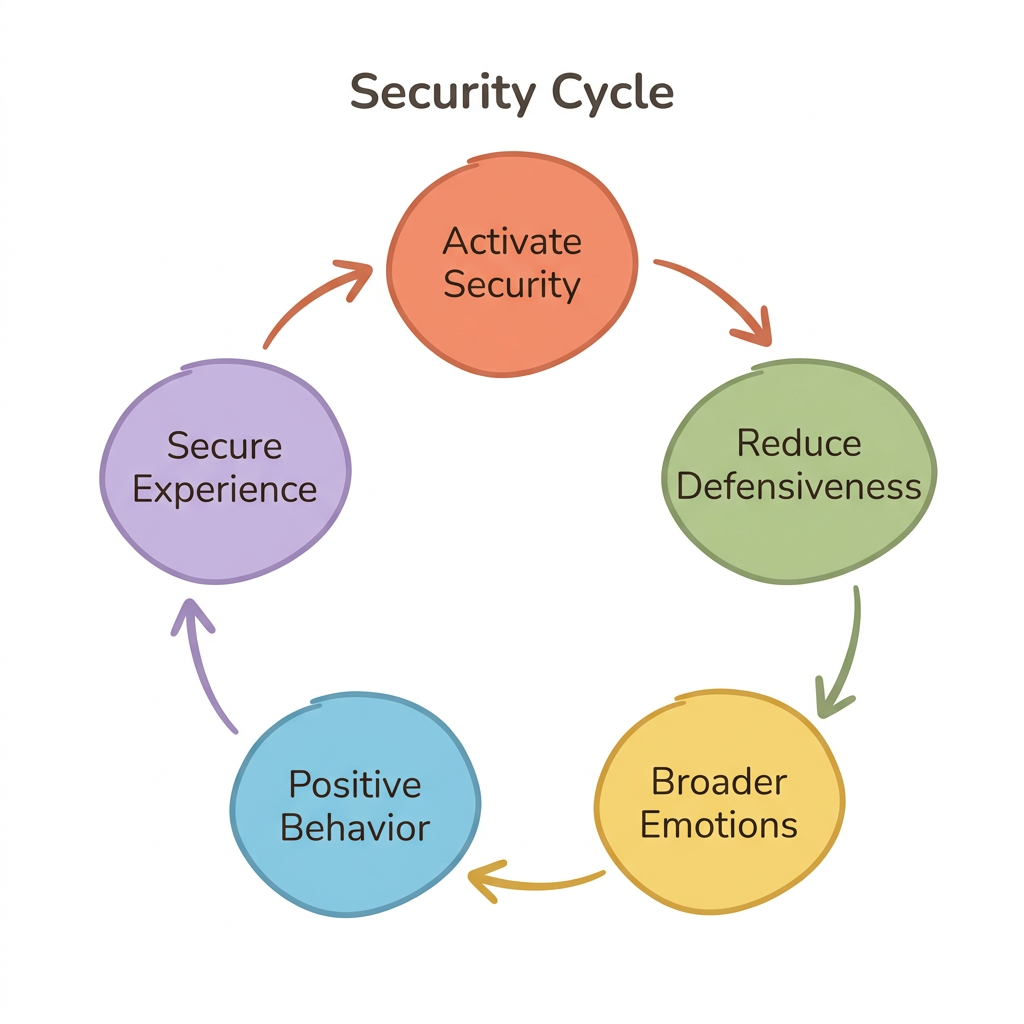
Research also found that security priming led to greater exploration behavior, novelty-seeking, and creative problem-solving. When your nervous system is not consumed by threat detection, it has bandwidth for curiosity and growth. If texting anxiety or relationship worry consumes your mental energy, security priming can help interrupt that cycle at its source.
Safe Harbor Visualization (daily security priming exercise)
- Close your eyes and bring to mind someone who has made you feel genuinely safe and accepted — a person, pet, or even a fictional character
- Recall a specific moment of felt safety with them — what did you see, hear, and feel in your body?
- Let the warmth of that memory expand through your chest and belly for 60 seconds
- Open your eyes and notice your current state — has anything shifted?
- Practice daily for two to three minutes, ideally at the same time each day
This is the explicit security priming technique studied by Mikulincer and Shaver. Consistency matters more than duration.
How Does Your Nervous System Shape Your Attachment Style?
Your nervous system directly shapes your attachment style by determining which relational states feel safe and which feel threatening. Polyvagal theory, developed by Stephen Porges (2011), explains that secure attachment correlates with higher ventral vagal tone — the branch of the vagus nerve that supports social engagement, calm presence, and the ability to connect without defensiveness.
Porges describes three nervous system states that map directly onto attachment behavior:
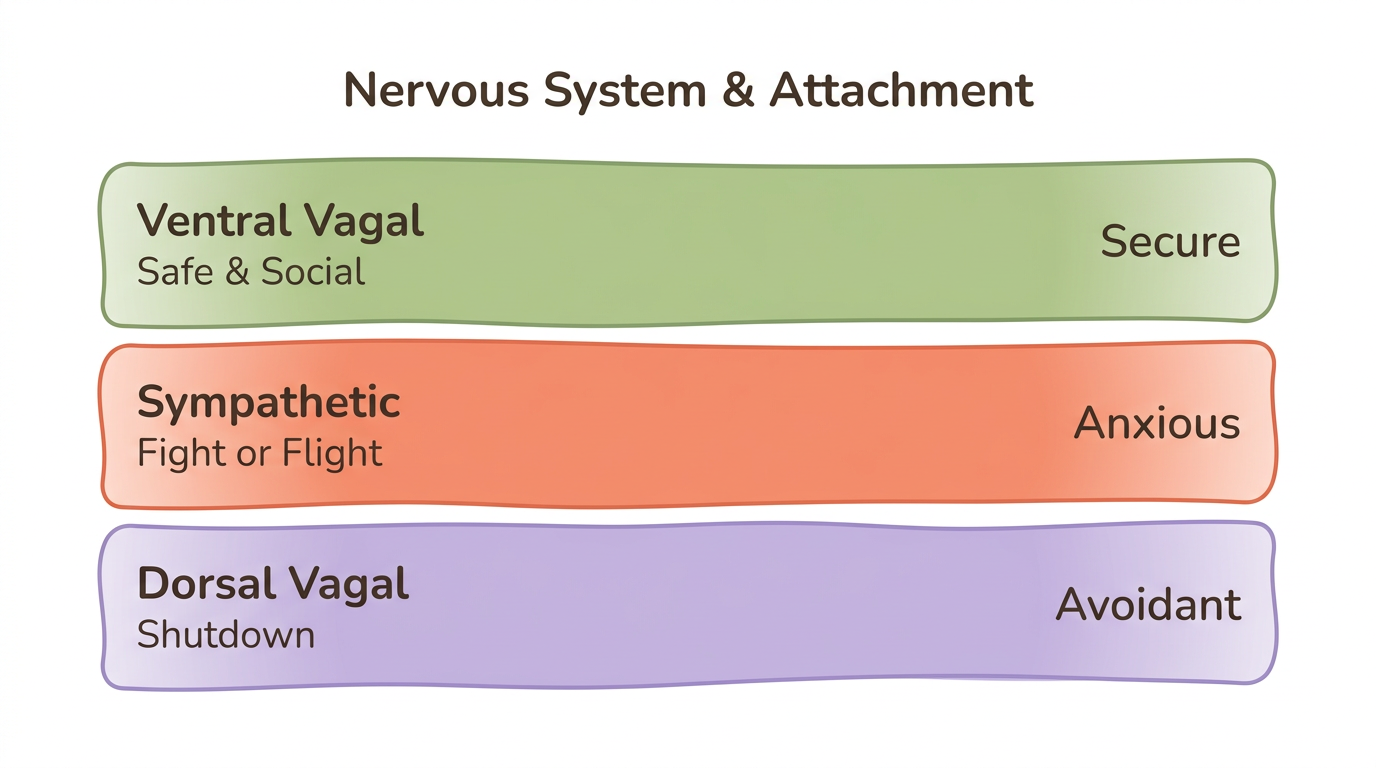
- Ventral vagal (safe and social): Relaxed breathing, eye contact, vocal warmth, curiosity — the physiological foundation of secure attachment
- Sympathetic (fight or flight): Hypervigilance, racing heart, scanning for threats — often the baseline state for anxious attachment
- Dorsal vagal (shutdown): Numbness, withdrawal, disconnection — often the default for avoidant attachment patterns
Insecure attachment keeps the nervous system biased toward defensive states. Vagal flexibility — the ability to shift smoothly between states — is what distinguishes secure attachment at the physiological level. Chopik and Kitayama (2020) found that life events can trigger attachment style changes, but people tend to revert to their baseline without sustained, intentional effort. Building vagal flexibility is the embodied practice that sustains change.
Co-regulation — borrowing another person's calm nervous system — is the bridge to self-regulation. Your nervous system learned to regulate (or not) through early co-regulation with caregivers. New co-regulatory experiences with safe people can retrain your vagal tone at any age.
5 Signs Your Nervous System Is in a Secure State
- Your breathing is slow and deep without effort
- Your facial muscles feel relaxed, especially around your jaw and forehead
- You can make eye contact comfortably without scanning for threat
- Your voice has natural melody and prosody rather than being flat or tight
- You feel curious rather than defensive when something unexpected happens
Vagal Toning Breath (somatic exercise)
- Inhale for 4 counts through your nose
- Exhale for 8 counts through pursed lips, as if blowing through a straw
- On the exhale, let your shoulders drop away from your ears
- Repeat for 5 cycles
- Then hum gently for 3 breaths — the vibration stimulates the vagus nerve directly
The extended exhale activates the ventral vagal system. Practice for 90 seconds whenever you notice your nervous system shifting into a defensive state.
Can You Build an Internal Secure Base Without a Partner?
Yes — you can build an internal secure base without a romantic partner. Internal Family Systems therapy, developed by Richard Schwartz, demonstrates that Self-leadership provides an internal attachment figure capable of offering your own parts the security, patience, and attunement they need. You do not need to wait for the right relationship to begin this work.
The IFS framework holds that everyone has a core Self that is inherently calm, curious, compassionate, and connected. When your protective parts (the anxious part, the withdrawn part, the inner critic) feel seen and reassured by Self, they can relax their defensive strategies. A 2021 pilot feasibility study found that 92 percent of IFS completers no longer met PTSD diagnostic criteria after 16 weeks of treatment, suggesting that internal attachment repair can produce significant clinical change.
Research on alternative attachment figures also shows that earned security typically requires emotional support from someone other than original caregivers — a grandparent, close friend, therapist, or mentor who listens and helps in times of distress. If you recognize avoidant patterns in yourself, building tolerance for receiving support from these figures is part of the path toward security.
The common fear that you need a romantic partner to heal your attachment style is understandable but not supported by the research. Arriaga et al. (2018) described interpersonal changes as one component of earning security, but those changes can happen in any consistent, emotionally attuned relationship. A therapist, a trusted friend, a sibling — any relationship where you are genuinely seen and responded to can serve as the relational foundation for earned security.
Parts Check-In (internal secure base exercise)
- Identify a part of you that feels activated right now — the anxious part, the withdrawn part, or the critical part
- Acknowledge it silently: "I see you. You are trying to protect me."
- Ask it: "What do you need from me right now?"
- Offer it what a secure caregiver would offer: reassurance, patience, or simply your presence
- Notice any softening in your body — a release in the chest, a slowing of the breath
This practice builds your capacity for Self-leadership, the internal secure base that IFS research shows can transform attachment patterns from the inside out.
What Are the Most Effective Therapies for Attachment Change?
Emotionally Focused Therapy is the most research-supported approach for attachment change in relationships, with an effect size of d = 1.31 when delivered with high fidelity — the largest of any couples therapy approach (Wiebe et al., 2022). Therapy provides what attachment researchers call a corrective emotional experience: a relationship where old patterns surface, are understood, and are responded to differently.
4 Evidence-Based Therapies for Attachment Change
-
Emotionally Focused Therapy (EFT) — Best for couples. Developed by Sue Johnson, EFT directly targets attachment bonds. It increases couple secure attachment, reduces conflict and stress, and improves communication and emotional expression. High-fidelity EFT (80 percent or greater therapist adherence) produces dramatically better outcomes than lower-fidelity delivery (d = 0.23).
-
Internal Family Systems (IFS) — Best for individual internal work. IFS builds an internal secure base through Self-leadership. A 2013 randomized controlled trial (N = 79) showed significant reductions in pain, physical impairment, and depressive symptoms. The 2021 pilot study showed 92 percent of completers no longer met PTSD criteria after 16 weeks.
-
Interpersonal Neurobiology (IPNB) — Integrates neuroscience with clinical practice. Developed by Dan Siegel, IPNB focuses on developing "mindsight" and promoting neural integration — linking thought with feeling, right hemisphere with left hemisphere, and neocortex with limbic system. Therapists serve as what Siegel calls "transformative attachment experts."
-
Polyvagal-informed somatic therapy — Best for nervous system regulation and embodied safety. Based on Porges's polyvagal theory, these approaches include the Safe and Sound Protocol, which uses filtered music to stimulate the ventral vagal system. Attachment is reframed as a dynamic, moment-to-moment process shaped by nervous system states rather than fixed traits.
Choosing the right therapy depends on your specific patterns. If relationship distress is primary, EFT has the strongest evidence. If you are working individually on deep internal patterns, IFS offers a structured path. If your body carries the imprint of insecurity — chronic tension, difficulty relaxing, feeling unsafe without knowing why — polyvagal-informed approaches address the somatic foundation directly.
How Long Does It Take to Develop Secure Attachment?
There is no fixed timeline for developing secure attachment, but research provides honest guideposts. Approximately 30 percent of adults change their attachment style when reassessed at a later time point, confirming that change is real but not automatic. Fraley (2019) identified that attachment styles are more malleable in childhood and adolescence than adulthood, but change remains possible throughout the lifespan.
Chopik and Kitayama (2020) found that life events — a new relationship, therapy, a major loss — can trigger immediate attachment style shifts. However, people tend to revert to pre-event trajectories over time. This finding carries a critical implication: sustained, intentional effort, not just positive experiences, is required for lasting change. A single corrective relationship experience can open the door, but walking through it requires consistent practice.
Based on the research, here are realistic milestones for the earned security journey:
- Weeks 1 through 4: Awareness — recognizing your attachment patterns as they happen, naming your triggers and defensive strategies
- Months 2 through 6: New behaviors — catching yourself mid-pattern and choosing differently approximately 10 percent more often, practicing security priming and nervous system regulation daily
- Months 6 through 12: Integration — new responses start to feel less effortful, you notice secure moments becoming more frequent
- Year 1 through 2 and beyond: Internalized security — secure responses become your new default in most situations, though old patterns may resurface under extreme stress
Longitudinal research also shows that anxious attachment tends to be high in adolescence, increases into young adulthood, then declines through middle and old age. Avoidant attachment declines more linearly across the lifespan. Time itself is a gentle ally in this process, but intentional work accelerates what might otherwise take decades.
You do not rewire attachment in a single insight. You rewire it by noticing 10 percent earlier, responding 10 percent differently, 10 percent more often.
Attachment Progress Tracker
- Rate your current comfort with intimacy, trust, and independence on a 1 to 10 scale
- Write one specific relational situation that triggers insecurity for you
- Note your typical response — what do you feel, think, and do?
- Revisit monthly and track any shifts in your ratings, triggers, or responses
- Celebrate small changes — moving from a 3 to a 4 in comfort with vulnerability is meaningful progress
Making invisible progress visible sustains motivation through the long middle of attachment change.
When Should You Seek Professional Help for Attachment Patterns?
You should seek professional help when your attachment patterns consistently cause significant distress in your relationships or daily functioning, or when self-directed approaches have not produced the change you need. Therapy is not a sign of failure — it is the most research-supported path to earned security and provides the corrective relational experience that attachment research consistently identifies as central to lasting change.
Consider seeking professional support if you notice any of the following:
- Persistent relationship distress that does not improve despite genuine effort from both partners
- Trauma responses (flashbacks, emotional flooding, dissociation) that are triggered by relational situations
- Inability to form or maintain close relationships despite wanting connection
- Attachment patterns that are causing harm to yourself, your partner, or your children
- A sense that you understand your patterns intellectually but cannot change them behaviorally
- Chronic feelings of emptiness, unworthiness, or terror of abandonment that interfere with daily life
When choosing a therapist, look for someone trained in attachment-based approaches. EFT has the strongest evidence base for couples work (effect size d = 1.31 at high fidelity). IFS and IPNB are well-supported for individual attachment work. Ask potential therapists directly about their training in attachment theory and their experience working with your specific pattern.
If you are in crisis, contact the 988 Suicide and Crisis Lifeline by calling or texting 988, or reach the Crisis Text Line by texting HOME to 741741.
Frequently Asked Questions
Can you change your attachment style as an adult?
Yes. Research shows approximately 30 percent of adults change their attachment style over time. While attachment patterns are more malleable in childhood, neuroplasticity means the brain can form new relational wiring throughout life. Therapy, secure relationships, and consistent self-awareness practices are the most effective catalysts for lasting change.
How long does it take to develop secure attachment?
There is no fixed timeline. Initial awareness can develop in weeks, behavioral changes emerge over months, and internalized security typically takes one to two years of sustained effort. Chopik and Kitayama (2020) found that without intentional, ongoing practice, people tend to revert to baseline attachment patterns after triggering life events.
What does earned secure attachment mean?
Earned secure attachment describes individuals who experienced insecure or difficult childhoods but developed attachment security later in life. Coined through the Adult Attachment Interview by Kaplan, George, and Main, the term refers to people who show coherent narratives about their past. Roisman et al. (2002) found they function just as well in relationships as continuously secure individuals.
Can you become securely attached without therapy?
You can make meaningful progress through self-directed practices like security priming, journaling, nervous system regulation, and building relationships with emotionally safe people. However, for deep trauma or persistent patterns, therapy — especially Emotionally Focused Therapy or Internal Family Systems — provides the corrective relational experience that research shows is most effective for lasting change.
Can you develop secure attachment on your own without a partner?
Yes. Research on alternative attachment figures shows security can develop through any consistent, emotionally attuned relationship — with a therapist, close friend, mentor, or family member. Internal Family Systems techniques also help build an internal secure base through Self-leadership. A romantic partner is helpful but not required for earned security.
What is the difference between continuous secure and earned secure attachment?
Continuous-secure individuals developed security through responsive childhood caregiving that was consistently available. Earned-secure individuals developed security later in life despite difficult early experiences, through reflection, therapy, or corrective relational experiences. Roisman et al. (2002) demonstrated that both groups achieve equally successful relationships and parent with equal effectiveness.
Can avoidant attachment become secure?
Yes. Avoidant attachment can shift toward security through building tolerance for emotional closeness, practicing vulnerability in safe relationships, and developing interoceptive awareness of internal states. Research shows avoidant attachment naturally declines across the lifespan, and intentional therapeutic work can accelerate this process significantly.
How does trauma affect attachment style?
Relational trauma — especially in childhood — disrupts the development of secure attachment by keeping the nervous system locked in defensive states. This creates hyperactivating strategies (anxious attachment, where the system stays on high alert) or deactivating strategies (avoidant attachment, where the system shuts down emotional signals). Trauma-informed approaches like IFS and polyvagal therapy address both the attachment pattern and the underlying nervous system dysregulation simultaneously.
Want to Go Deeper?
Meadow includes a structured assessment to help you understand your specific attachment patterns, followed by a 66-day program of daily practices designed to build earned security.
Start your free week →References
Longitudinal and Developmental Research
- Roisman, G. I., Padrón, E., Sroufe, L. A., & Egeland, B. (2002). Earned-secure attachment status in retrospect and prospect. Child Development, 73(4), 1204–1219. https://pubmed.ncbi.nlm.nih.gov/12146743/
- Fraley, R. C. (2019). Attachment in adulthood: Recent developments, emerging debates, and future directions. Annual Review of Psychology, 70, 401–422. https://pubmed.ncbi.nlm.nih.gov/29510301/
- Chopik, W. J., & Kitayama, S. (2020). How life events shape attachment style. Social Psychological and Personality Science, 11(4), 531–539. https://pubmed.ncbi.nlm.nih.gov/32790474/
- Filosa, M., et al. (2024). Earned secure attachment: A comprehensive scoping review of empirical studies. Psychological Reports. https://journals.sagepub.com/doi/abs/10.1177/00332941241277495
- Arriaga, X. B., Kumashiro, M., Simpson, J. A., & Overall, N. C. (2018). Revising working models across time: Relationship situations that enhance attachment security. Personality and Social Psychology Review, 22(1), 71–96. https://pubmed.ncbi.nlm.nih.gov/31573684/
Prevalence and Epidemiology
- Mickelson, K. D., Kessler, R. C., & Shaver, P. R. (1997). Adult attachment in a nationally representative sample. Journal of Personality and Social Psychology, 73(5), 1092–1106. https://pubmed.ncbi.nlm.nih.gov/9364763/
Neuroscience
- Lemche, E., et al. (2005). Human attachment security is mediated by the amygdala: Evidence from combined fMRI and psychophysiological measures. Human Brain Mapping, 27(8), 623–635. https://pubmed.ncbi.nlm.nih.gov/16284946/
- Feldman, R. (2017). The neurobiology of human attachments. Trends in Cognitive Sciences, 21(2), 80–99. https://ruthfeldmanlab.com/wp-content/uploads/2019/05/TiCS.Neurobiology-of-attachment.2017.pdf
- Siegel, D. J. Bringing brain science into therapy. Mindsight Institute. https://mindsightinstitute.com/articles/bringing-brain-science-into-therapy-dan-siegel/
Security Priming
- Mikulincer, M., & Shaver, P. R. (2020). Broaden-and-build effects of contextually boosting the sense of attachment security in adulthood. Current Directions in Psychological Science, 29(1), 22–26. https://journals.sagepub.com/doi/abs/10.1177/0963721419885997
Therapeutic Approaches
- Johnson, S. M. EFT research. International Centre for Excellence in Emotionally Focused Therapy. https://iceeft.com/eft-research-3/
- Wiebe, S. A., et al. (2022). A comprehensive meta-analysis on the efficacy of emotionally focused couple therapy. Couple and Family Psychology: Research and Practice, 12(2), 81–99. https://psycnet.apa.org/record/2023-02978-001
- Internal Family Systems Institute. https://ifs-institute.com/store/304
- Porges, S. W. (2011). The polyvagal theory: Neurophysiological foundations of emotions, attachment, communication, and self-regulation. Norton. https://pmc.ncbi.nlm.nih.gov/articles/PMC3490536/
- Polyvagal Institute. What is polyvagal theory? https://www.polyvagalinstitute.org/whatispolyvagaltheory
This article is for educational purposes only and is not a substitute for professional mental health care. If you are experiencing significant distress related to your attachment patterns, please consult a licensed therapist or counselor who specializes in attachment-based approaches.