Attachment style change is the process by which the relational patterns formed in early childhood shift over the course of your life. Research shows that approximately 30 percent of adults report a different attachment classification when retested at a later point in time (Fraley, 2002). A meta-analysis of over 21,000 participants found only moderate stability in attachment, with a correlation of r = .39 (Pinquart, Feussner and Ahnert, 2013).
Decades of research are clear: your attachment style is a tendency, not a life sentence. Your nervous system learned these patterns for good reason — they kept you safe when you were small. And now, with the right conditions, you can teach it something new. This article covers the science of how attachment changes, the neuroscience behind it, and practical exercises you can start today.
Key takeaway: Your attachment style can change over time. Approximately 30 percent of adults shift their attachment classification when retested, and both attachment anxiety and avoidance naturally decline with age. Change happens through therapy, positive relationships, and intentional self-work, though only about 25 percent of life-event-driven shifts are enduring without deliberate effort.
How Stable Are Attachment Styles Really?
Attachment styles are moderately stable but not fixed. The largest meta-analysis on attachment stability, covering 127 papers and over 21,000 participants, found a stability correlation of only r = .39 — meaningful but far from permanent (Pinquart, Feussner and Ahnert, 2013). This means attachment has roughly the same stability as personality traits like extraversion — consistent enough to be recognizable, flexible enough to shift.
Secure attachment is the most stable classification, with a 66 percent retention rate when people are retested over time (Cozzarelli et al., 2003). Insecure attachment styles are notably less stable, with only 38 to 49 percent retention depending on the subtype. If you have anxious attachment, you are statistically more likely to shift over time than someone who is securely attached.
Early childhood attachment shows even less stability. A separate meta-analysis found a correlation of only r = .28 for secure versus insecure classification in young children, with family instability and marital discord predicting lower stability (Verhage et al., 2020). The implication is significant: the younger you are, the more malleable your attachment patterns tend to be. But malleability does not disappear in adulthood — it simply requires more intentional effort.
If you worry you are permanently stuck in an insecure pattern, that fear makes sense — but stability exists on a spectrum, not as a binary. You are not either "stuck" or "completely different." Most people experience gradual movement along attachment dimensions rather than dramatic category switches.
Attachment Timeline Mapping
- Draw a horizontal timeline from childhood to the present day
- Mark major relationships and life transitions along the line
- For each period, note whether you felt more anxious, more avoidant, or more secure
- Look for patterns — what shifted your sense of security up or down?
- Spend five minutes journaling about what you notice
How Does Attachment Change Across Your Lifespan?
Both attachment anxiety and avoidance naturally decline as people age. The first study to track attachment across a 59-year period followed 628 participants from ages 13 to 72, measuring attachment dimensions at multiple time points (Chopik, Edelstein and Grimm, 2019). The findings were striking and largely reassuring.
Attachment anxiety was high in adolescence, increased into young adulthood, and then declined through middle and old age. Attachment avoidance started higher in adolescence and then declined linearly across the entire lifespan. The overall trajectory suggests that people naturally trend toward security as they accumulate relationship experience and develop emotional regulation skills.
Notably, anxiety and avoidance follow different trajectories — avoidance declines linearly from adolescence onward, while anxiety peaks in young adulthood before declining. If you lean anxious, your hardest years may be behind you. If you lean avoidant, your deactivating strategies are likely softening gradually across your whole life.
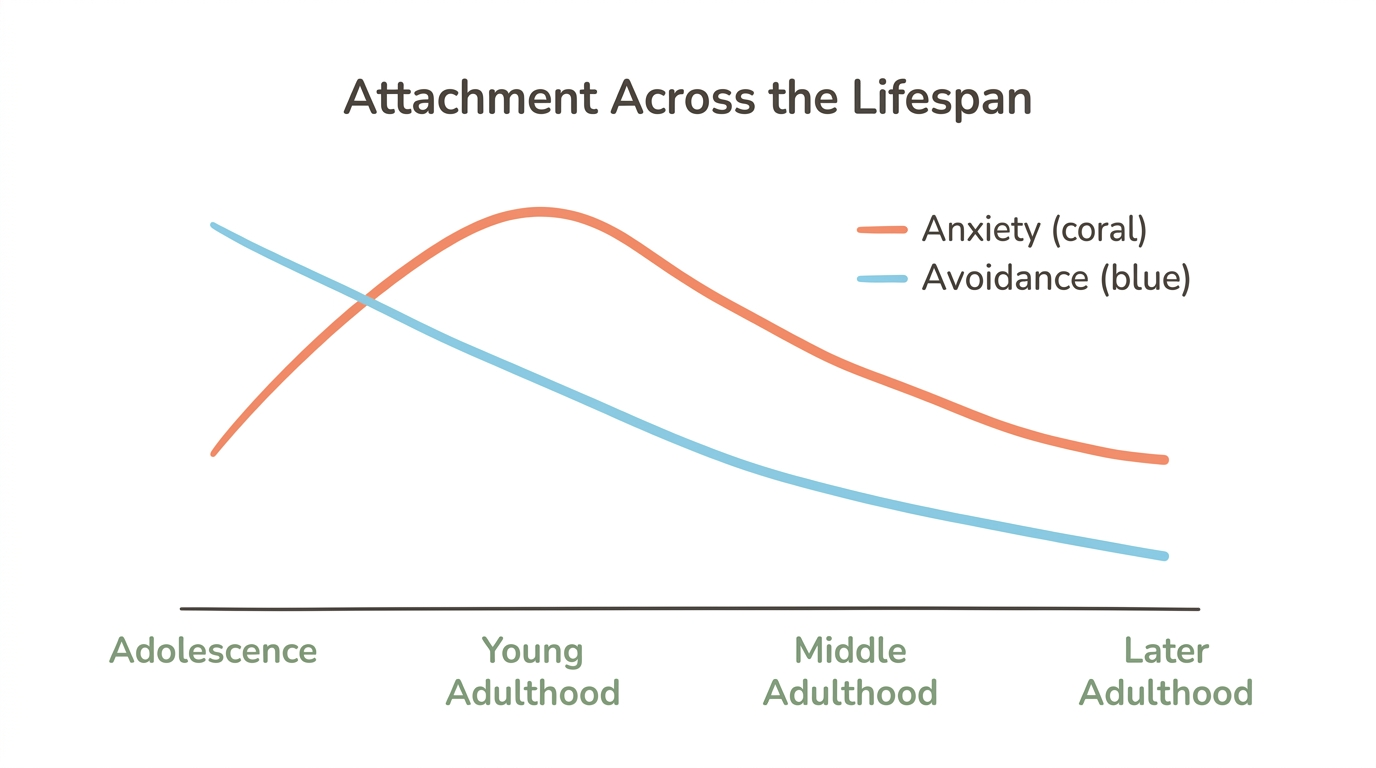
Here is what the research suggests about attachment at each life stage:
- Adolescence (13 to 18): High anxiety and avoidance as identity is still forming and early romantic experiences activate the attachment system intensely
- Young adulthood (18 to 30): Anxiety peaks during this period as intense romantic relationships and major life transitions create attachment activation
- Middle adulthood (30 to 50): Both anxiety and avoidance begin declining as relationship experience accumulates and emotional regulation strengthens
- Later adulthood (50 to 72): Lowest anxiety and avoidance scores, reflecting greater emotional perspective and decades of relational learning
If you recognize yourself as having avoidant attachment, the linear decline in avoidance across the lifespan is particularly encouraging. Deactivating strategies that feel rigid now naturally soften over time — especially if you are actively working on them.
Age-Stage Reflection
- Identify which life stage you are currently in from the list above
- Consider whether the described pattern matches your experience
- Write down one way you have already become more secure compared to five years ago
- Identify one area where you still notice insecure patterns activating
What Causes Attachment Styles to Change?
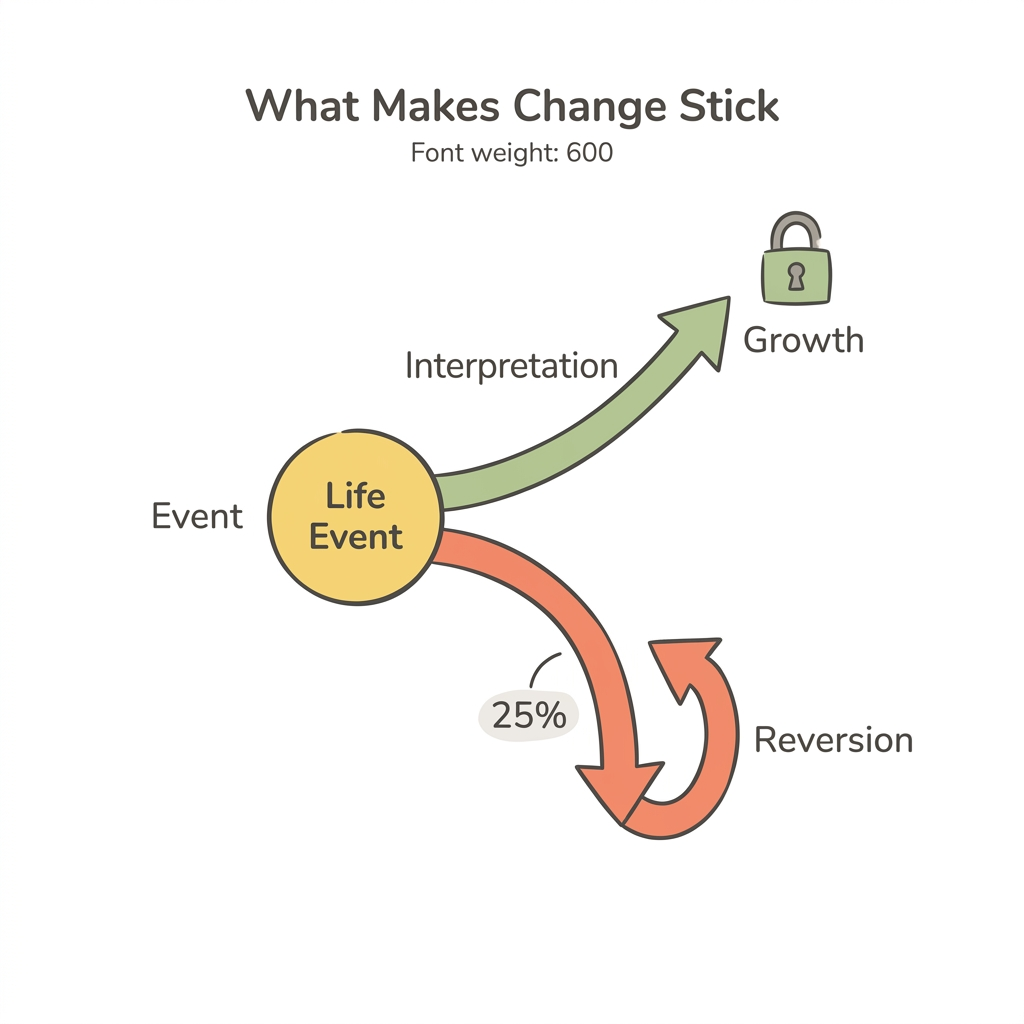
Life events, relationships, therapy, and intentional self-work cause attachment styles to change. However, the reversion effect is the most important — and most underreported — finding in attachment change research. Fraley et al. (2021) tracked 4,920 participants monthly for up to three years across 25 different life events. Approximately 50 percent of life events caused immediate shifts in attachment style. But here is the nuance most articles leave out: most people reverted to their pre-event attachment levels, and only 25 percent of changes endure without deliberate, sustained effort.
The critical differentiator was not the event itself but how the person interpreted it. People who perceived events positively shifted toward security. People who perceived the same types of events negatively became more anxious. Interpretation matters more than the event — which means your meaning-making capacity is one of your most powerful tools for attachment change.
Attachment change is also bidirectional. Most discussions focus on moving from insecure to secure, but the reverse happens too. Betrayal, toxic relationships, and unprocessed trauma shift securely attached people toward anxiety or avoidance. Recognizing both directions helps you protect the security you have already built.
Life events most linked to attachment change include:
- Entering a new romantic relationship (associated with decreased anxiety)
- Relationship breakup or divorce (associated with increased anxiety or avoidance)
- Becoming a parent (shifts attachment in either direction)
- Loss of a loved one (increases attachment anxiety)
- Experiencing betrayal or infidelity (moves secure people toward insecurity)
- Beginning therapy (consistently associated with movement toward security)
- Forming a close friendship or mentorship (associated with decreased avoidance)
Event Interpretation Reframe
- Identify a recent relationship event that activated your attachment system
- Write down your automatic interpretation — for example, "They are pulling away" or "I am too much"
- Write an alternative interpretation that accounts for other possibilities
- Notice how each interpretation makes your body feel — tightness, ease, warmth, constriction
- Choose the interpretation that serves your growth toward security
What Is Earned Secure Attachment?
Earned secure attachment describes people who experienced insecure childhoods but developed coherent, integrated narratives about their past and now function as securely attached adults. The concept, originally developed by Main and Hesse, represents one of the most hopeful findings in attachment research: your early experiences shape you, but they do not define you permanently.
A 2024 comprehensive scoping review confirmed the key factors that enable earned security: reflective functioning, secondary attachment figures such as therapists, mentors, and partners, and mentalization capacity — the ability to understand behavior in terms of underlying mental states (Filosa et al., 2024). Earned-secure adults show comparable emotional regulation and mentalization to adults who were continuously secure from childhood.
Reflective functioning is the cornerstone of earned security. Reflective functioning means being able to look at your childhood experiences and understand both what happened and why your caregivers behaved as they did — without minimizing, idealizing, or becoming overwhelmed. You do not have to forgive. You do not have to say it was okay. You simply need to build a narrative that is coherent rather than fragmented or dismissive (Roisman et al., 2002).
Coherent Narrative Writing
- Choose one difficult childhood memory related to caregiving
- Before writing, place one hand on your chest and breathe slowly — inhale for four counts, exhale for six counts — for three minutes to settle your nervous system
- Write the memory in third person, describing what happened, what the child felt, and what the child needed
- Now rewrite in first person, adding what you understand now that you did not understand then
- Notice where you feel tension or ease in your body as you write each version
- End by writing one sentence about what this experience taught you about relationships
If this exercise brings up overwhelming emotion, pause and return to slow breathing. This is activation, not weakness. Consider working through it with a therapist.
What Does Neuroscience Say About Changing Attachment Patterns?
Your brain rewires its attachment patterns throughout your entire life. The human social brain retains plasticity, and later attachments reorganize neural networks and partially repair the effects of negative early experiences (Feldman, 2017). This is not vague optimism — it is measurable in brain scans, hormone levels, and stress responses.
How Oxytocin and Dopamine Drive Attachment Rewiring
When you form a close bond, oxytocin and dopamine work together to keep your brain open to connection — literally reorganizing neural pathways each time you feel safe with someone. These neurochemicals form tighter crosstalk during bond formation, integrating reward with social focus to reshape neural networks. Remarkably, a single intranasal oxytocin dose induced a significant increase in experienced attachment security in insecurely attached adults (Buchheim et al., 2009). Your biology is built for bonding, even when your history has taught you to resist it.
How Attachment Changes Brain Threat Processing
Attachment style directly modulates how your brain processes social information. fMRI studies show that securely attached individuals have reduced amygdala reactivity to social threat cues compared to insecurely attached individuals (Vrtička et al., 2008). Secure attachment also produces a cortisol buffering effect — securely attached individuals show decreased cortisol release when their attachment system is activated, while insecurely attached individuals show stress-related cortisol spikes to the same stimuli. Research on the neuroscience of social interactions confirms these patterns extend across multiple types of relationships (Vrticka and Vuilleumier, 2012).
If you experience panic when your partner does not text back, that panic reflects heightened amygdala reactivity and cortisol spiking — not a character flaw. As you build security, these neural responses literally quiet down.
Vagal Toning Exercise
- Place one hand on your chest and one on your belly
- Breathe slowly and notice which hand rises more — aim for your belly hand to move
- On the exhale, gently hum or make a long "voo" sound to stimulate the vagus nerve
- Continue for two minutes, noticing any shift in body tension
- Bring to mind someone who feels safe to you — notice how your body responds to their image
- Practice for 30 seconds to two minutes daily to gradually build your ventral vagal capacity
Which Therapies Are Most Effective for Changing Attachment Style?
Emotionally Focused Therapy has the strongest evidence, with a meta-analytic effect size of d = 1.3 — larger than any other couple intervention studied (Wiebe et al., 2017). EFT couples showed increased attachment security and decreased avoidance compared to control groups, with two-year follow-up confirming lasting decreases in attachment anxiety and increased secure base behavior.
| Therapy | Evidence Level | Best For | Key Mechanism |
|---|---|---|---|
| Emotionally Focused Therapy (EFT) | Strong — d = 1.3 (Wiebe et al., 2017) | Couples, attachment anxiety | Restructuring emotional responses in bonding interactions |
| Security Priming | Moderate — multiple studies (Mikulincer and Shaver, 2020) | Self-help, daily practice | Activating mental representations of secure figures |
| Polyvagal-Informed Therapy | Moderate — based on vagal tone research (Porges, 2011) | Nervous system dysregulation | Shifting from threat response to social engagement |
| CBT | Moderate — for attachment-related cognitions | Cognitive patterns, internal working models | Restructuring core beliefs about self and others |
| IFS | Emerging — only 2 RCTs (Anderson, Spidel and Bhola, 2025) | Complex trauma, inner conflict | Working with protective "parts" that drive attachment behavior |
| Somatic Experiencing | Emerging — limited RCTs for attachment specifically | Body-held attachment trauma | Processing activation stored in the nervous system |
Security priming is particularly accessible as a self-help technique. Mikulincer and Shaver (2020) found that even brief exposure to mental representations of attachment figures produced measurable increases in compassion, emotion regulation, and prosocial behavior. Repeated priming creates cumulative broaden-and-build effects — each small exposure to felt security widens your capacity for connection. Earlier work by Mikulincer and Shaver (2005) established that attachment security promotes compassion and altruism, further supporting the ripple effects of building a secure base.
Polyvagal-informed approaches work by helping your nervous system shift from defensive states — fight, flight, or shutdown — into the ventral vagal state that supports social engagement and co-regulation (Porges, 2011). Co-regulation within a therapeutic relationship gradually rewires your default neuroception of danger.
Security Priming Visualization
- Close your eyes and bring to mind someone who makes you feel safe and accepted — this can be a real person, a fictional character, a pet, or a spiritual figure
- Visualize their face, their voice, and the feeling of being with them
- Hold this image for 60 seconds while breathing slowly
- Notice any warmth, relaxation, or softening in your body
- Practice before entering triggering social situations
- Over time, expand to multiple secure figures to build a broader "security network"
How Do You Know If Your Attachment Style Is Changing?
Signs of change show up in your body, your behavior, and your relationships — often before you consciously recognize the shift. You do not rewire attachment in a single insight. You rewire it by noticing 10 percent earlier, responding 10 percent differently, 10 percent more often.
Here are eight markers that your attachment style is shifting toward security:
- Longer gaps in communication no longer spiral you into anxiety or preemptive withdrawal
- Protest behaviors are decreasing — you send fewer anxious texts, or you withdraw and stonewall less frequently
- Naming your needs in relationships happens without shame, aggression, or minimizing
- Physical stress responses are quieter — the racing heart and stomach knots that accompany relationship triggers feel less intense
- When something feels hard, you reach for connection rather than relying solely on self-soothing or avoidance
- That familiar either-or thinking softens — you hold two truths simultaneously: "I am upset" and "this relationship is still safe"
- Conflict feels less existential — disagreements no longer feel like threats to the relationship's survival
- The time between a relational disruption and repair is getting shorter — you recover from ruptures faster
Your window of tolerance — the zone where you experience emotion without becoming overwhelmed or shutting down — is expanding. Co-regulation with trusted people feels more natural and less threatening.
Watch for regression signals too. Increased clinginess, sudden emotional withdrawal, difficulty sleeping before difficult conversations, or returning to old protest behaviors may signal that stress or new circumstances are pushing you back toward insecure patterns. Regression is not failure — it is information about what your nervous system still needs.
Attachment Change Journal
- Rate your attachment anxiety and avoidance each on a scale of one to ten, once per week
- Note one situation that triggered your attachment system this week
- Write how you responded compared to how you would have responded six months ago
- Celebrate any differences, however small — these are evidence of neural rewiring in action
Attachment Style Change: What the Research Shows
| Factor | Evidence For Change | Evidence For Stability |
|---|---|---|
| Lifespan trajectory | Anxiety and avoidance decline with age (Chopik, Edelstein and Grimm, 2019) | Secure attachment is most stable at 66 percent retention |
| Life events | 50 percent of events cause immediate shifts (Fraley et al., 2021) | 75 percent of event-driven changes revert to baseline |
| Therapy (EFT) | Effect size of d = 1.3, lasting at two-year follow-up (Wiebe et al., 2017) | — |
| Neurobiology | Brain retains social plasticity throughout life (Feldman, 2017) | Early neural pathways create strong defaults |
| Meta-analytic stability | Only moderate stability at r = .39 (Pinquart et al., 2013) | Stability is real and measurable, not zero |
| Earned security | Insecure to secure with reflective functioning (Filosa et al., 2024) | Requires sustained effort and is not automatic |
When Should You Seek Professional Help for Attachment Patterns?
Professional support becomes important when your attachment patterns cause persistent distress or interfere with your ability to form and maintain relationships, despite your self-awareness and efforts to change. Knowing your pattern and being unable to shift it is not a personal failure — it is a signal that your nervous system needs more support than self-help alone provides.
Seek a trauma-informed therapist if you experience any of the following: your attachment patterns repeat across multiple relationships despite conscious effort to change them, you have a trauma history that feels overwhelming to process alone, self-help exercises increase your distress rather than reduce it, or your attachment patterns are causing significant impairment in your work, friendships, or daily functioning.
Earned security often involves a therapeutic relationship. The research on earned secure attachment consistently highlights the role of secondary attachment figures — therapists, mentors, and partners — in helping people develop reflective functioning and coherent narratives. A skilled therapist provides the consistent, attuned relationship that your nervous system may need as a template for security.
Look for therapists trained in EFT, attachment-focused EMDR, somatic experiencing, or other modalities with evidence for attachment-related concerns. The therapeutic relationship itself — not just the techniques used — is a primary mechanism of attachment change.
Frequently Asked Questions
How long does it take to change your attachment style?
Therapy-based changes through Emotionally Focused Therapy show measurable shifts within 8 to 20 sessions, with gains lasting at two-year follow-up. Broader shifts through life experience unfold over months to years, depending on early experience severity and consistency of effort.
Can you change your attachment style without therapy?
Yes, though therapy accelerates the process significantly. Positive romantic relationships, secure friendships, mentorship, and consistent self-reflection all shift attachment patterns. Fraley et al. (2021) found that entering a new relationship is linked to decreased attachment anxiety.
Can a relationship change your attachment style?
Yes. Consistently secure partners serve as secondary attachment figures who help rewire insecure patterns. Research shows entering a new relationship is associated with decreased attachment anxiety. However, toxic or inconsistent relationships also shift secure people toward insecurity — attachment change works in both directions.
What is earned secure attachment?
Earned secure attachment describes people who had insecure childhoods but developed security through reflective functioning, therapy, or supportive relationships. A 2024 scoping review by Filosa et al. confirmed that earned-secure adults show emotional regulation and mentalization comparable to people who were continuously secure from childhood.
Can trauma change your attachment style?
Yes, in both directions. Trauma pushes securely attached people toward anxiety or avoidance, particularly experiences of betrayal, abandonment, or loss. Conversely, processing trauma through therapy moves insecurely attached people toward earned security. How you make meaning of the trauma — not just the event itself — determines the direction of change.
Can you go from anxious to secure attachment?
Yes. Research on earned security shows this pathway is well-documented. Key factors include developing reflective functioning, forming relationships with consistently responsive people, and building coherent narratives about past experiences. Longitudinal data from Chopik et al. (2019) also shows that attachment anxiety naturally declines with age.
Is attachment style genetic or learned?
Attachment style is mostly learned, though genetics play a supporting role. Twin studies suggest heritability of roughly 20 to 45 percent for attachment-related traits, with the remainder shaped by caregiving experiences, relationships, and life events.
How do I know if my attachment style is changing?
Look for behavioral shifts: less intense reactions to relationship triggers, faster recovery from conflict, greater comfort expressing needs directly, and reduced protest behaviors like excessive texting or emotional withdrawal. Tracking your responses weekly through journaling makes gradual changes visible that would otherwise go unnoticed.
Want to Go Deeper?
Meadow includes a structured assessment to help you understand your specific attachment patterns, followed by a 66-day program of daily practices designed to build earned security.
Start your free week →References
Longitudinal and Meta-Analytic Studies
- Fraley, R. C. (2002). Attachment stability from infancy to adulthood: Meta-analysis and dynamic modeling of developmental mechanisms. Personality and Social Psychology Review, 6(2), 123—151.
- Pinquart, M., Feussner, C., & Ahnert, L. (2013). Meta-analytic evidence for stability in attachments from infancy to early adulthood. Attachment & Human Development, 15(2), 189—218.
- Chopik, W. J., Edelstein, R. S., & Grimm, K. J. (2019). Longitudinal changes in attachment orientation over a 59-year period. Journal of Personality and Social Psychology, 116(4), 598—611.
- Fraley, R. C., Gillath, O., & Deboeck, P. R. (2021). Do life events lead to enduring changes in adult attachment styles? A naturalistic longitudinal investigation. Journal of Personality and Social Psychology, 120(6), 1567—1606.
- Cozzarelli, C., Karafa, J. A., Collins, N. L., & Tagler, M. J. (2003). Stability and change in adult attachment styles: Associations with personal vulnerabilities, life events, and global construals of self and others. Journal of Social and Clinical Psychology, 22(3), 315—346.
- Verhage, M. L., Schuengel, C., Madigan, S., Fearon, R. M. P., Oosterman, M., Cassibba, R., Bakermans-Kranenburg, M. J., & van IJzendoorn, M. H. (2020). Narrowing the transmission gap: A synthesis of three decades of research on intergenerational transmission of attachment. Psychological Bulletin, 142(4), 337—366.
Earned Security
- Filosa, M., et al. (2024). A comprehensive scoping review of earned secure attachment. Psychological Reports.
- Roisman, G. I., Padrón, E., Sroufe, L. A., & Egeland, B. (2002). Earned-secure attachment status in retrospect and prospect. Child Development, 73(4), 1204—1219.
Neuroscience
- Feldman, R. (2017). The neurobiology of human attachments. Trends in Cognitive Sciences, 21(2), 80—99.
- Buchheim, A., Heinrichs, M., George, C., Pokorny, D., Koops, E., Henningsen, P., O'Connor, M.-F., & Gündel, H. (2009). Oxytocin enhances the experience of attachment security. Psychoneuroendocrinology, 34(9), 1417—1422.
- Vrtička, P., Andersson, F., Grandjean, D., Sander, D., & Vuilleumier, P. (2008). Individual attachment style modulates human amygdala and striatum activation during social appraisal. PLoS ONE, 3(8), e2868.
- Buchheim, A., Labek, K., Walter, S., & Viviani, R. (2016). Effects of the Adult Attachment Projective Picture System on oxytocin and cortisol blood levels in mothers. Frontiers in Human Neuroscience, 10, 627.
- Vrticka, P., & Vuilleumier, P. (2012). Neuroscience of human social interactions and adult attachment style. Frontiers in Human Neuroscience, 6, 212.
Therapeutic Approaches
- Wiebe, S. A., Johnson, S. M., Lafontaine, M.-F., Burgess Moser, M., Dalgleish, T. L., & Tasca, G. A. (2017). Two-year follow-up outcomes in emotionally focused couple therapy: An investigation of relationship satisfaction and attachment trajectories. Journal of Marital and Family Therapy, 43(2), 227—244.
- Mikulincer, M., & Shaver, P. R. (2020). Broaden-and-build effects of felt security: Evidence for the benefits of repeatedly activating mental representations of attachment security. Current Directions in Psychological Science, 29(6), 601—607.
- Mikulincer, M., & Shaver, P. R. (2005). Attachment security, compassion, and altruism. Current Directions in Psychological Science, 14(1), 34—38.
- Porges, S. W. (2011). The polyvagal theory: Neurophysiological foundations of emotions, attachment, communication, and self-regulation. W. W. Norton.
- Anderson, R. E., Spidel, A., & Bhola, S. (2025). Internal Family Systems: A scoping review. Australian and New Zealand Journal of Family Therapy, 46(1).
This article is for educational purposes only and is not a substitute for professional mental health advice, diagnosis, or treatment. If you are experiencing significant distress related to your attachment patterns, please consult a licensed mental health professional. The exercises described in this article are intended as gentle self-exploration tools — if any exercise increases your distress, please stop and seek support from a qualified therapist.