Everything looks fine on paper, but you just do not feel it anymore. Relationship anxiety is a pattern of chronic doubt, fear, and hypervigilance about your romantic relationship that can produce the exact same internal experience as genuinely falling out of love. Approximately 20 percent of adults experience some form of relationship anxiety (Stillar Psychological), and over 50 percent of people with OCD identify with relationship-focused obsessive symptoms (Doron et al., 2013).
What makes this question so hard to answer from the inside is that anxiety hijacks the very system you would use to assess your feelings—your interoception, your ability to read your own body signals. When that system is compromised, doubt feels indistinguishable from truth. This article walks through the neuroscience of why anxiety mimics lovelessness, how each attachment style distorts love perception differently, and concrete somatic exercises to help you distinguish signal from noise.
Key takeaway: Relationship anxiety can feel identical to falling out of love through hyperactivation, emotional numbness, and interoceptive confusion—your body misreads its own stress signals as absence of feeling. The key differentiator is whether your doubt is pattern-based, showing up across relationships and spiking around triggers, or evidence-based, tied to specific unmet needs that produce growing clarity over time.
Why Does Anxiety Make You Question Whether You're in Love?
Anxiety produces doubt about love because it keeps your threat-detection system chronically activated, making normal relationship fluctuations feel like evidence that something is deeply wrong. This is not a character flaw—it is your nervous system doing exactly what it learned to do.
Mikulincer and Shaver (2007) describe this as hyperactivating strategies—a chronic intensification of emotions like jealousy, fear, and shame that keep you focused on the search for security. Your nervous system stays constantly alert for threats, separations, and betrayals. A delayed text becomes proof of abandonment. A quiet evening becomes evidence of fading love. Attachment system activation produces doubt as a feature, not a bug—it is your brain's way of scanning for danger in the relationship so you can preemptively protect yourself.
Hazan and Shaver (1987) found that anxiously attached adults report emotional highs and lows, preoccupation, and persistent doubt about whether their partner truly loves them. The painful paradox: many people stay in unhappy relationships because they mistake the intensity of anxiety for deep attachment. The racing heart, the obsessive thinking, the desperate need for reassurance—these feel like proof that you care deeply. And they do indicate that your attachment system is engaged. But doubt as a feature, not a bug means that the doubt itself does not tell you whether the relationship is right or wrong. It tells you that your nervous system is activated.
Understanding what triggers your relationship anxiety is the first step toward separating attachment noise from genuine information about your relationship.
The Doubt Timeline (for anxious attachment)
Anxious attachment keeps doubt implicit—this exercise makes it visible by moving the pattern from felt experience to observable data.
- Write down your last 5 moments of doubt about your relationship
- For each moment, note what was happening externally—were you apart, together, after a conflict, during a calm stretch?
- Record what your body was doing—tight chest, racing thoughts, stomach tension, emotional numbness
- Ask whether the doubt arrived after a trigger (delayed text, period of closeness, minor conflict) or after sustained, calm reflection
- Look for clusters—pattern-based doubt groups around triggers; evidence-based doubt emerges independent of external events
If your doubt consistently spikes after specific triggers rather than emerging from steady reflection, your attachment system is likely generating the doubt—not your genuine assessment of the relationship.
Can Anxiety Actually Make You Feel Like You Don't Love Your Partner?
Yes—anxiety can make you feel like you have lost your feelings for your partner through two distinct mechanisms, and neither one means the love is actually gone.
The first mechanism is interoceptive confusion. Research on interoception and mental health (Paulus et al., 2019) shows that people with anxiety feel body signals intensely but misinterpret them. Your heart races, your stomach tightens, your chest constricts—and your brain reads "something is wrong with this relationship" when what is actually happening is that your attachment system is activated. The body signals for anxiety and for love overlap significantly. Without interoceptive accuracy, you cannot reliably distinguish "I am afraid of losing this person" from "I do not love this person."
The second mechanism is anxiety-induced emotional numbness. When anxiety becomes extreme, your nervous system can trigger depersonalization—a protective shutdown that flattens your emotional experience entirely. Research shows that 45.2 percent of depersonalization disorder patients had fearful attachment, compared to 34 percent insecure attachment in control groups (ScienceDirect, 2022). This numbness feels identical to "I have lost my feelings," but it is your body's emergency brake, not a genuine emotional absence. The posterior cingulate cortex shows altered activity in anxiously attached individuals, linked to excessive rumination that can paradoxically flatten emotional experience (BMC Neuroscience, 2021).
That flatness can feel devastating—like proof you never cared at all. But your feelings did not disappear. Your nervous system pulled the circuit breaker.
Body Signal Sort (somatic exercise—all attachment styles)
- Sit comfortably, close your eyes, and bring your partner to mind—a specific recent memory together
- Scan your body slowly from head to feet for 90 seconds, noticing every sensation without labeling it good or bad
- For each sensation, note where it is located in your body
- Classify each sensation: is it sharp or buzzing (an anxiety signature) or heavy and hollow (an emotional absence signature)?
- Take three slow breaths—inhale for 4 counts, exhale for 6 counts—and notice which sensations shift
- Sensations that shift with breath regulation are anxiety. Sensations that remain stable after regulation carry more genuine emotional information
Thirty seconds of this is enough to start building the skill. You are training your nervous system to distinguish threat signals from emotional data.
Is It ROCD or Am I Really Not Happy?
ROCD—Relationship Obsessive-Compulsive Disorder—is a subtype of OCD featuring intrusive, unwanted doubts about your relationship that drive compulsive behaviors aimed at finding certainty. Doron et al. (2013) identified two presentations: relationship-centered ("Is this the right relationship?") and partner-focused (fixating on perceived partner flaws).
What distinguishes ROCD from genuine unhappiness is the quality of the doubt itself. ROCD doubt is ego-dystonic vs. ego-syntonic—it feels intrusive, unwanted, and distressing. You do not want to be having these thoughts. Genuine incompatibility, by contrast, produces ego-syntonic doubt that aligns with your values and observations. You think "I am not happy here" and it feels true, not torturous.
The double vulnerability model (Doron et al., 2013) shows that attachment anxiety combined with relationship-contingent self-worth jointly predict ROCD symptoms. If your sense of self depends heavily on your relationship being "right," every flicker of doubt becomes an existential threat.
ROCD also features a telltale cycle of compulsive reassurance-seeking: Googling "am I in love," mentally reviewing your feelings, comparing your relationship to others' relationships, or "testing" your emotions by imagining leaving. Each compulsion provides brief relief before the doubt loops back stronger. If you notice yourself overthinking in this pattern, that repetitive cycle is diagnostic.
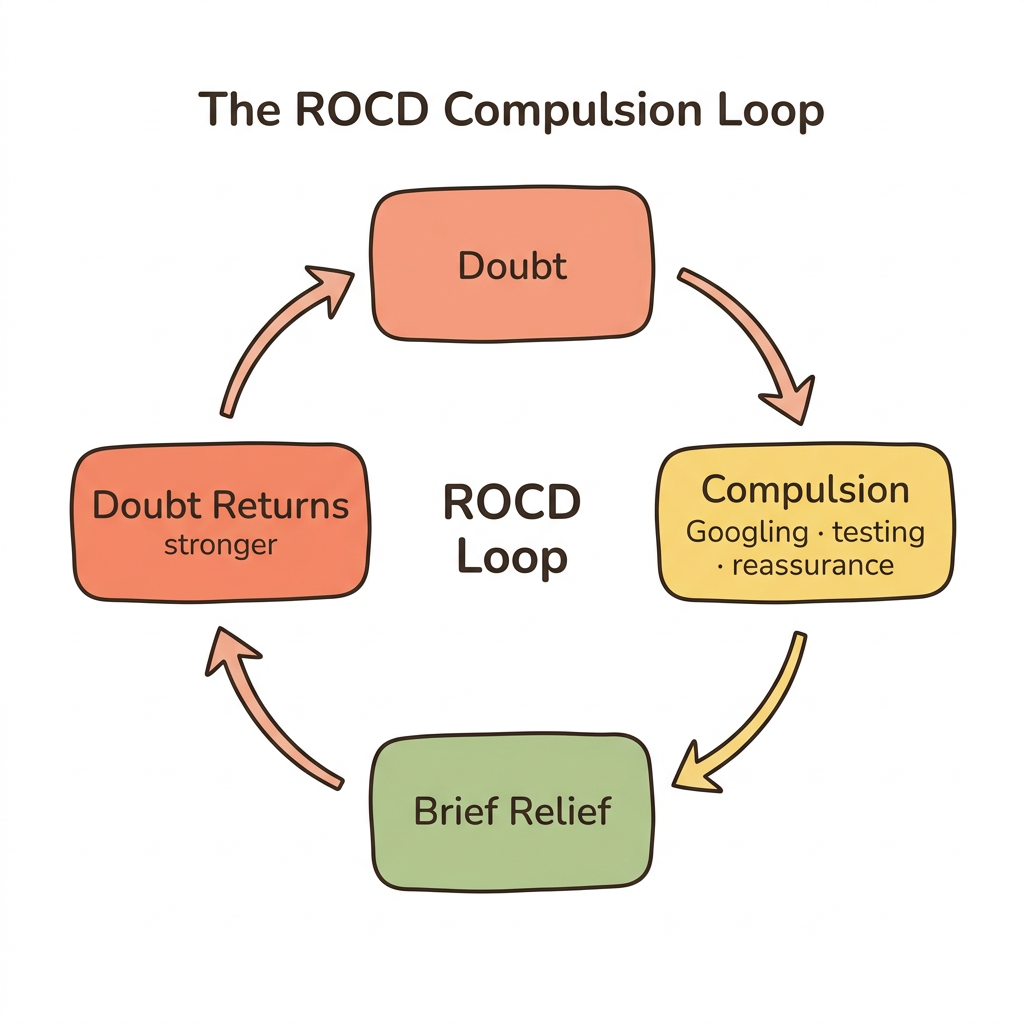
The statistics are sobering: the mean time untreated for OCD is 9 years, and 60 percent of OCD patients never receive gold-standard treatment (IOCDF, 2025). Recognizing ROCD early matters.
Compulsion Audit (for anxious attachment and ROCD-prone individuals)
The hyperactivation-compulsion loop in ROCD creates the illusion that each reassurance-seeking moment is unique and necessary. Tracking breaks that illusion.
For one week, keep a running tally of four behaviors: searching for reassurance online ("am I in love," relationship comparisons), mentally measuring your relationship against a friend's or ex's, asking your partner or friends to confirm your feelings, and "testing" yourself by imagining leaving and checking whether you feel relief or grief. Do not try to stop any of these—just count them. At the end of the week, look at the total. ROCD produces high-frequency, repetitive compulsions with brief relief followed by renewed doubt. Genuine reflection produces gradually increasing clarity rather than a loop. If your tally is high and the relief never lasts, that is ROCD mechanics—not evidence about your relationship.
What Does Your Attachment Style Have to Do with It?
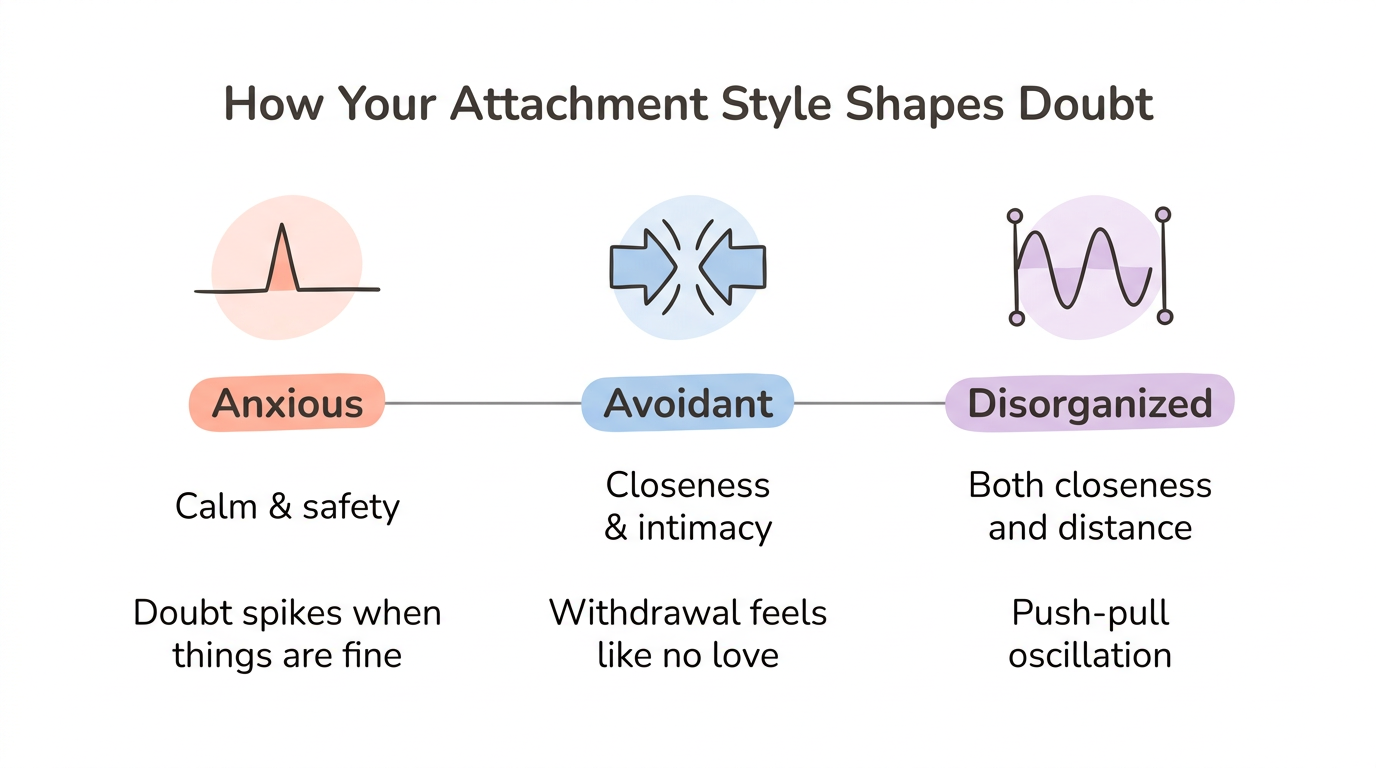
Your attachment style determines the specific way doubt distorts your perception of love—and no two styles produce the same distortion. This is the piece most advice misses: generic checklists cannot account for the fundamentally different ways hyperactivation vs. deactivation shape your experience of a relationship.
Anxious Attachment
When you have an anxious attachment style, doubt spikes after closeness or calm periods. Your nervous system—calibrated for chaos—interprets safety as a warning sign. You "test" the relationship through protest behaviors. You interpret your partner's normalcy as rejection. fMRI research shows that anxiously attached individuals show heightened activation in the dACC and anterior insula—brain regions that process social pain and threat detection—during even mild rejection cues (DeWall et al.). Your brain is literally scanning for danger in moments of connection. When your relationship is going well, anxiety often gets louder, not quieter.
Avoidant Attachment
For avoidant attachment, doubt spikes after increased intimacy. Deactivating strategies make closeness feel suffocating rather than safe. You confuse the urge to withdraw with "not being in love." Your nervous system suppresses the amygdala's emotional response as a way to manage relational threat—which produces a flattened emotional experience that genuinely feels like absence of love. The feelings are there. Your system just learned to turn the volume down.
Disorganized and Fearful-Avoidant Attachment
Disorganized attachment produces push-pull confusion—rapidly alternating between "I love them desperately" and "I feel nothing." Both hyperactivating and deactivating strategies fire, often simultaneously. The alternation itself becomes the evidence: "If I really loved them, I would not feel this way." But the oscillation is the pattern, not the verdict. Your system learned that the source of comfort was also the source of threat, so it cannot settle on a single response.
Attachment Lens Check (all attachment styles)
Ask yourself this: "If I felt completely safe and secure right now, would I still want to leave?" The answer you find in a state of safety carries more information than the answer you find in a state of activation. This exercise helps you separate attachment-driven doubt from relationship-driven doubt.
- Identify your primary attachment style—take Meadow's assessment or review the patterns above
- Read the corresponding doubt pattern for your style
- Ask yourself honestly: "Does my doubt follow this pattern, or does it exist independently of my attachment triggers?"
- Journal one sentence answering the framing question above
- Notice what shifts when you remove the attachment noise from the equation—does the doubt shrink, disappear, or remain exactly the same?
How Does the Brain's Love Chemistry Change Over Time?
The dopamine-fueled intensity of early romance fades within 12 to 24 months as the brain transitions from limerence vs. bonded attachment—and this shift is a normal neurochemical process, not evidence of falling out of love.
Early romantic love activates the VTA to substantia nigra shift in the brain's reward circuitry. During limerence, the ventral tegmental area (VTA) and caudate nucleus flood you with dopamine—producing the obsessive thinking, euphoria, and "can't eat, can't sleep" intensity of new love (Acevedo et al., 2020). That activation pattern is neurochemically unsustainable. Within one to two years, the brain shifts toward the substantia nigra and oxytocin/vasopressin bonding systems. Love does not disappear. It changes address in the brain.
Sternberg's Triangular Theory of Love (1986) maps this clearly: passion—the dopamine-driven component—peaks early and fades. Intimacy and commitment deepen over time. The absence of that initial rush does not mean the love is gone. It means the love has matured.
Here is where attachment style matters: anxiously attached individuals are particularly vulnerable to interpreting this normal shift as evidence of lovelessness. When your system is calibrated for high-intensity signals, the quiet hum of companionate love can register as silence. Butterflies do not equal love—they equal dopamine and norepinephrine surges that your brain was never designed to maintain permanently.
Love Evidence Inventory (for anxious attachment)
Anxious attachment creates a negativity filter that blocks reception of steady, low-key expressions of love. Building interoceptive accuracy for positive signals starts with deliberately cataloging what your hyperactivating system filters out.
- List 10 things your partner does that show care—not grand gestures, but small, consistent actions (makes you coffee, asks about your day, remembers your preferences)
- Rate each one on a scale of 1 to 10 for how much it registers emotionally when it happens
- Notice the gap: if the caring actions are present but score low emotionally, that is anxiety blocking reception
- If the caring actions are genuinely absent—you struggle to list 10—that is information about the relationship itself
- Repeat this inventory monthly and track whether your reception scores shift as you practice self-soothing
The gap between what your partner does and what you can feel tells you about your nervous system's filter—not about the quality of your relationship.
How Can You Tell the Difference? A Self-Assessment Framework
If you have read this far and still feel unsure, that is understandable—this is genuinely hard to sort out from the inside. The most reliable way to distinguish relationship anxiety from genuinely not being in love is to assess your doubt across six dimensions—not during a spike of activation, but from a regulated state. Pattern-based vs. evidence-based doubt is the core distinction.
| Dimension | Relationship Anxiety | Genuinely Not in Love |
|---|---|---|
| Onset of doubt | Triggered by specific events (closeness, distance, conflict) | Gradual, consistent realization over time |
| Pattern | Cycles—intense doubt followed by relief and reconnection | Steady, does not fluctuate with reassurance |
| Body sensation | Activated—chest tight, heart racing, stomach churning | Flat—emotional numbness without physical activation |
| Effect of reassurance | Brief relief, then doubt returns | No change; may feel irritated by reassurance |
| Relationship history | Similar doubts in past relationships | Specific to this relationship |
| Response to regulation | Doubt decreases when nervous system is calm | Feelings remain the same when regulated |
| Core fear | Losing the relationship or being abandoned | Staying in the wrong relationship |
| When things are good | Doubt often increases (foreboding joy) | Doubt remains or decreases |
The critical question is this: are you making a regulated vs. dysregulated assessment? Your nervous system's state fundamentally shapes what you perceive. Evaluating your relationship from the middle of an anxiety spike is like trying to read a map during an earthquake. The information you need is there, but you cannot access it while the ground is shaking.
Before you try to answer "Do I love them?"—first ask: "Am I in my window of tolerance right now?"
Regulated Check-In (somatic technique—all attachment styles)
Bilateral stimulation and physiological sighing shift your nervous system from sympathetic activation to ventral vagal safety—giving you access to signal vs. noise in your emotional experience.
- Sit with both feet on the floor and begin bilateral stimulation: alternately tap your left and right knees, slowly, for 2 minutes
- Pause and take 3 rounds of physiological sighing—a double inhale through your nose (short inhale, then a second fuller inhale) followed by a long, slow exhale through your mouth
- Place one hand on your chest and notice your heart rate settling
- Only now, bring your partner to mind and ask: "How do I feel about this person right now?"
- Compare this answer to what you feel during a spike of anxiety—notice the difference
- Write down both answers side by side
The regulated answer carries more accurate information. You are not suppressing your doubt by calming down—you are removing the distortion so you can see what is actually there. If the doubt remains after regulation, that is data worth listening to.
When Should You Seek Professional Help?
You deserve support when self-assessment alone is not giving you clarity—and reaching out is evidence of investment in yourself and your relationship, not evidence that something is broken.
Consider seeking professional help if doubt about your relationship consumes more than an hour of your day, interferes with your ability to work or sleep, or drives compulsive reassurance-seeking behaviors that you cannot stop despite wanting to. These are signs that the doubt has moved beyond normal relationship questioning into territory where specialized treatment can help.
ERP for ROCD (Exposure and Response Prevention) is the gold standard treatment for relationship-focused obsessive symptoms. ERP gradually exposes you to uncertainty about your feelings without engaging in compulsions—teaching your brain that uncertainty is tolerable. Doron et al. (2023) demonstrated the effectiveness of CBT-based interventions for ROCD in a randomized controlled trial. Given that 60 percent of OCD patients never receive gold-standard ERP treatment and the mean time untreated is 9 years (IOCDF, 2025), recognizing ROCD early and seeking specialized help can save years of suffering.
Emotionally Focused Therapy addresses the pursue-withdraw cycle that often develops when one partner's anxiety drives the relational dynamic. EFT helps couples identify the attachment cry underneath behaviors like "Do you really love me?"—mapping it as an attachment need rather than a deficit of love. EFT is APA-recommended and typically involves 8 to 20 sessions. If the anxious-avoidant dynamic has become entrenched, couples work can shift patterns that individual therapy cannot.
CBT can help identify emotional reasoning—the cognitive distortion where "I do not feel butterflies, so I must not be in love" feels like a logical conclusion rather than a thinking error. Cognitive restructuring targets the specific distortions that keep relationship anxiety alive.
If relationship anxiety has you wondering whether to leave, a therapist trained in attachment theory can help you distinguish pattern from truth in a way that Google searches never will.
Frequently Asked Questions
Can anxiety make you feel like you don't love your partner?
Yes. Anxiety activates your body's threat-detection system, which can produce emotional numbness or interoceptive confusion where stress signals get misread as absence of feeling. Research shows 45.2 percent of depersonalization patients have fearful attachment. Anxiety blocks emotional reception rather than eliminating actual love.
Is it ROCD or am I really not happy?
ROCD doubt feels intrusive and unwanted—you do not want to be having these thoughts. Genuine unhappiness feels aligned with your values and observations. ROCD also features compulsions: Googling reassurance, mentally "testing" feelings, and comparing your relationship to others, with brief relief that loops back to doubt.
Why do I doubt my feelings for my partner when everything is fine?
This is a hallmark of anxious attachment. When your relationship is calm, your threat-detection system—calibrated for chaos—interprets safety as danger. Brené Brown calls this foreboding joy—your nervous system does not trust the calm, so it manufactures doubt to stay vigilant. Understanding why anxiety spikes when things are going well can help you recognize this pattern.
How do I know if I'm falling out of love or just comfortable?
The dopamine rush of early romance fades within 12 to 24 months as the brain shifts from limerence to bonded attachment (Acevedo et al., 2020). Companionate love feels quieter but activates deep bonding systems. If you still choose your partner, feel safe with them, and care about their wellbeing, that is love—it just sounds different neurochemically.
What does relationship anxiety feel like physically?
Relationship anxiety produces chest tightness, stomach churning, racing heart, shallow breathing, and sometimes emotional numbness or "going blank" when thinking about your partner. These are nervous system activation responses—your body treating the relationship as a threat—not evidence about your actual feelings. Learning to read these body signals accurately is a skill you can build.
Can relationship anxiety ruin a good relationship?
Yes, if untreated. Chronic reassurance-seeking, emotional withdrawal during anxiety spikes, and the pursue-withdraw cycle can erode trust and intimacy over time. However, relationship anxiety is highly treatable through ERP, EFT, and attachment-informed therapy, with most people seeing significant improvement within months.
Is relationship anxiety a sign you should break up?
Not on its own. Relationship anxiety is an internal experience driven by attachment patterns and nervous system responses—it says more about your history than your current partner. The question to ask is whether anxiety is the cause of your doubt or a response to genuine problems. This guide can help you sort through that distinction.
Why does anxiety make me question everything about my relationship?
Anxious attachment activates the brain's threat-detection centers—the dACC and anterior insula—which scan for danger in close relationships (DeWall et al.). This hypervigilance turns ordinary moments—a short text, a distracted partner—into evidence of rejection. The questioning is a compulsive search for certainty that attachment anxiety makes impossible to resolve through thinking alone.
Want to Go Deeper?
Meadow includes a structured assessment to help you understand your specific attachment patterns, followed by a 66-day program of daily practices designed to build earned security.
Start your free week →References
Attachment Theory and Hyperactivation
- Mikulincer, M., & Shaver, P. R. (2007). Attachment in Adulthood: Structure, Dynamics, and Change. Guilford Press.
- Hazan, C., & Shaver, P. (1987). Romantic love conceptualized as an attachment process. Journal of Personality and Social Psychology, 52(3), 511–524.
- DeWall, C. N., et al. (2012). Do neural responses to rejection depend on attachment style? An fMRI study. Social Cognitive and Affective Neuroscience, 7(2), 184–192.
Relationship OCD (ROCD)
- Doron, G., Derby, D. S., Szepsenwol, O., & Talmor, D. (2013). Tainted love: Exploring relationship-centered obsessive compulsive symptoms in two non-clinical cohorts. Journal of Obsessive-Compulsive and Related Disorders, 1(1), 16–24.
- Doron, G., et al. (2023). A randomized controlled trial of a CBT-based mobile application for ROCD. PMC.
- Frontiers in Psychiatry (2016). ROCD: Interference, symptoms, and maladaptive beliefs.
- International OCD Foundation (2025). America's OCD Care Crisis Report.
Neuroscience of Love
- Acevedo, B. P., et al. (2020). Neural and genetic correlates of romantic love in newlywed marriages. Frontiers in Psychology.
- Sternberg, R. J. (1986). A triangular theory of love. Psychological Review, 93(2), 119–135.
Interoception and Body Signals
- Paulus, M. P., et al. (2019). An insular view of anxiety. Biological Psychiatry: Cognitive Neuroscience and Neuroimaging, 6(3), 321–331.
- Khalsa, S. S., et al. (2018). Interoception and mental health: A roadmap. Biological Psychiatry, 3(6), 501–513.
Emotional Numbness and Dissociation
- Fearful attachment in depersonalization disorder. (2022). ScienceDirect.
- BMC Neuroscience (2021). Neural basis of attachment anxiety and altered resting-state functional connectivity.
- Frontiers in Psychiatry (2024). Depersonalization and depression risk.
This article is for educational purposes only and is not a substitute for professional mental health care. If you are experiencing persistent relationship distress, ROCD symptoms, or emotional numbness, please consult a licensed therapist trained in attachment theory or OCD treatment.