Relationship anxiety is persistent worry, doubt, and physical distress about a romantic relationship—even when the relationship is objectively going well. According to a Thriveworks survey, 34 percent of Americans say romantic relationships are the leading cause of their mental health concerns. This is not a rare experience, and it is not a personal failing.
If you have ever felt your chest tighten when your partner takes too long to text back, or lain awake replaying a conversation for hidden meanings, you know this goes beyond ordinary worrying. Your body is involved. Your thoughts loop. Your behaviors shift in ways you might not even recognize. This article starts where relationship anxiety actually starts—in your body—then explains why your nervous system responds this way and how the experience differs depending on your attachment style.
Key takeaway: Relationship anxiety feels like a combination of physical symptoms such as racing heart, chest tightness, and stomach knots alongside mental loops of constant doubt and reassurance-seeking. It is your attachment system detecting threat where there may be none. It manifests differently depending on your attachment style, and it is real, biological, and treatable.
What Does Relationship Anxiety Feel Like in Your Body?
Relationship anxiety lives in your body before it becomes a conscious thought. Racing heart, chest tightness, shallow breathing, stomach knots, jaw clenching, muscle tension, and insomnia—these are the most commonly reported physical symptoms, and they are real physiological responses, not signs of weakness or imagination.
Your nervous system has shifted into sympathetic activation—the fight-or-flight state. According to polyvagal theory (Porges), your body unconsciously scans for danger through a process called neuroception. When your nervous system was shaped by unpredictable early relationships, it can flag ambiguity in a romantic relationship as a genuine threat. That stomach drop when your partner seems distant? That is your threat detection system firing.
The gut-brain axis plays a significant role here. Stress hormones affect gut motility and microbiome balance, producing nausea, cramping, and that familiar "pit in your stomach" feeling (ADAA). This is not psychosomatic in a dismissive sense—it is a well-documented biological pathway between emotional distress and digestive disruption.
Sleep disruption compounds the problem. A meta-analysis found that attachment anxiety correlates with poorer sleep quality (r = −0.23), longer sleep latency, and greater daytime sleepiness (ScienceDirect, 2024). Sleep loss, in turn, increases anxiety symptoms with a moderate-to-large effect size (SMD = 0.57–0.63) across 154 studies (APA). Your body enters a feedback loop: anxiety disrupts sleep, and lost sleep amplifies anxiety.
Your nervous system learned these responses for good reason. At some point, hypervigilance kept you safe. And now you can begin teaching your body that safety looks different than it once did.
Body Map Check-In (for anxious attachment)
- Pause and close your eyes
- Scan slowly from your head to your toes, noticing where you feel tension, heat, tightness, or emptiness
- Name each sensation without judgment—"tight chest," "heavy stomach," "clenched jaw"
- Place one hand on the area with the strongest sensation
- Breathe into that area for 3 slow breaths
- Notice if the sensation shifts—it does not need to disappear
Hyperactivation sends signals throughout your body that often get ignored or misread. Pausing to locate and name sensation interrupts the automatic escalation cycle and re-engages your body's awareness before the mind takes over.
What Does the Mental Spiral of Relationship Anxiety Sound Like?
The mental experience of relationship anxiety sounds like a voice that will not stop asking questions it cannot answer. Constant doubt about your partner's feelings, overanalyzing words and tone for hidden meanings, unfounded jealousy, self-silencing to prevent abandonment—these cognitive patterns are exhausting and consuming.
Mikulincer and Shaver (2003) describe this as hyperactivation of the attachment system. When your brain perceives a threat to the bond—real or imagined—it cranks up vigilance. Every unanswered text becomes evidence. Every neutral facial expression becomes a puzzle to decode. The goal of hyperactivation is to keep your attachment figure close, but the cost is that you cannot be present in the relationship you are trying to protect.
Approximately 20 percent of adults have anxious attachment (Hazan and Shaver, 1987; Mickelson et al., 1997), and this hyperactivation pattern is their nervous system's default strategy for managing uncertainty. If this sounds familiar, you are not alone—and recognizing the pattern is the first step toward changing your relationship to it.
Here are six common relationship anxiety thought patterns:
- "They didn't text back—they must be losing interest"
- "That comment felt off—what did they really mean?"
- "Things are going too well—something bad is about to happen"
- "Do I really love them, or am I just afraid of being alone?"
- "If I bring this up, they'll think I'm too much and leave"
- "I need to hear them say they love me—again"
These thoughts feel urgent and true in the moment. Understanding what triggers your relationship anxiety can help you recognize when the pattern is driving rather than genuine concern.
Thought Labeling Practice (for anxious attachment)
The reason this technique works is that naming a pattern engages your prefrontal cortex—the part of your brain responsible for perspective-taking—which interrupts the hyperactivation loop. You shift from being inside the spiral to observing it.
- When you notice a worry spiral starting, pause
- Label the thought category: "reassurance-seeking," "mind-reading," "catastrophizing," or "testing"
- Say to yourself: "This is my attachment system activating, not necessarily reality"
- Write the thought down—externalizing it reduces its grip
Our article on how to stop overthinking in relationships offers additional techniques for working with these spirals.
What Behaviors Does Relationship Anxiety Drive?
Relationship anxiety does not stay in your head—it changes how you act. Reassurance-seeking (repeatedly asking "Do you love me?"), checking your partner's phone or social media, picking fights to test loyalty, self-sabotaging a good thing, avoiding vulnerability, and difficulty being present are all common behavioral patterns.
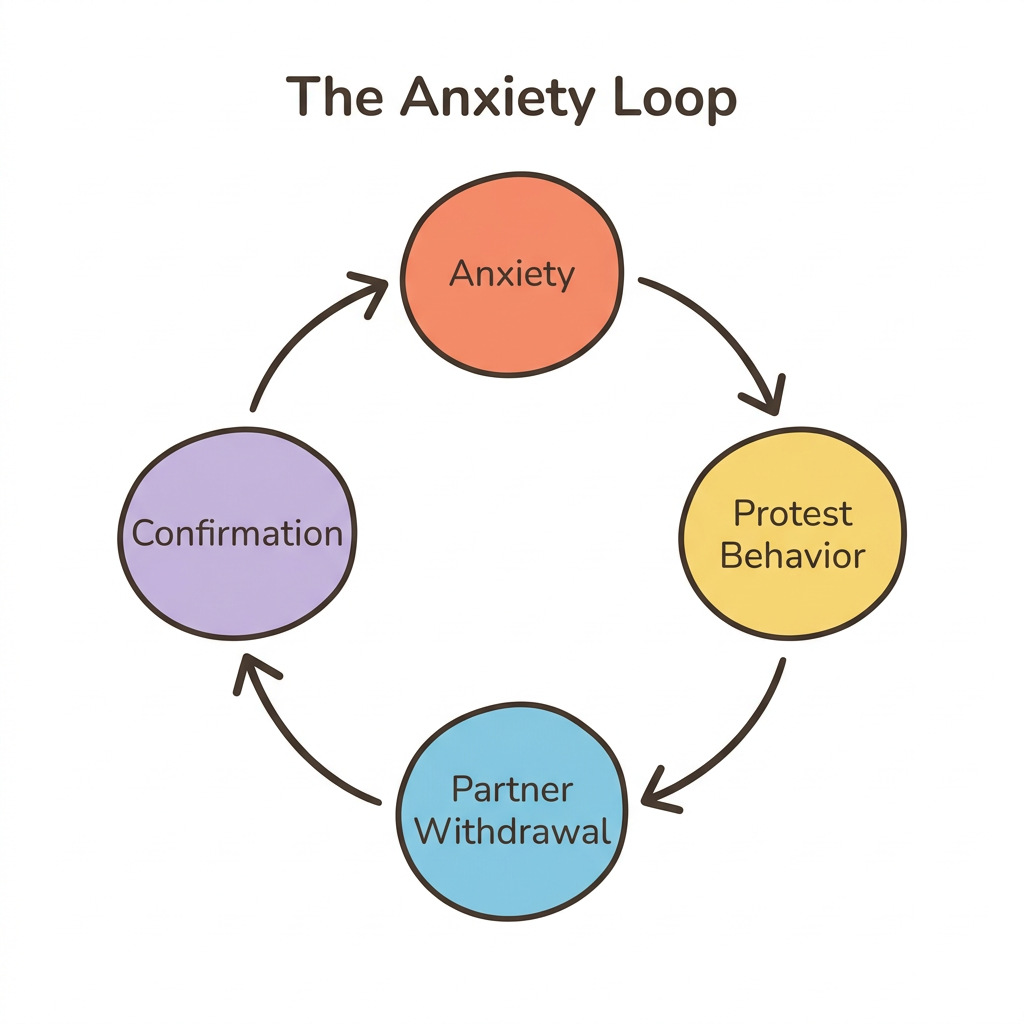
If you recognize yourself in these patterns, that recognition itself is meaningful. Mikulincer and Shaver (2007) call these protest behaviors—actions designed to re-establish closeness when the attachment system perceives threat. The painful paradox is that these behaviors are attempts to reduce anxiety, but they actually increase it. Reassurance-seeking loops erode your partner's patience. Testing pushes them toward the very withdrawal you fear. Self-sabotage creates the instability your nervous system was scanning for.
This creates what researchers call a self-fulfilling prophecy. The anxiety tells you the relationship is at risk, so you behave in ways that genuinely put it at risk—which confirms the anxiety's narrative. You can learn to meet the same underlying needs in ways that strengthen your relationship rather than strain it.
Behavior-Need Translation (for anxious attachment)
Protest behaviors mask legitimate attachment needs. When you can identify and voice the real need directly, you break the cycle of indirect communication that escalates both your anxiety and your partner's defensiveness.
- Identify a recent anxious behavior—checking their social media, re-reading texts, starting an argument
- Ask yourself: "What was I really needing in that moment?" (connection, reassurance, a sense of mattering)
- Ask: "What would a direct request for that need sound like?" (for example, "I'd love to hear from you today—I'm feeling disconnected")
- Practice the direct request next time the urge arises
How to communicate your needs without triggering your partner goes deeper into building this skill.
Why Does Your Body React This Way to Relationship Uncertainty?
Your body reacts to relationship uncertainty as though it is a survival threat because, to your nervous system, it is. Amygdala hyperreactivity—heightened sensitivity in the brain's threat detection center—is significantly correlated with attachment anxiety. Research by Vrtička et al. (2008) found that anxiously attached individuals show increased left amygdala activation when viewing angry faces and negative social feedback, meaning their brains respond more intensely to social punishment cues.
At the same time, impaired prefrontal regulation means the brain's "brake" on fear responses is weaker. Securely attached people show stronger orbitofrontal cortex activation during emotion regulation, effectively calming the amygdala. Anxious attachment is associated with weaker top-down control—so the fear signal fires harder and the calming mechanism works less effectively.
You may recognize this cascade in your own body: your threat detection system fires, cortisol floods your system, your chest tightens and stomach churns, your immune system takes a hit—research links higher attachment anxiety to fewer CD3+, CD4+, and CD8+ T-cells and elevated cortisol (Fagundes et al., 2014)—your sleep gets disrupted, and the sleep loss makes the anxiety worse the next day.
Even at rest, the brains of anxiously attached people show altered activity. A 2021 study in BMC Neuroscience found differences in resting-state brain connectivity, including enhanced monitoring of threat and separation cues—suggesting the nervous system stays partially activated even when nothing is wrong.
Porges' concept of neuroception explains why this happens in good relationships. Your nervous system unconsciously evaluates safety. When it was calibrated in an unpredictable early environment, it can interpret stability and closeness as unfamiliar—and unfamiliar registers as potentially dangerous. This is why you might feel most anxious when things are going well.
Vagal Tone Reset (for all insecure attachment styles)
- Exhale longer than you inhale—breathe in for 4 counts, out for 6 counts—for 5 breaths (this activates the ventral vagal pathway, your body's built-in calming circuit)
- Hum or sing for 30 seconds—the vibration directly stimulates the vagus nerve
- Splash cold water on your face or hold a cold object against your neck
- Notice the shift from chest tightness to slight opening or settling
You are working with your nervous system's biology rather than trying to think your way out of a body-level response. This is effective across attachment styles because it counteracts sympathetic activation at the source. How attachment style affects your nervous system explains the underlying mechanics in more detail.
Does Relationship Anxiety Feel Different Depending on Your Attachment Style?
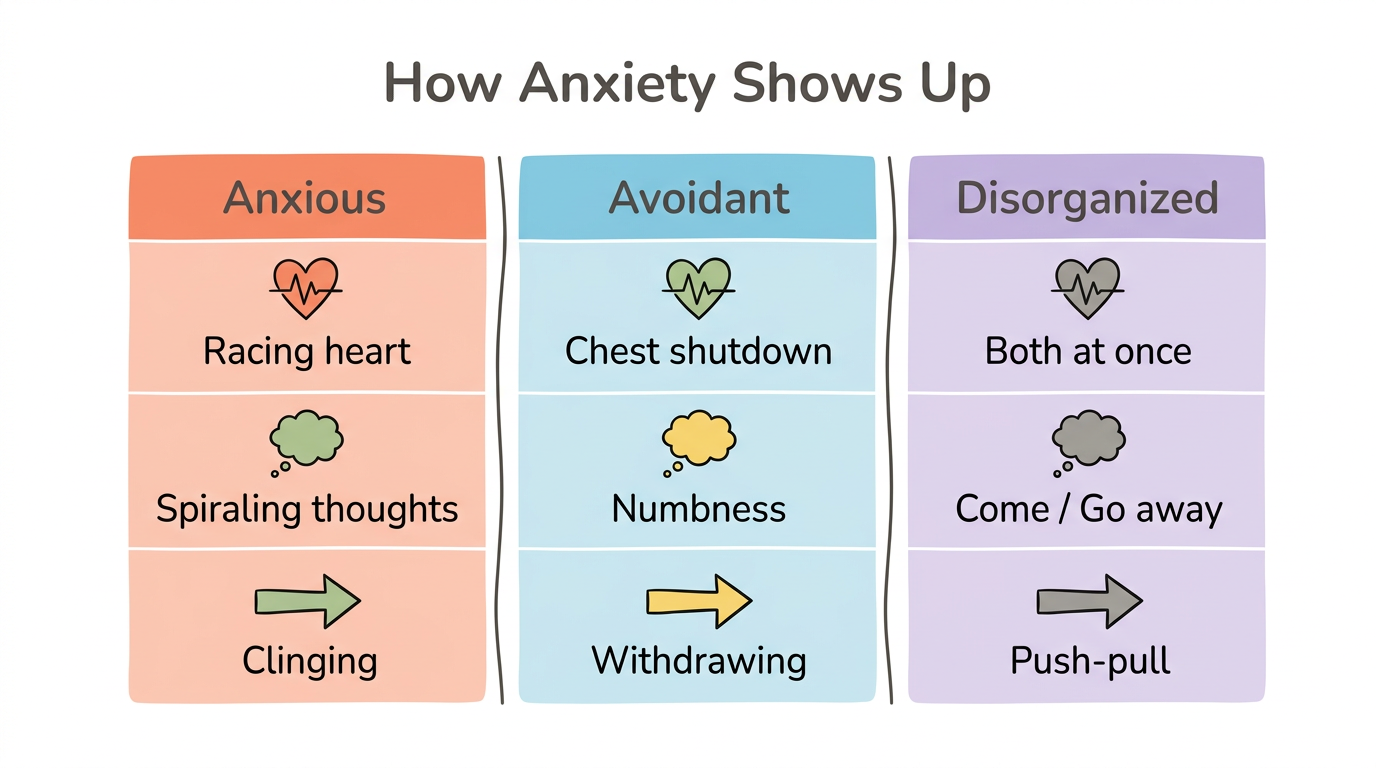
Relationship anxiety feels markedly different depending on your attachment style, and this distinction is one of the most overlooked aspects of the experience. Mikulincer and Shaver (2003, 2016) describe two opposing strategies—hyperactivation and deactivation—that produce very different symptoms from the same underlying insecurity.
| Anxious Attachment | Avoidant Attachment | Disorganized Attachment | |
|---|---|---|---|
| Primary feeling | Panic, urgency | Suffocation, numbness | Simultaneous craving and terror |
| Body sensation | Racing heart, stomach knots | Chest tightness, shutdown | Oscillating between activation and freeze |
| Mental pattern | "They're going to leave me" | "I need space / I don't need anyone" | "Come here—go away" |
| Behavioral response | Reassurance-seeking, clinging | Withdrawal, emotional shutdown | Push-pull, unpredictable reactions |
| Attachment system | Hyperactivated | Deactivated | Disorganized (both simultaneously) |
| Anxiety triggered by | Perceived distance or ambiguity | Too much closeness or demand | Both closeness and distance |
Anxious Attachment
With anxious attachment, relationship anxiety feels like urgency. Your system moves toward the partner with intensifying energy—more texts, more checking, more reassurance-seeking. Separation feels genuinely threatening, and the anxiety does not settle until you have proof of connection.
Avoidant Attachment
With avoidant attachment, relationship anxiety is often unrecognized as anxiety at all. It leaks out as irritability, emotional flatness, or a sudden need for space. The system moves away—shutting down rather than reaching out. Closeness itself triggers the discomfort.
Disorganized Attachment
Disorganized attachment produces the most confusing experience: wanting closeness desperately while feeling terrified of it simultaneously. Your system oscillates between reaching out and pulling away, sometimes within the same conversation. The approach-withdraw oscillation can feel like emotional whiplash.
Attachment Style Awareness Journal (for all attachment styles)
- At the end of each day, note one moment of relationship anxiety
- Record three things: What triggered it? What did you feel in your body? What did you do?
- After one week, look for your pattern: Do you move toward (anxious), away (avoidant), or both (disorganized)?
- Name the pattern without judgment—"There's my toward-move again"
Identifying your specific pattern matters because it determines which interventions will be most effective. An anxious person needs different tools than an avoidant person—and someone with disorganized attachment needs to understand both sides of their oscillation before meaningful change can happen.
Is It Relationship Anxiety, ROCD, or a Real Problem?
These three experiences can feel confusingly similar, but they have different mechanisms and require different interventions. Distinguishing between them matters because the wrong approach can make things worse.
Attachment-based relationship anxiety is driven by fear of abandonment. It is triggered by perceived distance or ambiguity from your partner. Protest behaviors like reassurance-seeking, checking, and testing are its signature. Reassurance helps—temporarily. The anxiety is fundamentally about the bond: Will you stay?
ROCD (Relationship OCD) involves ego-dystonic intrusive doubts—thoughts that feel foreign and unwanted, like "Do I really love them?" repeating on a loop. Over 50 percent of OCD sufferers identify with this relationship-focused subtype (IOCDF). Doron et al. (2016) found that ROCD symptoms predict relationship dissatisfaction and depression above and beyond general OCD. The key difference: ROCD is driven by compulsive doubt loops, not protest behavior. Reassurance helps for minutes, not hours, before the doubt cycles back.
Genuine incompatibility looks different from both. There is a consistent pattern of unmet needs, values misalignment, or repeated boundary violations. The dominant emotion is sadness more than anxiety. The concerns remain stable rather than spiking and dropping. We explore this distinction further in how to tell the difference between anxiety and intuition.
If you are unsure which category fits, that uncertainty itself is worth exploring—ideally with a therapist who understands the distinctions. The question of whether it is relationship anxiety or not being in love is one of the most common places people get stuck.
Source of Distress Reflection (for anxious attachment and ROCD-prone readers)
Distinguishing the source of your distress changes the intervention entirely. Attachment-based anxiety responds to co-regulation and earned security work. ROCD responds to Exposure with Response Prevention. Applying the wrong treatment can reinforce the pattern you are trying to change.
- Write down the recurring doubt or worry
- Ask: "Does this worry spike when I feel distant from my partner, or does it come out of nowhere?"
- Ask: "Does reassurance settle it for hours or days (attachment anxiety) or only minutes (ROCD)?"
- Ask: "Is this about fear of losing them, or doubt about whether I want them?"
- If ROCD resonates strongly, seek an OCD-specialized therapist trained in ERP
When Should You Seek Professional Help for Relationship Anxiety?
Professional help is worth pursuing when relationship anxiety significantly impairs your daily functioning, your relationship quality, your sleep, your work, or your physical health. If the exercises in this article feel like trying to bail out a sinking boat with a cup, therapy provides the structural repair.
Several evidence-based treatments show strong results. Emotionally Focused Therapy (EFT) is the gold standard for attachment-based relationship distress, with an effect size of d = 0.93 to 1.3 (ICEEFT; Johnson et al., 1999). It directly reorganizes attachment patterns through accessing and restructuring emotional responses. CBT is effective approximately 75 percent of the time for couples and targets the catastrophic thinking and reassurance-seeking loops. For ROCD specifically, Exposure with Response Prevention (ERP) is the recommended treatment. Somatic and polyvagal-informed approaches address the nervous system regulation piece that talk therapy alone can miss.
Seeking help is not a sign that your anxiety has "won." It is a sign that you are ready to work with your attachment system rather than against it. Can relationship anxiety go away? explores what recovery actually looks like, and how to self-soothe anxious attachment offers tools for the work between sessions.
Frequently Asked Questions
Is relationship anxiety normal?
Some relationship worry is normal, especially during transitions like moving in together or saying "I love you" for the first time. It becomes relationship anxiety when the worry is persistent, consuming, and disproportionate to what is actually happening—interfering with your ability to enjoy the relationship or function day to day.
What does relationship anxiety feel like physically?
Relationship anxiety often shows up as racing heart, chest tightness, shallow breathing, stomach knots, jaw clenching, muscle tension, and insomnia. These are real physiological responses—your nervous system's threat detection system activating—not something you are imagining.
Can anxiety make you feel like you don't love your partner?
Yes. Anxiety can create emotional numbness, doubt, and disconnection that feel identical to falling out of love. This is especially common in ROCD, where intrusive doubts about your feelings become compulsive. The key distinction: anxiety-driven numbness fluctuates with stress and attachment triggers, while genuine loss of love is more consistent and accompanied by sadness rather than panic.
Does relationship anxiety get worse over time?
Without intervention, relationship anxiety often intensifies because the coping behaviors it drives—reassurance-seeking, testing, avoidance—erode trust and trigger partner defensiveness, creating a self-reinforcing cycle. With awareness and targeted work such as EFT or attachment-focused therapy, it can significantly improve.
How do I know if it's anxiety or my gut telling me something?
Anxiety tends to feel urgent, spinning, and located in the chest or throat, while intuition feels quieter, steady, and located lower in the body. Anxiety spikes around ambiguity and calms temporarily with reassurance. Intuition persists even when things seem fine on the surface. We explore this in depth in how to tell the difference between anxiety and intuition in relationships.
Can relationship anxiety cause physical symptoms?
Research links attachment anxiety to elevated cortisol, immune suppression (fewer CD3+, CD4+, and CD8+ T-cells), disrupted sleep, and gut disturbances (Fagundes et al., 2014). A meta-analysis found attachment anxiety correlates with poorer sleep quality at r = −0.23 (ScienceDirect, 2024). These physical symptoms are biological responses, not signs that you are overreacting.
Do I have ROCD or real relationship problems?
ROCD involves ego-dystonic intrusive doubts—thoughts that feel foreign and distressing, like "Do I really love them?" repeating compulsively. Real relationship problems involve consistent patterns of unmet needs or values misalignment, accompanied by sadness more than anxiety. ROCD responds to ERP therapy, while relationship problems respond to couples work or honest evaluation of compatibility.
Want to Go Deeper?
Meadow includes a structured assessment to help you understand your specific attachment patterns, followed by a 66-day program of daily practices designed to build earned security.
Start your free week →References
Attachment Theory and Psychology
-
Mikulincer, M., & Shaver, P. R. (2003). The attachment behavioral system in adulthood: Activation, psychodynamics, and interpersonal processes. Advances in Experimental Social Psychology, 35, 53–152.
-
Mikulincer, M., & Shaver, P. R. (2007/2016). Attachment in Adulthood: Structure, Dynamics, and Change. Guilford Press.
-
Hazan, C., & Shaver, P. (1987). Romantic love conceptualized as an attachment process. Journal of Personality and Social Psychology, 52(3), 511–524.
-
Mickelson, K. D., Kessler, R. C., & Shaver, P. R. (1997). Adult attachment in a nationally representative sample. Journal of Personality and Social Psychology, 73(5), 1092–1106.
-
Psychology Today. (2024). Relationship anxiety. Retrieved from psychologytoday.com.
Neuroscience and Biology
-
Vrtička, P., Andersson, F., Grandjean, D., Sander, D., & Vuilleumier, P. (2008). Individual attachment style modulates human amygdala and striatum activation during social appraisal. PLOS ONE, 3(8), e2868.
-
Fagundes, C. P., Glaser, R., Hwang, B. S., Malarkey, W. B., & Kiecolt-Glaser, J. K. (2014). Depressive symptoms enhance stress-induced inflammatory responses. Brain, Behavior, and Immunity, 31, 172–176. PubMed: 23307944.
-
Pietromonaco, P. R., & Powers, S. I. (2015). Attachment and health-related physiological stress processes. Current Opinion in Psychology, 1, 34–39.
-
BMC Neuroscience. (2021). Resting-state brain activity and attachment anxiety. BMC Neuroscience, 22, Article 617-4.
-
Porges, S. W. (2011). The Polyvagal Theory: Neurophysiological Foundations of Emotions, Attachment, Communication, and Self-Regulation. W. W. Norton.
Sleep and Physical Health
-
ScienceDirect. (2024). Meta-analysis: Attachment anxiety and sleep quality. Sleep Medicine Reviews. doi:10.1016/j.smrv.2024.
-
APA. (2023). Sleep loss and anxiety: A meta-analysis of 154 studies. Psychological Bulletin, 149(11–12), 510–525.
-
Anxiety and Depression Association of America (ADAA). How to calm an anxious stomach: The brain-gut connection. Retrieved from adaa.org.
Prevalence and Surveys
-
National Institute of Mental Health (NIMH). Any anxiety disorder. Retrieved from nimh.nih.gov.
-
Thriveworks. (2023). Research: Widespread relationship anxiety. Retrieved from thriveworks.com.
ROCD
-
International OCD Foundation (IOCDF). Relationship OCD. Retrieved from iocdf.org.
-
Doron, G., Derby, D. S., Szepsenwol, O., Nahaloni, E., & Moulding, R. (2016). Relationship obsessive-compulsive disorder: Interference, symptoms, and maladaptive beliefs. Frontiers in Psychiatry, 7, 58.
Treatment Efficacy
-
International Centre for Excellence in Emotionally Focused Therapy (ICEEFT). EFT research. Retrieved from iceeft.com.
-
Johnson, S. M., Hunsley, J., Greenberg, L., & Schindler, D. (1999). Emotionally focused couples therapy: Status and challenges. Clinical Psychology: Science and Practice, 6(1), 67–79.
-
CogBTherapy. CBT for relationship problems. Retrieved from cogbtherapy.com.
-
Healthline. Relationship anxiety: Symptoms and treatment. Retrieved from healthline.com.
-
Talkspace. Relationship anxiety: Signs, causes, and treatment. Retrieved from talkspace.com.
This article is for educational purposes only and is not a substitute for professional mental health advice. If relationship anxiety is significantly affecting your daily life, please consult a licensed therapist or counselor who specializes in attachment-based or anxiety-focused treatment.