"Is this my gut telling me something is wrong, or is my anxiety talking?" If you've asked yourself this question mid-spiral—phone in hand, heart hammering, rereading a text for the fourth time—you're not imagining the difficulty. Anxiety and intuition activate the same brain region, the anterior insula, which is why they produce nearly identical physical sensations. Research shows that people with anxiety are actually more aware of their body signals but less accurate at interpreting them (Paulus and Stein, 2010). Your body is speaking loudly. The problem isn't the volume—it's the translation.
This confusion isn't random. Roughly 19 percent of adults have an anxious attachment style (Hazan and Shaver, 1987), and for these individuals, the nervous system's threat-detection system is calibrated toward danger by early relational experience. A one-word text becomes evidence of fading love. A cancelled plan becomes proof of abandonment. The alarm feels urgent and real every single time—because the brain hardware generating it is the same hardware that produces genuine gut feelings. Understanding how your attachment style shapes what your body tells you is the first step toward learning which signals to trust.
Why Do Anxiety and Intuition Feel So Similar?
Anxiety and intuition feel so similar because they activate the same brain region—the anterior insula, the hub for both interoceptive awareness and anxiety processing. "Is this my gut telling me something is wrong, or is my anxiety talking?" is one of the most common questions in relationship psychology, and neuroscience reveals why the answer is so hard to find.
Research using fMRI shows that anxiously attached individuals display heightened anterior insula and dorsal anterior cingulate cortex activation during perceived social rejection—the exact same neural regions that process genuine gut feelings (DeWall et al., 2012). Your brain is literally using the same hardware to generate both signals, which is why they feel physically identical.
That familiar stomach drop when your partner takes too long to reply? The tightness that creeps in when they seem distant? Your body registered a signal. Whether that signal reflects a real threat or a pattern from your past is the question that matters. What makes this so difficult to untangle is the interoceptive accuracy paradox: people with anxiety are more aware of their body signals but less accurate at interpreting them (Paulus and Stein, 2010). You feel more—the racing heart, the stomach drop, the tightness in your chest—but your system misreads what those sensations mean.
Early attachment relationships shape how well your interoceptive system develops in the first place. Research on maternal affective touch shows that caregiver responsiveness literally scaffolds the maturation of your body's internal sensing system (Montirosso and McGlone, 2020). Disrupted attachment can leave you with a body that sends louder signals but less reliable translations.
Key takeaway: Anxiety and intuition activate the same brain region, the anterior insula, which is why they produce nearly identical physical sensations. People with anxiety feel body signals more intensely but interpret them less accurately. Your attachment history shapes how reliably your body reads threat versus safety, and learning to check your nervous system state before interpreting a feeling is the most effective way to distinguish the two.
"Signal Mapping" Body Scan (for anxious attachment)
- Close your eyes and take three slow breaths
- Notice where you feel the concern in your body—chest, throat, stomach, shoulders
- Rate the sensation's intensity from 1 to 10
- Notice the quality: is the sensation tight, contracted, or buzzing? Or is it steady, open, and weighted?
- Write down both the location and the quality of the sensation
This works for anxious attachment because hyperactivated interoception means you feel more than most people—but without a vocabulary for those sensations, your mind defaults to "danger." Building a personal map of how anxiety versus intuition shows up in your specific body gives you data to work with instead of panic.
How Does Your Attachment Style Shape What You "Know"?
Your attachment style acts as a filter between what happens in your relationship and what your nervous system tells you happened. Each insecure attachment pattern creates a different kind of distortion—and understanding yours is the first step toward trusting your own signals.
Stephen Porges' concept of neuroception explains why. Neuroception is your nervous system's process of scanning the environment for safety or danger below conscious awareness (Porges, 2022). A resilient nervous system is biased toward detecting safety cues. A nervous system shaped by insecure attachment is miscalibrated—biased toward detecting threat, even in safe relationships. You can learn more about this process in How Does Attachment Style Affect Your Nervous System?.
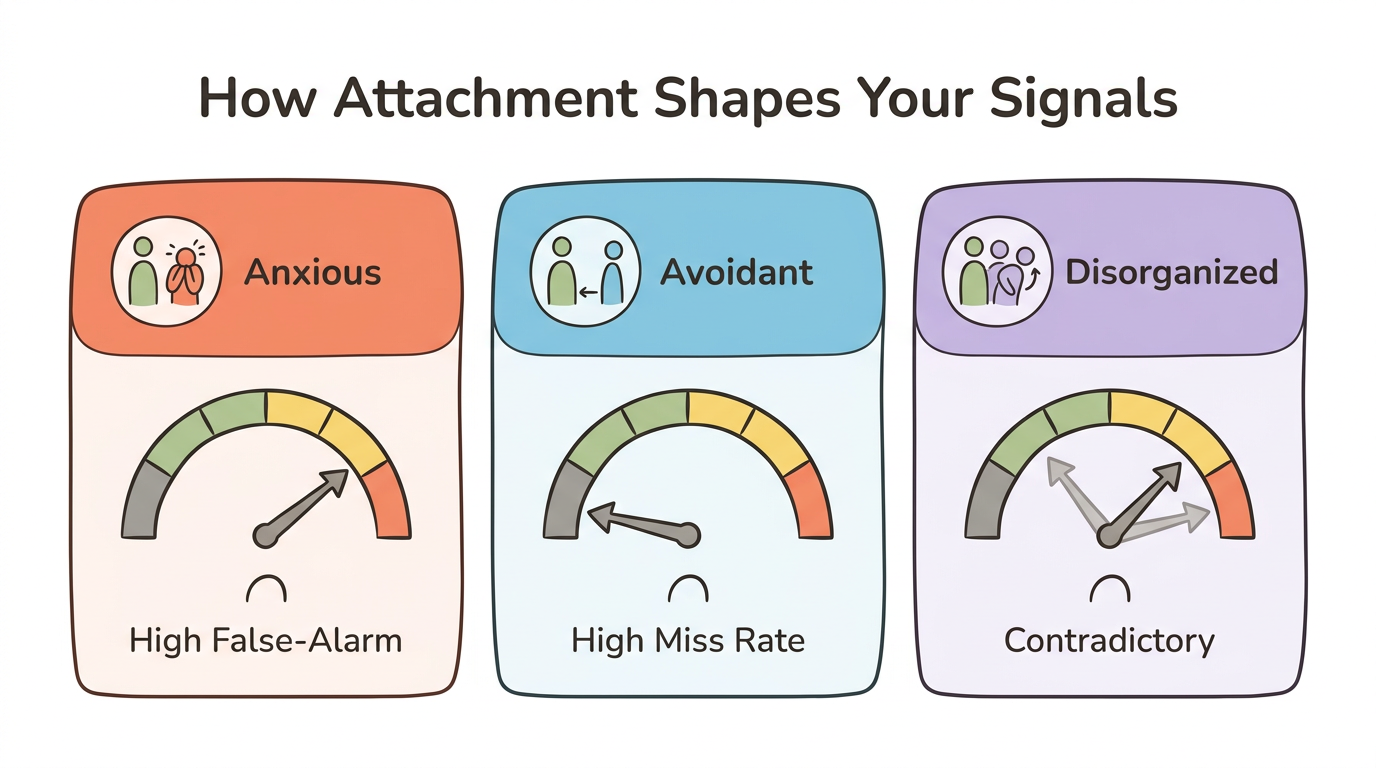
3 Attachment-Specific Patterns of Confusion:
-
Anxious attachment—high false-alarm rate. Hyperactivating strategies produce "anxious, hypervigilant attention to relationship partners and rapid detection of possible signs of disapproval, waning interest, and pending abandonment" (Mikulincer and Shaver, 2003). Approximately 19 percent of adults have anxious attachment (Hazan and Shaver, 1987), and these individuals consistently detect signs of threat in what others would consider benign events. One-word texts become evidence of fading love. A cancelled dinner plan becomes proof of abandonment. The alarm feels urgent and real every single time.
-
What happens when the system works in reverse? Avoidant attachment doesn't amplify signals—it suppresses them. Rather than a high false-alarm rate, you get a high miss rate. Genuine concerns get dismissed as "overreacting" or "being too needy." You might push away the very awareness that something is genuinely wrong because your system learned that needs are dangerous.
-
Disorganized attachment—contradictory signals. Your nervous system sends "run toward" and "run away" simultaneously. One moment you feel certain something is wrong; the next moment you're convinced you're manufacturing the whole thing. This freeze-then-flip pattern makes the anxiety-versus-intuition question feel nearly impossible to answer.
"Neuroception Check-In" (for all insecure attachment styles)
- Pause before acting on the feeling
- Ask yourself: "Am I in ventral vagal (calm, connected, curious), sympathetic (heart racing, scanning for threats), or dorsal vagal (shut down, numb, foggy)?"
- If you notice sympathetic or dorsal vagal activation, recognize that your threat-detection system is online—signals from this state are less reliable
- Regulate first: try bilateral tapping (alternating taps on your knees), extend your exhale to six counts, or run cold water over your wrists for thirty seconds
- Once your body feels calmer, ask: "Does the concern still feel true now?"
This works across attachment styles because neuroception miscalibration is the shared root. Anxious attachment fires too many alarms. Avoidant attachment mutes them. Disorganized attachment does both. Checking your autonomic state before interpreting a signal addresses all three patterns at the source—the nervous system itself, not the story your mind constructs around it.
What Are the Key Differences Between Anxiety and Intuition?
The most reliable way to distinguish anxiety from intuition is to examine six specific qualities of the feeling: its tempo, its response to reassurance, its specificity, its body location, its time stability, and its familiarity.
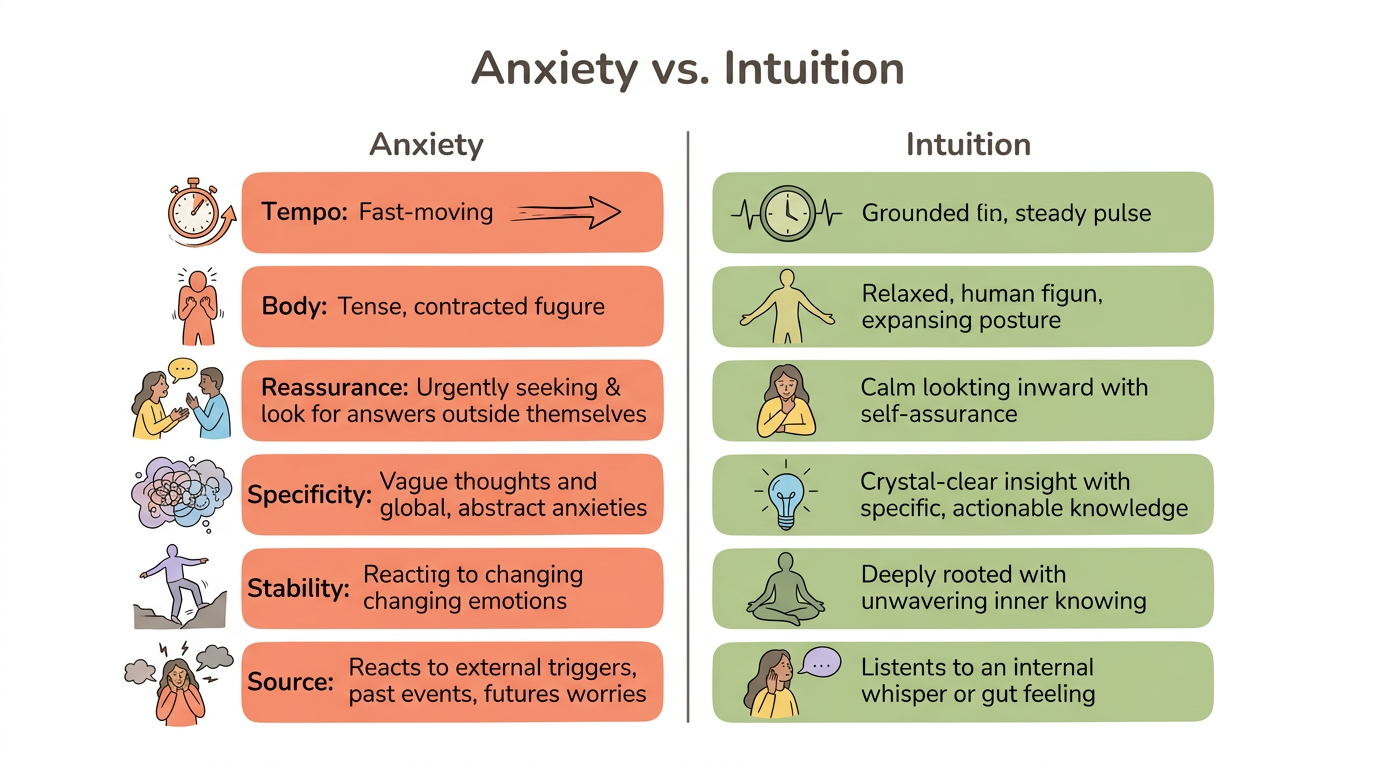
| Feature | Anxiety | Intuition |
|---|---|---|
| Tempo | Urgent, frantic, needs resolution NOW | Steady, patient, not demanding immediate action |
| Body location | Chest, throat, shoulders—tight and buzzing | Gut and belly—heavier, quieter, grounded |
| Response to reassurance | Temporarily calms, then returns | Persists even after comfort or reassurance |
| Specificity | Vague dread ("something is wrong") | Points to specific observations or patterns |
| Time stability | Fluctuates—spikes and drops within hours | Remains consistent over days or weeks |
| Familiarity | Often echoes old wounds ("this feels like what happened with my parent") | Responds to present-moment data |
| Nervous system state | Sympathetic activation (fight or flight) | Ventral vagal (calm, connected) |
| After acting on it | Relief is short-lived; a new worry emerges | Sense of alignment, even if the action was hard |
Your nervous system learned to protect you through speed, not accuracy. That's worth honoring—it kept you alive. And now you can teach it to slow down enough to read its own signals.
Levine and Heller describe how anxiously attached individuals "tend to jump to conclusions very quickly, and when they do, they tend to misinterpret people's emotional state." Protest behaviors—the excessive texting, the monitoring, the hovering—feel like intuitive urgency. "Something is wrong. I must act NOW." But this is the activated attachment system speaking, not intuition. If you've experienced this pattern, Why Do I Panic When My Partner Doesn't Text Back? explores it in depth.
Notice the tempo difference especially. Anxiety demands immediate resolution. Intuition can wait. Anxiety screams. Intuition speaks at a conversational volume and doesn't raise its voice when you don't immediately respond.
"The 48-Hour Test" (for anxious attachment)
- When you feel a strong "gut feeling" about your relationship, write it down with the date and time
- Do NOT act on it yet—do not seek reassurance, do not send the text, do not initiate the conversation
- After 48 hours, re-read what you wrote
- If the concern dissolved or shifted dramatically, it was likely anxiety. If it remains steady and specific, it is worth examining as potential intuition
- Note what happened in between: Did reassurance make it vanish? Did a new worry replace the old one?
This directly interrupts the hyperactivation cycle that drives protest behaviors in anxious attachment. Your attachment system wants you to act immediately because delay feels dangerous. Building in a 48-hour window teaches your nervous system that you can tolerate uncertainty—and gives you clearer data about whether the signal persists or dissolves.
When Is Anxiety Actually the Right Signal?
Sometimes anxiety is your intuition. Not all anxiety is a false alarm, and oversimplifying the distinction—anxiety equals noise, intuition equals signal—can lead you to dismiss real concerns about your relationship.
Your nervous system might be accurately detecting a partner who IS emotionally unavailable, dismissive, or inconsistent. When you're paired with someone who stonewalls, minimizes your feelings, or cycles between warmth and withdrawal, your anxiety is responding to real behavioral data. The feeling isn't a relic of your childhood—it's a reasonable reaction to a present-moment pattern. If this dynamic sounds familiar, What Is the Anxious-Avoidant Trap? describes the pursuit-withdrawal cycle in detail.
Meta-analytic research confirms that attachment insecurity—both anxiety and avoidance—negatively affects relationship satisfaction across 132 studies with over 71,000 participants (Candel and Turliuc, 2019). Anxious individuals in relationships with avoidant partners aren't imagining the disconnection. The pattern is real, and their anxiety is detecting observable behaviors, not inventing threats.
Here's the key distinction: does the anxiety point to observable behaviors or to imagined scenarios?
Observable behaviors sound like: "They cancel plans regularly." "They change the subject every time I mention the future." "They dismiss my feelings as dramatic."
Imagined scenarios sound like: "They're probably going to leave me." "They must be losing interest." "They probably don't really love me."
One is data. The other is narrative. Both feel equally true in the moment.
"Evidence vs. Interpretation" Journal (for anxious attachment)
- Draw two columns on a page: "What I Observed" and "What I Interpreted"
- Under "Observed," write only factual, behavioral evidence—things a camera would capture. Example: "They looked at their phone while I was talking about my day"
- Under "Interpreted," write the story your mind created. Example: "They don't care about me"
- After a week, review your entries. Ask: is there a pattern across multiple observations, or am I building a narrative from a single data point?
- If multiple observations point to the same pattern over weeks, this may be intuition detecting a real dynamic worth communicating directly
Notice what happens as you fill in the two columns over a week. Most people with anxious attachment find that the "Interpreted" column sounds remarkably similar across entries—the same fear wearing different outfits. When a genuine pattern emerges, it looks different: the "Observed" column starts repeating, not just the interpretation. That distinction is one of the clearest signs your signal detection is picking up something real.
How Can You Rebuild Trust in Your Own Signals?
You rebuild trust in your own signals by learning to regulate your nervous system before interpreting what it tells you, then gradually recalibrating through IFS parts work, cognitive defusion, and interoceptive training. This isn't a single insight—it's a process of recalibrating your nervous system's threat-detection system through repeated experience. You don't rewire attachment in one conversation with yourself. Each time your nervous system registers safety where it once expected threat, the calibration shifts slightly.
Your body learned to read relationships a certain way for good reason. Every false alarm, every suppressed feeling, every contradictory signal was an adaptation that once made sense. And now you can teach your system something new.
IFS Parts Work—Is This a Protector or Self?
Imagine you're sitting across from your partner at dinner and a wave of dread washes over you—they seem quieter than usual. Before you spiral into "they're upset with me," pause: who inside you is speaking? In Internal Family Systems therapy, anxiety often comes from a protective Part—an inner firefighter or manager trying to prevent pain. Intuition, by contrast, speaks from Self: the calm, curious, compassionate core that exists beneath all protective layers. When a Part speaks, the voice is panicked, urgent, and demanding immediate action. When Self speaks, the voice is calm, clear, and almost matter-of-fact (IFS Institute).
Cognitive Defusion
What if the problem isn't the thought itself, but how tightly you're gripping it? Cognitive defusion from Acceptance and Commitment Therapy helps you observe thoughts without fusing with them. Instead of "My partner is pulling away," you practice saying "I'm having the thought that my partner is pulling away." This small linguistic shift creates enough space to evaluate the thought rather than react to it as literal truth.
Interoceptive Training
Where IFS and cognitive defusion work with the mind's relationship to thoughts, interoceptive training works directly with the body. Emerging research suggests that interoceptive training may influence how the brain processes body signals (Eggart et al., 2024). Over time, practices like body scans and mindful breathing help you read your body signals with greater accuracy—shrinking the gap between what you feel and what those feelings actually mean.
Earned Secure Attachment
As you develop earned secure attachment, your neuroception gradually recalibrates. Why Do I Feel Anxious When My Relationship Is Going Well? explores how safety itself can feel threatening when your system is wired for vigilance. With consistent corrective experiences—in therapy, in safe relationships, in your own practice—your gut feelings become more reliable.
For couples working on this together, Emotionally Focused Therapy shows an effect size of 1.3 for relationship satisfaction—the largest of any couples intervention (ICEEFT). EFT works especially well for individuals with higher initial attachment anxiety because it directly targets the attachment system driving the confusion.
"Part or Self?" Check (for all insecure attachment styles—IFS-informed)
- When you feel a strong signal about your relationship, pause
- Notice the voice quality: Is it panicked, urgent, demanding immediate action? Or is it calm, clear, almost matter-of-fact?
- Notice the body quality: Contracted and tight (likely a protective Part) or open and grounded (likely Self)?
- If it is a Part: thank it for trying to protect you, then ask, "What are you afraid will happen?"
- From this place of curiosity, re-evaluate the original concern
Each insecure attachment style produces protective Parts with different strategies. Anxious attachment generates hyperactivated Parts that scan for abandonment. Avoidant attachment generates Parts that suppress needs. Disorganized attachment generates contradictory Parts that fight each other. Learning to hear the Part without becoming the Part is how you access more reliable information about your relationship.
When Should You Seek Professional Support?
You should seek professional support when your ability to distinguish anxiety from intuition consistently overwhelms your capacity to manage it on your own—and when self-help tools are no longer enough to find stable ground.
Specific signs that professional help would be valuable:
Your nervous system is "always on." Anxiety is so pervasive that you cannot access any calm, regulated state from which to evaluate your signals. Self-soothing techniques aren't reaching the activation level your body holds. Research shows anxiously attached individuals have higher baseline cortisol than securely attached individuals, meaning the body is primed for threat before anything happens (Powers et al., 2006). When this baseline is chronically elevated, professional support can help regulate what self-practice alone cannot.
You recognize patterns of relationship OCD. ROCD involves intrusive, unwanted doubts about your partner or relationship that feel distressing because they conflict with your values. The key difference from attachment anxiety: ROCD thoughts are ego-dystonic—they feel foreign, intrusive, and disturbing. Attachment anxiety thoughts are ego-syntonic—they feel like "me" and are rooted in relational history. If your doubts feel compulsive and drive you to seek reassurance that never satisfies, an OCD specialist can help.
You suspect your partner's behavior IS harmful, but you keep second-guessing yourself. When someone systematically undermines your perception of reality—dismissing your concerns, rewriting events, telling you that you're "too sensitive"—your confusion between anxiety and intuition may reflect gaslighting, not a calibration problem.
Effective therapeutic approaches include EFT for couples (effect size of 1.3), IFS for parts work and self-leadership, EMDR for attachment trauma, and exposure and response prevention therapy for ROCD.
Frequently Asked Questions
How do I know if it's anxiety or a gut feeling in my relationship?
Anxiety tends to be urgent, vague, and fluctuating—it spikes with triggers and temporarily calms with reassurance. Intuition is steadier, more specific, and persists even when you feel comforted. Checking your nervous system state first helps you read the signal more accurately.
Can anxiety disguise itself as intuition?
Yes. Anxiety and intuition activate the same brain region—the anterior insula—which is why they produce similar physical sensations. Anxiously attached individuals are especially prone to this because their threat-detection system (neuroception) is miscalibrated toward danger, creating convincing false alarms.
Is my gut feeling about my partner right?
It depends on your nervous system state when the feeling arises. Gut feelings from a calm, regulated state (ventral vagal) tend to be more reliable. Gut feelings that arise during fight-or-flight activation are more likely colored by past attachment wounds rather than present reality.
Why do I always feel something is wrong in my relationship?
Chronic unease often reflects an activated attachment system rather than an actual problem. Anxiously attached individuals have higher baseline cortisol, meaning their body is primed for threat before anything happens. This creates a persistent background sense that something is off, even in safe relationships.
Can anxious attachment make you distrust your partner?
Anxious attachment creates hypervigilant attention to signs of disapproval or abandonment, leading you to interpret neutral behaviors as threatening. Research shows anxiously attached people "tend to jump to conclusions very quickly" and misinterpret partners' emotional states (Levine and Heller), which can erode trust even when a partner is reliable.
Is relationship anxiety a sign you should break up?
Not necessarily. Relationship anxiety often reflects your attachment history more than your current relationship's health. However, if anxiety points to specific, repeated, observable behaviors from your partner—not just vague dread—it may be worth examining whether the relationship meets your needs.
What does relationship OCD feel like?
Relationship OCD (ROCD) involves intrusive, unwanted doubts about your partner or relationship that feel distressing precisely because they conflict with your values. Unlike attachment anxiety, ROCD thoughts are ego-dystonic—they feel foreign and disturbing. If your doubts feel compulsive and cause you to seek excessive reassurance, consider consulting an OCD specialist.
How can you trust your gut when you have anxiety?
Start by learning to regulate your nervous system before interpreting body signals. Practice the 48-hour test—write down the concern, wait without acting, then reassess. Over time, interoceptive training and somatic practices can help you distinguish anxiety-driven sensations from genuine intuitive signals.
Want to Go Deeper?
Meadow includes a structured assessment to help you understand your specific attachment patterns, followed by a 66-day program of daily practices designed to build earned security.
Start your free week →References
Attachment Theory and Hyperactivation
-
Mikulincer, M., & Shaver, P. R. (2003). Attachment theory and affect regulation: The dynamics, development, and cognitive consequences of attachment-related strategies. Motivation and Emotion, 27(2), 77–102.
-
Mikulincer, M., & Shaver, P. R. (2003). The attachment behavioral system in adulthood: Activation, psychodynamics, and interpersonal processes. Advances in Experimental Social Psychology, 35, 53–152.
-
Levine, A., & Heller, R. (2010). Attached: The new science of adult attachment and how it can help you find—and keep—love. TarcherPerigee.
-
Hazan, C., & Shaver, P. (1987). Romantic love conceptualized as an attachment process. Journal of Personality and Social Psychology, 52(3), 511–524.
Neuroscience
-
DeWall, C. N., Masten, C. L., Powell, C., Combs, D., Schurtz, D. R., & Eisenberger, N. I. (2012). Do neural responses to rejection depend on attachment style? An fMRI study. Social Cognitive and Affective Neuroscience, 7(2), 184–192.
-
Schulz, A., Köster, S., Beutel, M. E., & Schächinger, H. (2015). The role of the anterior insula in cardiac interoception: An fMRI study. NeuroImage: Clinical, 9, 159–167.
-
Powers, S. I., Pietromonaco, P. R., Gunlicks, M., & Sayer, A. (2006). Dating couples' attachment styles and patterns of cortisol reactivity and recovery in response to a relationship conflict. Journal of Personality and Social Psychology, 90(4), 613–628.
-
Abend, R., Gold, A. L., Britton, J. C., Michalska, K. J., Shechner, T., Sachs, J. F., ... & Pine, D. S. (2020). Anxiety and the neurobiology of temporally uncertain threat anticipation. Journal of Neuroscience, 40(41), 7949–7964.
Polyvagal Theory and Neuroception
- Porges, S. W. (2022). Polyvagal theory: A science of safety. Frontiers in Integrative Neuroscience, 16, 871227.
Interoception and Body-Based Processing
-
Paulus, M. P., & Stein, M. B. (2010). Interoception in anxiety and depression. Brain Structure and Function, 214(5-6), 451–463.
-
Montirosso, R., & McGlone, F. (2020). The body comes first: Embodied reparation and the co-creation of infant bodily-self. Neuroscience and Biobehavioral Reviews, 113, 77–87.
-
Eggart, M., Queri, S., & Müller-Oerlinghausen, B. (2024). Interoceptive training impacts insula cortex and affects depressive symptoms. Translational Psychiatry, 14, 193.
Meta-Analyses
-
Candel, O. S., & Turliuc, M. N. (2019). Insecure attachment and relationship satisfaction: A meta-analysis of actor and partner associations. Personality and Individual Differences, 147, 190–199.
-
Li, T., & Chan, D. K. S. (2012). How anxious and avoidant attachment affect romantic relationship quality differently: A meta-analytic review. European Journal of Social Psychology, 42(4), 406–419.
-
Zhang, X., Li, J., Xie, F., Chen, X., Xu, W., & Hudson, N. W. (2022). The relationship between adult attachment and mental health: A meta-analysis. Journal of Personality and Social Psychology, 123(5), 1089–1137.
Therapeutic Modalities
-
Johnson, S. M. (2019). Attachment theory in practice: Emotionally focused therapy (EFT) with individuals, couples, and families. Guilford Press. See also: ICEEFT EFT Research Summary.
-
Schwartz, R. C. (2021). No bad parts: Healing trauma and restoring wholeness with the Internal Family Systems model. Sounds True.
-
Hölzel, B. K., Lazar, S. W., Gard, T., Schuman-Olivier, Z., Vago, D. R., & Ott, U. (2011). How does mindfulness meditation work? Proposing mechanisms of action from a conceptual and neural perspective. Perspectives on Psychological Science, 6(6), 537–559.
This article is for educational purposes only and is not a substitute for professional mental health advice. If you are experiencing persistent relationship distress, intrusive thoughts, or difficulty distinguishing your feelings, please consult a licensed therapist who specializes in attachment or anxiety-related concerns.