The anxious-avoidant couple faces a therapeutically unique challenge—one partner pursues closeness while the other withdraws, and standard communication tips often backfire because they never reach the attachment system driving the conflict. Research shows that approximately 75 percent of couples worldwide get caught in this pursue-withdraw cycle (Christensen and Heavey, 1990).
If you recognize this pattern in your relationship, the specific type of therapy you choose matters enormously. Not all couples therapy is built for attachment dynamics. This article compares the leading modalities head-to-head—with actual research data, not vague recommendations—so you can make an informed choice about what kind of help to seek.
Key takeaway: Emotionally Focused Therapy is the most researched therapy for anxious-avoidant couples, with 70 to 73 percent of distressed couples recovering. Integrative Behavioral Couple Therapy and Cognitive-Behavioral Couple Therapy show comparable outcomes. The right modality depends on both partners' needs, and combining couples work with individual attachment-focused therapy produces the strongest results.
Why Do Anxious-Avoidant Couples Need a Specific Type of Therapy?
Generic couples counseling often fails anxious-avoidant pairs because it targets surface behaviors—communication style, conflict habits—without addressing the attachment layer underneath. The pursue-withdraw cycle is self-reinforcing at a nervous system level, and skill-building alone cannot interrupt it.
If you have lived this loop, you know how exhausting it is—and how confusing it feels when nothing you try seems to help. Here is what is actually happening beneath the surface. The anxious partner feels disconnected and reaches for reassurance. Their bids come out with intensity—questions, emotional escalation, sometimes criticism. The avoidant partner's nervous system reads this intensity as threat and shuts down. That withdrawal confirms the anxious partner's deepest fear: I'm being abandoned. So they pursue harder. The avoidant partner retreats further.
The cycle is the enemy—not either partner. Approximately 20 percent of adults have anxious attachment and 20 to 25 percent have avoidant attachment (Hazan and Shaver, 1987), making this one of the most common couple pairings. And roughly 75 percent of couples worldwide fall into the pursue-withdraw pattern (Christensen and Heavey, 1990). If you are caught in this dynamic, you are not unusual. You are dealing with one of the most well-documented relationship patterns in attachment research.
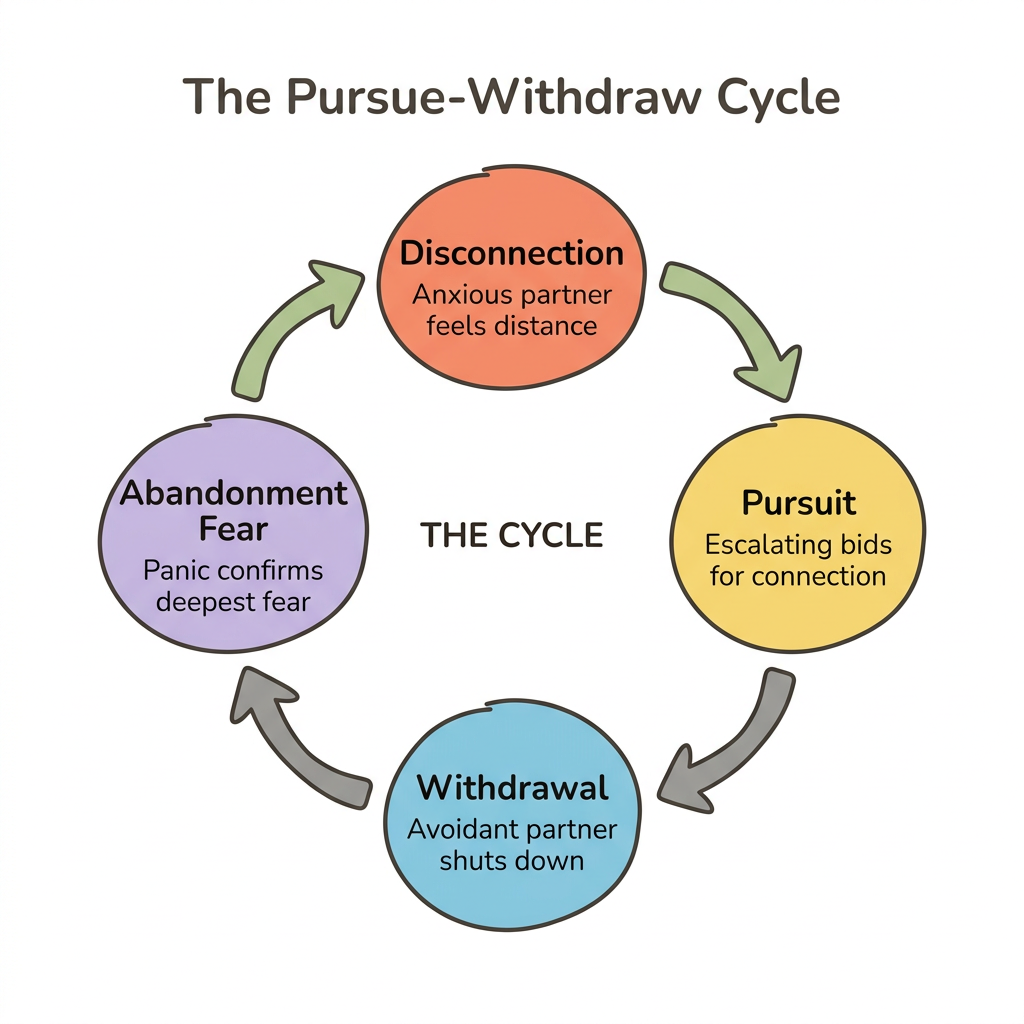
Standard advice like "use I-statements" or "take a timeout" does not reach the pursue-withdraw cycle at its root. What these couples need is a therapy modality designed to work with attachment emotions—the fear of abandonment beneath the pursuing, the fear of inadequacy beneath the withdrawal.
"Name the Cycle" Mapping Exercise (for both attachment styles)
- Choose a recent conflict you both remember
- The pursuing partner writes down what they felt underneath the pursuing—usually fear of being left, not being enough, or losing the connection
- The withdrawing partner writes down what they felt underneath the withdrawal—usually fear of failing, being overwhelmed, or not measuring up
- Share only the underneath layer with each other, not the surface behavior
- Together, give the cycle a name (couples have called it "the tornado," "the wall and the wave," "our old dance")
This works for both anxious and avoidant attachment because it externalizes the pattern as a shared enemy rather than locating blame in either partner—the foundational move in Emotionally Focused Therapy.
What Is Emotionally Focused Therapy and Why Is It the Gold Standard?
Emotionally Focused Therapy, developed by Sue Johnson, is the most empirically validated couples therapy for attachment-based dynamics. It treats relationship distress as fundamentally an attachment crisis, not a communication problem—and the research supports this framing with unusually strong evidence.
Johnson et al. (1999) conducted a meta-analysis of four rigorous outcome studies and found an effect size of d = 1.3—larger than any other couples intervention at the time. That same analysis showed a 70 to 73 percent recovery rate from distress, with 86 percent of couples showing clinically significant improvement. A more recent comprehensive meta-analysis by Spengler et al. (2024), covering 33 randomized controlled trials with 2,730 participants, confirmed medium effect sizes at post-treatment (g = 0.73) and at six-month follow-up (g = 0.66).
What makes these numbers especially relevant to anxious-avoidant couples: Burgess Moser et al. (2016) found that preoccupied (anxiously attached) partners made the most gains in marital satisfaction through EFT. And Wiebe et al. (2017) found that decreases in avoidance were the strongest predictor of higher relationship satisfaction at follow-up. EFT appears to work precisely where this pairing needs it most.
For a deeper look at how these couples reach earned security, see Can an Anxious-Avoidant Relationship Become Secure?.
EFT follows a three-stage, nine-step model:
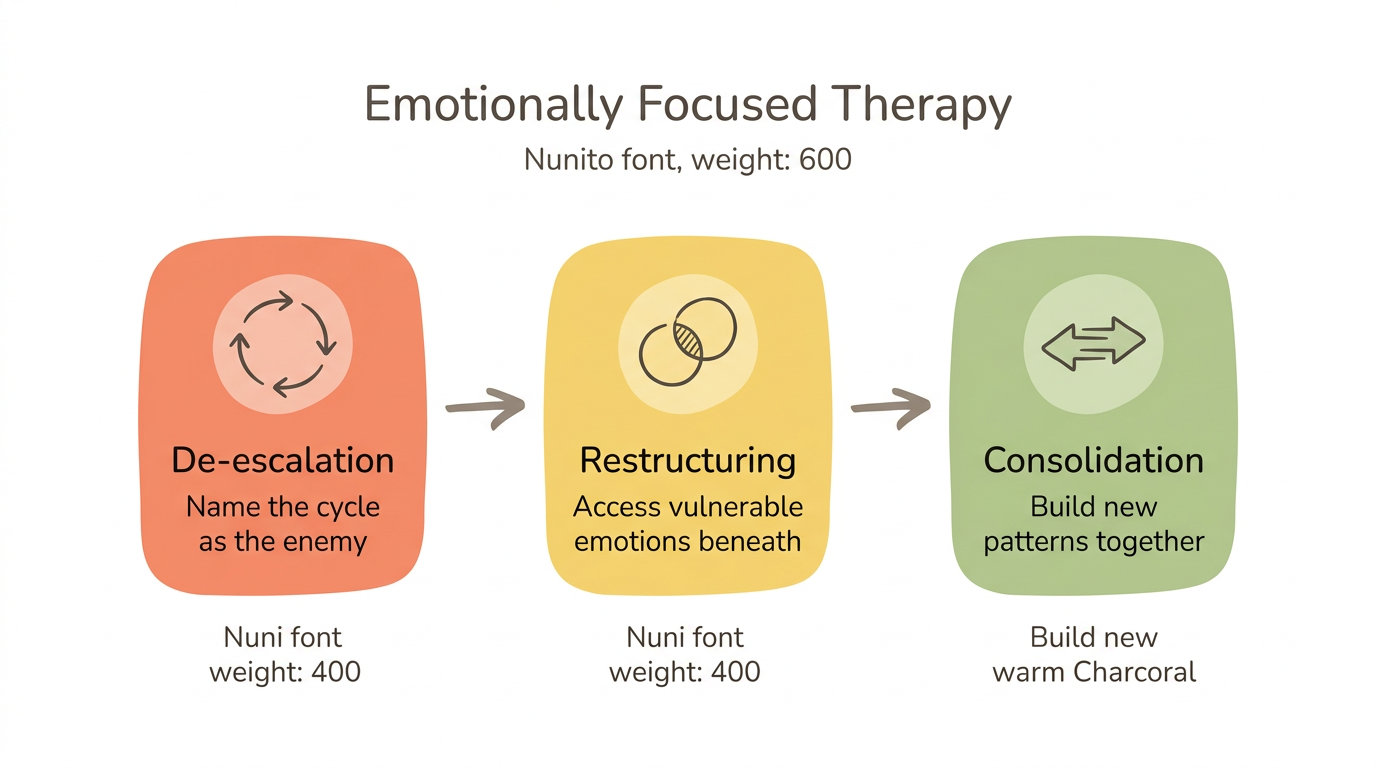
- Stage 1: De-escalation — The therapist helps both partners identify the pursue-withdraw cycle and see it as "the enemy" rather than each other. You learn to recognize when the cycle is running and what triggers it.
- Stage 2: Restructuring — Each partner accesses the vulnerable attachment emotions beneath their protective behaviors—fear of abandonment for the anxious partner, fear of engulfment or inadequacy for the avoidant partner. This stage includes bonding events where partners share their deepest needs.
- Stage 3: Consolidation — New interaction patterns get integrated into daily life. Couples practice responding to each other from the vulnerable layer rather than the protective one.
"Hold Me Tight" Conversation Starter (for both attachment styles)
- Partner A shares one attachment fear using this stem: "When [trigger], I feel [emotion], and what I really need is [need]"
- Partner B reflects back what they heard without defending or problem-solving
- Swap roles
- Together, identify one small action each partner can take this week to address the stated need
This gives the anxious partner a structured way to express needs without escalating, and gives the avoidant partner a contained, predictable format that reduces overwhelm. For more on communicating needs across attachment styles, see How to Communicate Your Needs Without Triggering Your Partner.
How Does EFT Compare to Other Couples Therapy Approaches?
EFT, IBCT, and CBCT all show comparable recovery rates for anxious-avoidant couples, with no single approach clearly outperforming the others across all measures. The differences lie in how each modality reaches those outcomes, and the best choice depends on what both partners need most.
Integrative Behavioral Couple Therapy (IBCT) uses an acceptance-based approach supported by three clinical trials with five-year follow-up data (Christensen et al., 2004, 2006, 2010). Its rate of change—0.37 points per weekly session—is comparable to EFT's 0.39 points. IBCT's acceptance-based approach may particularly help avoidant partners because it promotes understanding of differences in intimacy needs rather than demanding emotional change.
Cognitive-Behavioral Couple Therapy (CBCT) shows no significant difference from EFT in overall efficacy. Baucom et al. (2022) found both approaches achieve effect sizes of d = 0.80 or higher, with 60 to 72 percent reliable improvement. CBCT maintains effects impressively over five years (d = 0.92). It addresses attachment patterns indirectly through cognitive restructuring and behavioral skill-building.
Gottman Method has extensive process research but fewer randomized controlled trials than EFT, IBCT, or CBCT. It excels at communication repair—soft startups, repair attempts, turning toward bids for connection. Many therapists integrate Gottman tools with EFT attachment work.
Internal Family Systems (IFS) is increasingly recommended alongside EFT to help each partner explore their "protector parts"—the pursuer and the withdrawer—and access vulnerable attachment needs underneath. Evidence for couples-specific application is growing but limited.
| Approach | Core Focus | Best For (This Pairing) | Evidence Base | Recovery Rate | Typical Duration | Limitation |
|---|---|---|---|---|---|---|
| EFT | Attachment emotions | Accessing vulnerable emotions underneath the cycle | 33 RCTs, d = 1.3 | 70–73% | 8–20 sessions | May move too fast emotionally for avoidant partners |
| IBCT | Acceptance of differences | Helping avoidant partners feel accepted | 3 trials with 5-year follow-up | Comparable to EFT | 20–26 sessions | Less direct attachment focus |
| CBCT | Cognitive restructuring | Changing negative thought patterns | d = 0.80+, 5-year d = 0.92 | 60–72% | 15–20 sessions | May stay cognitive, miss emotional layer |
| Gottman | Communication skills | Building practical repair skills | Extensive process research, fewer RCTs | Not yet established in RCTs | Varies | Fewer controlled trials |
| IFS | Internal parts work | Exploring protector parts driving patterns | Growing clinical support, limited RCTs | Not yet established | Varies | Limited couples-specific research |
"Therapy Fit" Reflection Checklist (for both attachment styles)
- Each partner rates (1 to 5) how much they value each of these goals:
- Understanding why we get stuck emotionally (points toward EFT)
- Accepting our differences without trying to change each other (points toward IBCT)
- Learning concrete communication skills we can use daily (points toward Gottman or CBCT)
- Exploring the protective parts that drive our patterns (points toward IFS)
- Compare your answers and discuss where they overlap and where they diverge
- Use the comparison to guide your therapist search
This helps couples choose a modality that fits both partners' needs rather than defaulting to one. Anxious partners often gravitate toward emotional depth, while avoidant partners may prefer skill-based structure—finding a balance matters.
What Happens in Your Brain During the Anxious-Avoidant Cycle?
The anxious-avoidant cycle is not just an emotional pattern—it is a neurobiological event. Understanding what happens in each partner's brain explains why willpower and good intentions rarely interrupt it. For a full exploration of attachment and the nervous system, see How Does Attachment Style Affect Your Nervous System?.
The Anxious Partner's Brain Under Threat
When an anxiously attached person perceives relational distance, their amygdala hyperactivates and the HPA axis floods the body with cortisol. Brain imaging shows increased activity in the anterior temporal pole, hippocampus, and dorsal anterior cingulate cortex when processing negative emotions. At the same time, reduced orbitofrontal cortex activity impairs the ability to suppress negative thoughts—meaning the anxious partner cannot simply think their way out of the panic.
The Avoidant Partner's Brain Under Threat
Avoidant attachment shows a different neural signature. During social exclusion, avoidant individuals display decreased activity in the anterior insula and dorsal anterior cingulate—a blunted distress signal that looks like not caring but is actually a learned suppression strategy. Their brains also show decreased activity in the inferior frontal gyrus and ventral tegmental area, meaning they receive less reward signaling from connection itself.
Why This Matters for Therapy
Oxytocin effects depend on attachment style—a finding that surprised researchers. Only low-avoidance individuals showed increased social affiliation after oxytocin administration. High-avoidance individuals actually showed faster threat detection instead. Epigenetic modification of the oxytocin receptor gene has been linked to attachment avoidance (Ein-Dor et al., 2018). Your biology is not destiny, but it does shape the starting line.
Through a polyvagal lens (Porges), the anxious partner operates from sympathetic hyperactivation—fight-or-flight—where the other partner's withdrawal triggers survival-level panic. The avoidant partner operates from dorsal vagal shutdown—freeze or collapse—where the other partner's pursuit feels like a threat requiring escape. Both partners have a narrowed window of tolerance. The therapy goal is to help both access the ventral vagal state—the zone of social engagement and felt safety—through co-regulation.
Perhaps the most compelling neuroscience finding: Johnson et al. (2013) conducted an fMRI study showing that after EFT, partner hand-holding reduced neural threat responding in the brain. Therapy literally changed how partner contact mediated the brain's threat response. Your nervous system can learn new responses to the same person.
"Partner Co-Regulation" Body Scan (somatic exercise for both attachment styles)
- Sit facing each other, feet flat on the floor
- Each partner places one hand on their own chest to notice their heart rate
- Begin synchronized breathing—4 counts in through the nose, 6 counts out through the mouth—for 2 minutes
- If comfortable, one partner extends a hand palm-up; the other places their hand on top
- Notice what shifts in the body—warmth, tension release, resistance, numbness. All responses are valid information.
- Afterward, name aloud what you noticed: "I felt my shoulders drop" or "I noticed I wanted to pull away"
The anxious partner practices co-regulation without verbal reassurance-seeking. The avoidant partner practices proximity tolerance with a clear, time-limited structure. Synchronized breathing activates the ventral vagal social engagement system, counteracting both sympathetic hyperactivation and dorsal vagal shutdown.
Should Both Partners Also Do Individual Therapy?
Yes—individual and couples therapy together produce stronger outcomes than either alone. Each partner brings different attachment-related challenges into the room, and individual work builds the capacity to engage more fully in couples sessions.
Your nervous system learned its protective strategies in your earliest relationships. Those strategies are deeply personal, and some of the work of understanding them happens best one-on-one. That said, the couples therapist and individual therapists should ideally communicate so that individual work supports—rather than undermines—the couples process.
For the Anxious Partner
Distress tolerance skills are foundational. Your nervous system escalates quickly when it senses disconnection, and individual therapy can help you build a wider window between trigger and response.
- Can you sit with uncertainty without reaching for your phone to text them? Distress tolerance and DBT skills build that capacity—learning to stay with discomfort rather than immediately seeking reassurance.
- Self-soothing practices — Building internal regulation capacity so your partner is not your only source of calm
- Picture this: your partner does not respond for two hours and your mind leaps to "they are leaving me." Challenging catastrophic abandonment cognitions means examining whether silence genuinely carries the meaning your nervous system assigns it.
For the Avoidant Partner
Your protective pattern—shutting down, pulling away, going numb—made sense once. It kept you safe when showing feelings was met with dismissal, criticism, or simply nothing at all. That learning runs deep. Now, emotional exposure at a pace you can tolerate is the path forward.
- Gradual emotional exposure — Practicing vulnerability in small, titrated doses with a safe therapist
- What happens in your body when someone asks "how are you feeling?" Somatic reconnection uses body-based approaches to identify emotions that have been suppressed below conscious awareness (Can Avoidant Attachment Be Healed? explores this in depth)
- Start simple: "I feel tense" counts. Identifying and naming emotions builds the interoceptive vocabulary that deactivating strategies have muted.
"Emotional Vocabulary Builder" (for avoidant attachment)
- Set a daily 2-minute timer—just 2 minutes
- Complete the sentence "Right now I feel ___" using a feelings wheel or list
- Add where in your body you notice this feeling ("tightness in my jaw," "heaviness in my chest," "nothing—just blank")
- Write it down without judging, analyzing, or fixing it
- After one week, share three entries with your partner or therapist
Avoidant partners often use deactivating strategies that suppress emotional awareness below the threshold of consciousness. This exercise builds the interoceptive capacity needed to engage in couples therapy—you cannot share what you cannot feel. Noticing "blank" or "nothing" is a valid and important starting point.
How Do You Find the Right Therapist for Attachment-Based Couples Work?
The difference between a therapist who can help your specific dynamic and one who inadvertently worsens it often comes down to training and specialization. Not all couples therapists work with attachment, and not all who claim to have completed rigorous training.
EFT Certified versus EFT Trained is the most important distinction to understand. "EFT Trained" means a therapist attended a workshop—sometimes just a few days. "EFT Certified" means they completed the full externship, received ongoing supervision, and demonstrated competency. Search the ICEEFT directory (the International Centre for Excellence in Emotionally Focused Therapy) for certified practitioners.
On Psychology Today, filter for "Emotionally Focused" or "attachment-based" under therapeutic approach. When you schedule a consultation call, ask about pursue-withdraw dynamics specifically—a therapist who does not recognize this term may not have the attachment-specific training this pairing requires.
Red flags include therapists who consistently take sides, focus only on the content of arguments rather than the emotional process underneath, or push emotional vulnerability at a pace that overwhelms one partner.
"Therapist Interview" Question List (for both attachment styles)
- What is your training in attachment theory and EFT or IBCT specifically?
- How do you work with pursue-withdraw dynamics?
- How do you handle it when one partner shuts down in session?
- Do you recommend concurrent individual therapy, and how do you coordinate with individual therapists?
- What does a typical course of treatment look like for an anxious-avoidant couple?
Anxious partners often rush into therapy without vetting, driven by urgency. Avoidant partners need reassurance that the therapist will not force emotional exposure before they are ready. These questions help both partners feel confident in their choice before committing.
When Should You Consider Leaving Instead of Doing More Therapy?
This is the section most relationship advice avoids. Your attachment system is telling you to fight for this relationship—or to run from it. Both impulses can be protective adaptations rather than clear signals about what to do.
Therapy cannot fix every anxious-avoidant dynamic. Certain conditions make repair unlikely:
- One partner refuses to examine their own patterns. Therapy requires both people to look inward, not just point outward. Willingness to examine their own patterns—not just agreeing to attend sessions—is the minimum threshold.
- Imagine sitting across from your partner in session and realizing they speak about you with disgust. Active contempt, which Gottman's research identifies as the strongest divorce predictor, erodes the emotional foundation that repair depends on.
- The relationship involves abuse. Couples therapy is contraindicated when one partner is unsafe. Abuse is not an attachment issue to be worked through—it is a safety issue requiring individual support and possibly separation.
- Has the cycle started producing symptoms beyond relational distress? When anxiety disorders, depression, or physical symptoms are directly linked to the relationship dynamic, your body is sending information worth listening to.
Before concluding that therapy has failed, consider whether you have done at least 15 to 20 sessions of EFT with a certified therapist. Many couples try two or three sessions of generic counseling and conclude "therapy doesn't work for us." That is not a fair test.
Leaving can be earned security. Choosing yourself—choosing safety, peace, and a life where your nervous system is not constantly in survival mode—is sometimes the most attachment-informed decision you can make.
"Honest Assessment" Reflection (for both attachment styles)
- Has your partner shown genuine willingness to examine their own patterns—not just yours?
- Are both of you willing to be uncomfortable in therapy, not just attend?
- Is the cycle causing harm beyond relational distress—anxiety disorders, depression, physical symptoms?
- Have you completed at least 15 to 20 sessions of EFT with a certified therapist before concluding therapy does not work?
Anxious partners may stay too long, hoping that enough love and effort will eventually break through. Avoidant partners may leave too soon, before therapy has had time to take effect. This framework grounds the decision in observable evidence rather than attachment-driven impulse.
When Should You Seek Professional Help?
If you are reading this article, you are likely already sensing that your relationship dynamic needs more than willpower and good intentions. That instinct is worth trusting. You do not have to wait until things are unbearable.
Couples therapy—specifically attachment-informed therapy—was designed for exactly these dynamics. Consider seeking help if you recognize any of these signs:
- Recurring arguments that follow the same pattern with no resolution
- Emotional or physical withdrawal lasting days after conflict
- Do you feel lonelier inside the relationship than outside it?
- Anxiety or depression that worsens in the context of the relationship
- You have started seriously considering separation but feel frozen, unable to move in either direction
EFT was built for the anxious-avoidant cycle. You are not too broken for therapy—you are exactly who it was designed to help. Can Therapy Change Your Attachment Style? explores how the therapeutic relationship itself becomes a vehicle for earned security.
If you or your partner are in crisis, contact the 988 Suicide and Crisis Lifeline (call or text 988) or the Crisis Text Line (text HOME to 741741).
Frequently Asked Questions
Can an anxious-avoidant relationship work?
Yes. Research shows 70 to 73 percent of distressed couples recover through Emotionally Focused Therapy (Johnson et al., 1999). The anxious-avoidant pairing is challenging but treatable when both partners commit to understanding their cycle and accessing the vulnerable emotions beneath their surface behaviors.
Is EFT or Gottman better for anxious-avoidant couples?
EFT has stronger RCT evidence with a d = 1.3 effect size and directly targets attachment dynamics. Gottman excels at communication skill-building but has fewer randomized controlled trials directly comparing outcomes. Many therapists integrate both—using EFT for emotional restructuring and Gottman tools for daily interaction repair.
How long does couples therapy take for attachment issues?
EFT typically requires 8 to 20 sessions, though anxious-avoidant dynamics with entrenched patterns may need 20 or more sessions. IBCT trials ran 20 to 26 sessions. Meaningful shifts in the pursue-withdraw cycle often emerge by sessions 8 to 12, but consolidating new patterns takes longer.
Can couples therapy make an anxious-avoidant relationship worse?
Poorly matched therapy can worsen dynamics. A therapist who pushes emotional vulnerability too fast may overwhelm the avoidant partner, triggering more shutdown. Finding an attachment-informed, certified EFT or IBCT therapist matters significantly for this pairing.
What is the pursue-withdraw cycle?
The pursue-withdraw cycle occurs when one partner—typically anxiously attached—escalates bids for connection while the other—typically avoidantly attached—withdraws. Research shows approximately 75 percent of couples worldwide fall into this pattern (Christensen and Heavey, 1990), making it the most common destructive relationship cycle.
Should both partners do individual therapy alongside couples therapy?
Yes. Individual therapy helps each partner build skills specific to their attachment style. Anxious partners benefit from distress tolerance and self-soothing work. Avoidant partners benefit from gradual emotional exposure and somatic awareness. Combined individual and couples therapy produces stronger outcomes.
Can you change your attachment style through couples therapy?
Research confirms attachment styles can shift through therapy. Wiebe et al. (2017) found that decreases in attachment avoidance were the strongest predictor of relationship satisfaction after EFT. Partners can develop earned security through consistent corrective emotional experiences.
How do I find a therapist who specializes in attachment?
Search the ICEEFT directory for EFT-certified therapists—not just "trained." On Psychology Today, filter for "Emotionally Focused" or "attachment-based." In your consultation, ask specifically how they work with pursue-withdraw dynamics and what happens when one partner shuts down in session.
Want to Go Deeper?
Meadow includes a structured assessment to help you understand your specific attachment patterns, followed by a 66-day program of daily practices designed to build earned security.
Start your free week →References
Meta-Analyses and RCTs
-
Johnson, S. M., Hunsley, J., Greenberg, L., and Schindler, D. (1999). Emotionally focused couples therapy: Status and challenges. Journal of Clinical Psychology: Science and Practice, 6(1), 67–79. Meta-analysis of 4 outcome studies: d = 1.3 effect size, 70–73% recovery rate, 86% clinically significant improvement.
-
Spengler, P. M., et al. (2024). Comprehensive meta-analysis of emotionally focused couple therapy. Journal of Counseling Psychology. 33 RCTs (n = 2,730): g = 0.73 at post-test, g = 0.66 at 6-month follow-up.
-
Baucom, D. H., et al. (2022). Comparison of cognitive-behavioral and emotionally focused couple therapies. PMC. No significant differences: both d ≈ 0.80+, 60–72% reliable improvement. CBCT 5-year effect size d = 0.92.
-
Christensen, A., et al. (2004, 2006, 2010). Integrative Behavioral Couple Therapy clinical trials with 5-year follow-up data. Rate of change 0.37 points per weekly session.
-
Wiebe, S. A., et al. (2017). Predicting follow-up outcomes in emotionally focused couple therapy. Journal of Marital and Family Therapy. Decreases in attachment avoidance were the strongest predictor of relationship satisfaction.
-
Burgess Moser, M., et al. (2016). Changes in attachment-related behaviors in emotionally focused couple therapy. Preoccupied/anxious men made the most gains in marital satisfaction.
Neuroscience
-
Johnson, S. M., et al. (2013). Soothing the threatened brain: Leveraging contact comfort with emotionally focused therapy. PLOS ONE. fMRI study: partner hand-holding reduced neural threat responding after EFT.
-
Vrtička, P., and Vuilleumier, P. (2012). Neuroscience of human social interactions and adult attachment style. Frontiers in Human Neuroscience. Anxious attachment: amygdala hyperactivation, elevated cortisol, reduced orbitofrontal cortex regulation.
-
Zhang, X., et al. (2021). Neural basis of attachment styles. BMC Neuroscience. Avoidant attachment: decreased anterior insula/dACC during social exclusion, reduced IFG and VTA reward signaling.
-
Ein-Dor, T., et al. (2018). Epigenetic modification of the oxytocin receptor gene and attachment avoidance. Attachment and Human Development. OXTR methylation linked to attachment avoidance.
Foundational Works
-
Hazan, C., and Shaver, P. (1987). Romantic love conceptualized as an attachment process. Journal of Personality and Social Psychology, 52(3), 511–524. Attachment style distribution: approximately 60% secure, 20% anxious, 20–25% avoidant.
-
Christensen, A., and Heavey, C. L. (1990). Gender and social structure in the demand/withdraw pattern of marital conflict. Journal of Personality and Social Psychology, 59(1), 73–81. Approximately 75% of couples worldwide fall into the pursue-withdraw pattern.
-
Porges, S. W. Polyvagal theory: The science of safety. Polyvagal Institute. Framework for understanding sympathetic hyperactivation (anxious) and dorsal vagal shutdown (avoidant) in couples.
Clinical and Applied Sources
-
International Centre for Excellence in Emotionally Focused Therapy (ICEEFT). EFT research overview.
-
Gottman Institute. Integrating Gottman Method with emotionally focused approaches.
This article is for educational purposes only and does not constitute therapy, medical advice, or a substitute for professional mental health care. If you are in distress, please reach out to a licensed mental health professional or contact a crisis helpline.