The fawn response is a trauma survival pattern in which a person automatically suppresses their own needs, opinions, and boundaries to become whatever someone else wants—not out of generosity, but out of fear. According to a YouGov survey, 49 percent of Americans self-identify as people-pleasers, but for some, this goes beyond personality. It is a nervous system survival strategy wired in childhood.
If you have ever agreed to something you resented, said "I'm fine" while your stomach churned, or could not identify what you actually wanted because you were so focused on what the other person needed—you may recognize this pattern. Your body learned to prioritize someone else's emotional state over your own because, at some point, that was the safest option available. This article explains where the fawn response comes from, how it differs from healthy empathy, and what attachment science reveals about healing it.
Key takeaway: The fawn response is a trauma survival pattern where you automatically abandon your own needs to appease others and avoid conflict. Coined by Pete Walker as the fourth F alongside fight, flight, and freeze, fawning develops when caregivers are both the source of comfort and threat, making appeasement the safest strategy. Unlike healthy kindness, fawning is driven by fear rather than choice.
Where Did the Term "Fawn Response" Come From?
Psychotherapist Pete Walker coined "fawn" as the fourth F in his trauma response typology—fight, flight, freeze, fawn—in his book Complex PTSD: From Surviving to Thriving (Walker, 2013). He defines fawning as "becoming more appealing to the threat": mirroring or merging with another person's desires to diffuse conflict and find safety.
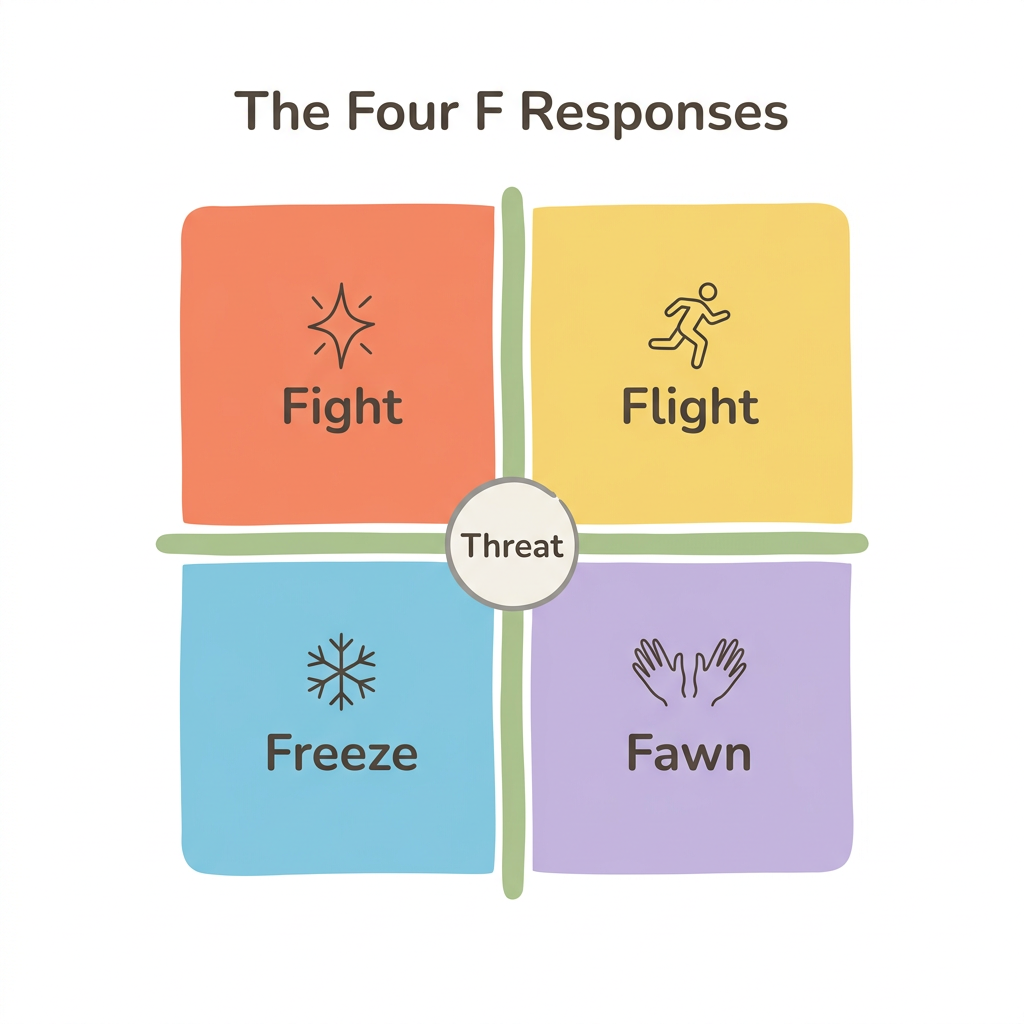
Walker's insight was that fawning is not a personality flaw. It is a survival adaptation that develops in children who learn that the only way to reduce danger is to become whatever the threatening person wants them to be. He positions fawning as the developmental root of codependency—which he defines as "the inability to express rights, needs and boundaries in relationship; a disorder of assertiveness that causes the individual to attract and accept exploitation, abuse and/or neglect" (Walker, 2013).
The term "fawn response" does not appear in formal peer-reviewed diagnostic literature. However, the construct maps onto well-established research on codependency, self-silencing (Jack and Dill, 1992), and appeasement behavior. Even across species, the pattern is recognizable: de Waal (2000) documented how subordinate primates placate dominant aggressors through submission gestures to avoid injury—the evolutionary precursor to human fawning. For a deeper look at whether people-pleasing is always trauma-driven, see Is People-Pleasing a Trauma Response or an Attachment Style Thing?.
The Four F Self-Check (for all attachment styles)
Imagine this scenario: your partner raises their voice unexpectedly during a conversation. Notice your first impulse—not what you think you should do, but what your body wants to do.
- Do you want to argue back or get loud? (fight)
- Do you want to leave the room or change the subject? (flight)
- Do you go blank, numb, or spacey? (freeze)
- Do you immediately try to fix their mood, apologize, or soften your tone? (fawn)
Notice which response feels most automatic—that is your nervous system's default. Awareness does not mean the pattern disappears, but it creates a gap between trigger and reaction where choice can eventually live.
What Does the Fawn Response Look Like in Daily Life?
Fawning goes far beyond being "nice." It is a pattern of shape-shifting—becoming whoever the other person needs you to be, across every area of your life. At work, fawning looks like over-functioning for a critical boss, volunteering for tasks no one asked you to do, and swallowing disagreements before they reach your lips. In friendships, you are always the listener, never the one with needs. In romantic relationships, you mold your preferences, opinions, and even personality to match your partner's.
Walker identified three fawn subtypes that show how this pattern blends with other trauma responses. Fawn-fight is the "smother mother"—someone who aggressively pursues caretaking of others. Fawn-flight is the "super nurse"—a workaholic helper who earns safety through relentless service. Fawn-freeze is the passive victim—someone entrenched in a scapegoat role, often vulnerable to domestic violence (Walker, 2013).
A YouGov survey found that 56 percent of women and 42 percent of men self-identify as people-pleasers. But the fawn response runs deeper than social agreeableness. It involves monitoring others' facial expressions and emotional tone before deciding what to say, what to feel, or who to be.
7 Signs You May Be Fawning
- When asked what you want, your mind goes blank or defaults to "whatever you want"—your own preferences feel inaccessible
- You scan others' facial expressions and tone before deciding what to say
- Apologizing happens reflexively, even when you have done nothing wrong
- Other people's emotions feel like your responsibility to manage
- Saying "no" produces physical anxiety symptoms—tightness in your chest, nausea, racing heart
- Friends and colleagues describe you as "too nice" or "the easy one"
- Resentment builds quietly, but the moment you agreed to something you did not want? You cannot pinpoint it
Preference Excavation (for anxious and disorganized attachment)
- For one day, pause before every small decision—what to eat, what to watch, where to sit
- Ask yourself: "What do I actually want right now?"
- Write down the answer, even if it feels selfish, wrong, or trivial
- Notice any anxiety, guilt, or blankness that arises—do not try to fix it, just name it
- At the end of the day, review your list and notice any patterns
This works for anxious and disorganized attachment because fawning suppresses access to self-referential preferences. Your nervous system learned that having wants was dangerous—this exercise gently rebuilds the neural pathway between "What do I feel?" and "What do I choose?"
What Causes the Fawn Response?
The fawn response develops when a child learns that managing a caregiver's emotions is the safest way to survive. This pattern—called parentification—occurs in environments where children assume the parental role, restricting their own anger and distress to reduce further neglect or abuse (Schorr, 2023).
Main and Hesse (1990) proposed that disorganized attachment arises when the caregiver is the source of comfort and fear simultaneously. The infant faces an impossible paradox: the person they need to run toward for safety is also the person they need to run away from. Fight, flight, and freeze all fail to resolve this conflict. Fawning offers a fourth option—self-erasure to neutralize the threat while maintaining the attachment bond.
This is different from anxious attachment, where hyperactivation pulls the caregiver closer through protest behaviors. In the fawn response, the child does not protest at all. They dissolve. They become whatever shape reduces the danger. Jack and Dill (1992) described this process as "self-silencing"—suppressing your own needs to nurture others, silencing the anger that arises from the sacrifice, and judging yourself entirely through external standards.
What makes fawning so difficult to recognize is that it often looks like maturity, empathy, or selflessness from the outside. The child who manages a volatile parent's moods gets praised for being "so grown up." That praise reinforces the pattern. The message lands in the nervous system: your safety depends on disappearing. Walker describes this as growing up in shame-based family systems where the experience of "fear without solution" (Main and Hesse, 1990) teaches the child that their own needs are not just unimportant—they are dangerous. For more on how this attachment pattern develops, see What Is Disorganized Attachment?.
The Origin Inventory (for disorganized and fearful-avoidant attachment)
- Find a quiet place and set a timer for 10 minutes
- Write your responses to these three questions:
- "Growing up, whose emotions did I feel responsible for managing?"
- "What happened when I expressed anger, disagreement, or a need that inconvenienced someone?"
- "What did I learn was the safest way to be?"
- Notice what you feel in your body as you write—tightness, heat, numbness, or nothing at all
- Close by writing one sentence starting with: "I learned to fawn because..."
This connects present-day fawning to childhood relational templates. For disorganized and fearful-avoidant attachment, the origin of fawning is not a single event—it is an atmosphere. Naming the atmosphere begins to make the pattern visible.
How Is Fawning Different from Healthy Kindness?
Fawning and healthy kindness can look identical from the outside—but they are driven by entirely different nervous system states. The difference lies in whether caregiving is a compulsion or a choice.
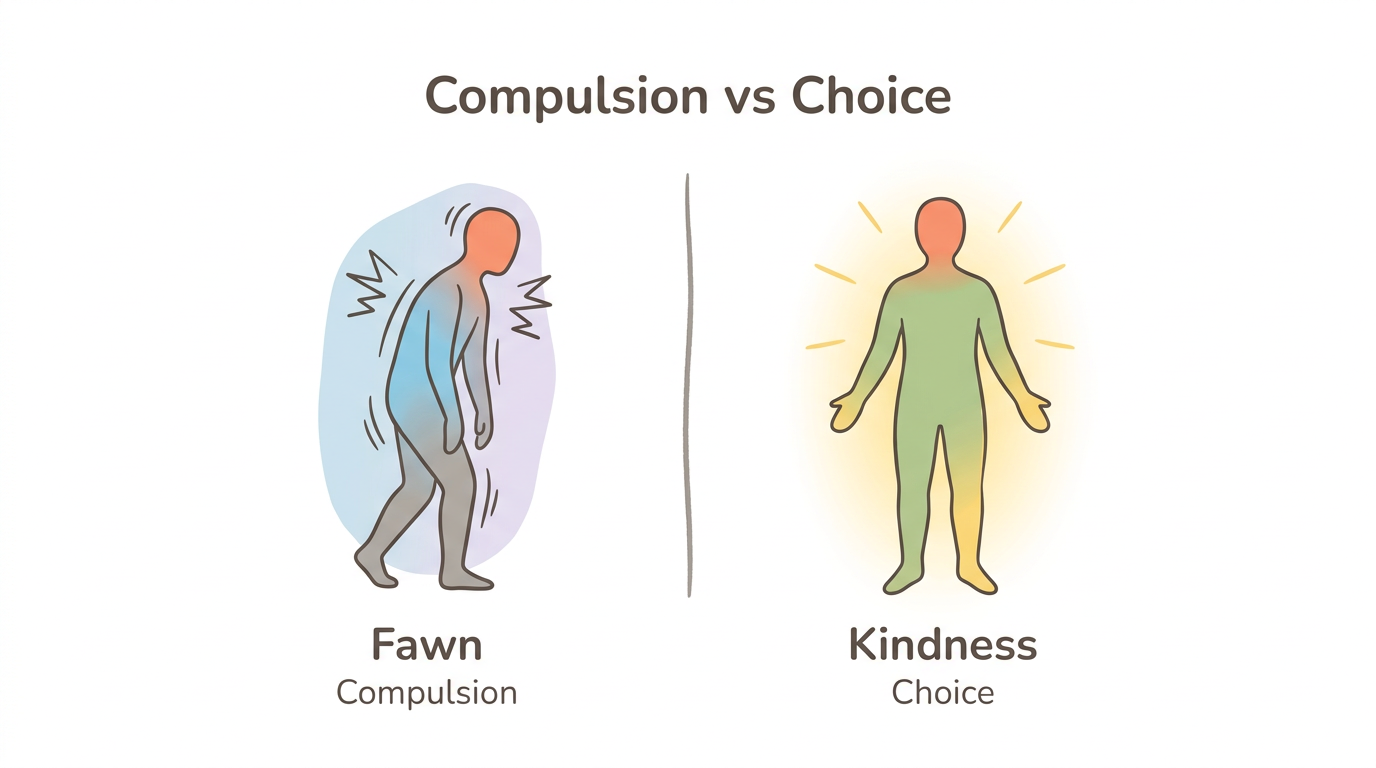
Taylor and colleagues (2000) identified a stress response called tend-and-befriend, mediated by oxytocin, in which people nurture others and build social networks under stress. This is a healthy, adaptive affiliative response. Your sense of self stays intact. You can say no without your body flooding with panic. Affiliation is voluntary, reciprocal, and comes from a place of relative safety.
Fawning hijacks this same affiliative drive. Instead of oxytocin-buffered connection from a ventral vagal state, fawning operates from self-abandonment under threat. You are not choosing to be kind—your nervous system is calculating the safest possible response to perceived danger. Jack and Dill (1992) found that women who suppress their own needs, silence their anger, and judge themselves through external standards are significantly more vulnerable to depression. Research suggests approximately 25 percent of young women seeking primary health care meet criteria for codependence.
The core distinction is one-directional caregiving. Healthy kindness flows in both directions—you give, you receive, your boundaries are honored. Fawning flows one way. You give, they take, and asking for reciprocity feels like a betrayal of the unspoken contract your nervous system wrote in childhood.
| Dimension | Fawn Response | Healthy Kindness | Tend-and-Befriend |
|---|---|---|---|
| Driven by | Fear of conflict, rejection, or harm | Care and choice | Oxytocin-mediated stress response |
| Nervous system state | Hybrid dorsal vagal and sympathetic | Ventral vagal (safe, social) | Ventral vagal with oxytocin buffering |
| Sense of self | Lost—merges with other's needs | Maintained—clear boundaries | Maintained—nurturing from stability |
| Can you say no? | No—feels dangerous | Yes—without guilt | Yes—affiliation is voluntary |
| Reciprocity | One-directional (you give, they take) | Mutual | Mutual (social network building) |
| Feels like | Compulsion, anxiety, self-erasure | Warmth, generosity | Connection, safety |
| Attachment origin | Disorganized or fearful-avoidant | Secure | Secure or adaptive |
| After the interaction | Resentment, exhaustion, emptiness | Fulfillment | Calm, bonded |
What Happens in Your Nervous System When You Fawn?
Fawning is the most cognitively complex trauma response. Unlike fight, flight, or freeze—which are relatively automatic—fawning engages the prefrontal cortex. Your brain has to read social cues, calculate the safest response, and perform empathy under threat, all in real time.
Your amygdala hypervigilance plays a central role. In people who fawn, the amygdala perceives any potential conflict as a survival-level threat, triggering appeasement before conscious awareness catches up. That moment when you sense someone's mood shifting and your body tenses before you even know why—that is your amygdala running the show.
Stephen Porges' polyvagal theory offers the clearest map of what fawning looks like in the nervous system. Fawning operates as a hybrid state—simultaneous dorsal vagal (freeze, shutdown, collapse) and sympathetic (mobilization) activation. Your body is mobilized to appease while simultaneously in a collapsed, submissive state. You are not fighting and you are not running. You are performing compliance while your deeper nervous system has already surrendered. To understand more about how these nervous system states connect to attachment patterns, see How Does Attachment Style Affect Your Nervous System?.
Chronic fawning keeps the HPA axis in sustained cortisol activation. Over time, this alters hippocampal and amygdala structure, impairing emotion regulation and making it progressively harder to distinguish real threats from perceived ones. Taylor (2000) showed that oxytocin promotes affiliation under stress—but in fawning, this affiliative drive is hijacked by threat, creating compulsive rather than voluntary caregiving.
Fawn Body Scan (for disorganized and anxious attachment)
When you notice yourself about to agree to something, pause—even for three seconds. Place one hand on your chest and one on your belly. Then work through these checks:
- Is your jaw clenched? Are your shoulders pulled forward in a protective posture?
- Is there a hollow feeling in your chest or stomach? Is your breathing shallow?
- Name the sensation without changing it: "I notice tightness in my throat" or "I notice my stomach feels hollow"
- Ask yourself: "Am I saying yes because I want to, or because my body is afraid of what happens if I say no?"
This builds interoceptive awareness—the ability to read your body's signals before the fawn response overrides them. For anxious and disorganized attachment, fawning is so automatic that you often do not realize you have abandoned yourself until hours later. This exercise interrupts the appeasement loop by creating a moment of self-referential awareness.
How Does the Fawn Response Connect to Attachment Styles?
Fawning maps onto specific attachment styles, but the nervous system mechanics are different for each. Understanding which attachment pattern drives your fawning changes how you heal it.
Disorganized and Fearful-Avoidant Attachment
Fawning is the primary coping strategy of disorganized attachment. Main and Hesse (1990) described the core dilemma as "fear without solution"—the caregiver is simultaneously needed and feared, and the child cannot resolve the approach-avoid conflict. Appeasement becomes the only available strategy. The body oscillates between wanting closeness and bracing for harm, and fawning attempts to resolve both at once. If you recognize this oscillation, What Is Fearful-Avoidant Attachment? explores this pattern in depth.
Anxious-Preoccupied Attachment
Hyperactivating people-pleasing in anxious attachment looks similar to fawning but runs on a different engine. Anxious attachment drives people-pleasing through fear of abandonment—you are pulling the other person closer. Fawning drives people-pleasing through fear of the other person themselves—you are neutralizing a threat. The behavior may look the same. The nervous system state is not.
Dismissive-Avoidant Attachment
Dismissive-avoidant individuals rarely fawn overtly. However, some use intellectual compliance as a deactivating strategy—agreeing on the surface to end emotional conversations as quickly as possible. This is less self-abandonment and more strategic withdrawal disguised as cooperation.
Secure Attachment
Securely attached individuals can engage in healthy accommodation without self-erasure. They read others' emotions and respond with care, but their own needs remain accessible. The key difference: after accommodating, they do not feel resentment, exhaustion, or emptiness—because the accommodation was chosen, not compelled.
Attachment-Aware Trigger Map (for disorganized and anxious attachment)
- Draw two columns on a piece of paper
- Label the left column: "Situation that triggers my fawning"
- Label the right column: "What I'm afraid will happen if I don't fawn"
- List 5 recent situations where you noticed yourself fawning
- For each one, identify the underlying fear—be as specific as possible
- Notice the pattern: Do your fears center on abandonment AND engulfment or harm (disorganized)? Or do they center on rejection and being too much (anxious)?
Identifying the underlying fear reveals the attachment wound driving the fawn response. For disorganized attachment, fears often pull in both directions—you are afraid of being left AND afraid of being hurt if you stay. For anxious attachment, fears cluster around rejection. This distinction matters because the different nervous system mechanics require different healing approaches.
How Do You Heal the Fawn Response?
Your nervous system learned to fawn for good reason. It kept you safe in an environment where being yourself was dangerous. Honoring that truth is where healing begins—not in forcing yourself to "just set boundaries," but in understanding why boundaries feel like a death sentence to your body.
Healing fawning requires recovering healthy anger—the suppressed fight response that was never safe to express. This is what most advice about fawning misses. "Set boundaries" is the destination, not the directions. You cannot set boundaries until your nervous system believes you are allowed to protect yourself. That belief lives in the body, not the mind.
Walker (2013) outlines a recovery framework that addresses this directly:
- Psychoeducation—naming the fawn response and understanding it as a survival adaptation, not a character flaw
- Remembering and feeling—allowing yourself to revisit the childhood powerlessness that made fawning necessary
- Grief work—mourning the self you could not be, the needs that went unmet, the anger that was never expressed
- Anger recovery—unlocking healthy anger as self-protection, not aggression. Walker describes this as reclaiming the functional fight response
- Assertiveness practice—graduated exposure to expressing disagreement, starting with low-stakes situations and building tolerance for the fear that arises
- Therapeutic modalities—Internal Family Systems (IFS) identifies and honors the "pleaser part" without pathologizing it. EMDR reprocesses the traumatic memories fueling appeasement behavior, supported by meta-analyses of over 20 randomized controlled trials. Somatic Experiencing (Peter Levine) helps the body complete the incomplete fight and flight responses that were never safe to express (Schwartz)
You do not rewire fawning in a single insight. You rewire it by noticing 10 percent earlier, responding 10 percent differently, 10 percent more often. For specific strategies to practice assertiveness in relationships, see How to Stop People-Pleasing in Relationships. For the longer arc of building secure attachment patterns, see How to Develop Secure Attachment as an Adult.
Healthy Anger Letter (for disorganized and fearful-avoidant attachment)
- Choose someone who taught you that your needs were inconvenient, dangerous, or too much
- Write a letter you will never send—let yourself say what could not be said then
- Let yourself feel angry. Not to harm, but to reconnect with the part of you that knew something was wrong
- As you write, notice what happens in your body. Does your chest open? Do your hands feel warmer? Does your jaw unclench?
- That warmth and openness is your fight response coming back online—the self-protective energy that was suppressed
- When you are finished, read the letter aloud to yourself. Then put it somewhere safe or destroy it—your choice
Anger recovery is essential for fawners because fawning develops specifically from the suppression of healthy fight and flight responses, leaving only appeasement available. This exercise does not ask you to become an angry person. It asks you to remember that anger is information—it tells you where your boundaries are. For disorganized and fearful-avoidant attachment, this feeling was dangerous in childhood. Your body needs to learn that it is safe now.
When Should You Seek Professional Help for Fawning?
Self-awareness and somatic exercises are powerful starting points, and many people find real relief through the practices described above. Some patterns, though, run deep enough that they need professional support to shift safely.
Consider seeking trauma-specialized therapy if your fawning is linked to difficulty ending unhealthy relationships—research suggests approximately 80 percent of codependent individuals report this struggle. Dissociative episodes during conflict—going blank, losing time, or feeling like you are watching yourself from outside your body—signal that your nervous system is overwhelmed beyond what self-help can address. Chronic depression that worsens when you try to assert yourself may reflect the self-silencing pattern Jack and Dill (1992) identified, where suppressing needs and anger feeds depressive symptoms.
Parentification trauma—having been the emotional caretaker of a parent in childhood—often requires professional processing because the relational templates it creates are pre-verbal. They live in the body before language, which is why talk therapy alone sometimes is not enough.
Trauma-specialized therapy modalities particularly effective for fawning include IFS (which honors the pleaser part rather than trying to eliminate it), EMDR (which reprocesses the traumatic memories driving appeasement), and Somatic Experiencing (which helps the body complete the defensive responses that were never safe to express). Research suggests approximately 45 percent of codependent individuals report difficulty setting boundaries—a therapist can help you build this capacity at a pace your nervous system can tolerate.
Meadow's app can complement therapy with daily attachment awareness exercises, helping you track patterns between sessions and build the interoceptive awareness that interrupts automatic fawning.
Frequently Asked Questions
What is the fawn response?
The fawn response is a trauma survival pattern where you automatically suppress your own needs and become whatever someone else wants to avoid conflict or rejection. Coined by Pete Walker as the fourth trauma response, it develops when appeasing a threatening caregiver was the safest childhood strategy.
Is fawning a trauma response?
Yes. Fawning is a survival strategy that develops when a child's caregiver is both the source of comfort and threat. The child learns that appeasing the threatening person is safer than fighting, fleeing, or freezing. Fawning is particularly associated with complex trauma and disorganized attachment (Main and Hesse, 1990).
What is the difference between fawning and people-pleasing?
People-pleasing is the visible behavior; fawning is the nervous system survival mechanism driving it. You can people-please from social conditioning or anxious attachment without trauma. Fawning specifically involves a trauma-wired, automatic self-abandonment response where your body perceives conflict as a survival-level threat. See Is People-Pleasing a Trauma Response or an Attachment Style Thing? for a deeper exploration.
What causes the fawn response?
Fawning typically develops in childhood when a caregiver is unpredictable, frightening, or emotionally volatile. The child learns to manage the adult's emotions through appeasement—a pattern called parentification (Schorr, 2023). Fawning is strongly linked to disorganized attachment, where the caregiver is simultaneously needed and feared.
What does fawning look like in adults?
Adult fawning includes reflexive apologizing, inability to identify your own preferences, monitoring others' moods before speaking, chronic over-giving in relationships, difficulty saying no without physical anxiety, and a pattern of attracting or staying in exploitative relationships. From the outside, it often looks like extreme niceness.
How do I stop fawning?
Healing fawning requires more than setting boundaries. It involves reconnecting with healthy anger—the suppressed fight response—building interoceptive awareness so you can read your body's signals before appeasement kicks in, grief work for the self you could not be, and graduated assertiveness practice. Trauma-informed therapy accelerates recovery.
Is fawning the same as codependency?
Pete Walker describes fawning as the developmental root of codependency. Codependency is the relational pattern of being unable to express needs and boundaries. Fawning is the nervous system mechanism that creates it. Not all codependency stems from fawning, but chronic fawning almost always produces codependent relationship dynamics.
Can you fawn without trauma?
Mild people-pleasing can develop from social conditioning, cultural norms, or anxious attachment without acute trauma. However, the fawn response as a reflexive, automatic nervous system pattern involving self-abandonment under perceived threat is specifically trauma-driven. The distinction matters for choosing the right healing approach.
Want to Go Deeper?
Meadow includes a structured assessment to help you understand your specific attachment patterns, followed by a 66-day program of daily practices designed to build earned security.
Start your free week →References
Foundational Works
- Walker, P. (2013). Complex PTSD: From Surviving to Thriving. Azure Coyote Publishing.
- Walker, P. "Codependency, Trauma and the Fawn Response." pete-walker.com.
- Walker, P. "The 4Fs: A Trauma Typology in Complex PTSD." pete-walker.com.
Attachment Theory
- Main, M. & Hesse, E. (1990). Parents' unresolved traumatic experiences are related to infant disorganized attachment status. In M. Greenberg, D. Cicchetti, & E.M. Cummings (Eds.), Attachment in the Preschool Years. University of Chicago Press.
- Hesse, E. & Main, M. (2000). Disorganized infant, child, and adult attachment: Collapse in behavioral and attentional strategies. Journal of the American Psychoanalytic Association, 48(4), 1097–1127.
Neuroscience and Polyvagal Theory
- Porges, S. Polyvagal theory and the fawn response. National Institute for the Clinical Application of Behavioral Medicine (NICABM).
- MindLab Neuroscience. "Fawn Response: The Neuroscience of Trauma and People-Pleasing." mindlabneuroscience.com.
- Taylor, S.E., Klein, L.C., Lewis, B.P., Gruenewald, T.L., Gurung, R.A.R., & Updegraff, J.A. (2000). Biobehavioral responses to stress in females: Tend-and-befriend, not fight-or-flight. Psychological Review, 107(3), 411–429.
- Bellevue Trauma Recovery Center. "The Neuroscience Behind Trauma: Understanding How Trauma Impacts the Brain." thebtrc.com.
Self-Silencing and Codependency
- Jack, D.C. & Dill, D. (1992). The Silencing the Self Scale: Schemas of intimacy associated with depression in women. Psychology of Women Quarterly, 16(1), 97–106.
- Schorr, M. (2023). Parentification and family dynamics. Family Relations, 72(4).
Ethology
- de Waal, F. (2000). Primates—A natural heritage of conflict resolution. Science, 289(5479), 586–590.
Statistics
- YouGov. People-pleaser self-identification survey. (n = 1,000 U.S. adults).
- The Recovery Village. "Codependency Statistics." therecoveryvillage.com.
Clinical and Applied Sources
- Schwartz, A. "The Fawn Response in Complex PTSD." drarielleschwartz.com.
- EMDRIA. "EMDR, Internal Family Systems, and Somatic Experiencing." emdria.org.
This article is for educational purposes only and is not a substitute for professional mental health treatment. If you are experiencing trauma responses that interfere with your daily functioning or relationships, please consult a licensed mental health professional. If you are in crisis, contact the 988 Suicide and Crisis Lifeline by calling or texting 988.