Pushing people away while wanting them close is an attachment-driven protective pattern in which your nervous system treats intimacy as a threat. Research shows approximately 44 percent of adults have an insecure attachment style (Hazan & Shaver, 1987), and up to 25 percent of young adults aged 18 to 24 display the fearful-avoidant pattern most associated with this push-pull dynamic.
If you have ever ghosted someone you were falling for, picked a fight right after a tender moment, or felt a wave of panic when a partner said "I love you" — you are not broken. Your nervous system learned an equation early in life: closeness equals danger. This article explains why that happens, how it shows up across all insecure attachment styles, and what the research says about changing it.
Key takeaway: Pushing people away while wanting closeness is a protective pattern rooted in your attachment system. When early relationships taught your nervous system that intimacy equals danger, your brain developed strategies — deactivating, protest behaviors, or both — to manage the fear. This is not a character flaw. It is a survival adaptation that can change through awareness, somatic practices, and corrective relational experiences.
What Does It Actually Mean to Push People Away?
Pushing people away is not a single behavior — it is a category of protective strategies that your attachment system uses to manage the perceived danger of closeness. These strategies range from emotional shutdown and distancing to over-pursuing and testing, and they all serve the same function: keeping intimacy at a distance your nervous system can tolerate.
Mikulincer and Shaver (2003) identified two secondary attachment strategies that explain this range. Deactivating strategies suppress attachment needs entirely — you withdraw, shut down emotionally, or convince yourself you do not need anyone. Hyperactivating strategies do the opposite — you cling, protest, test, and pursue so intensely that partners pull away. Bartholomew and Horowitz (1991) added a crucial third category: the fearful-avoidant pattern, where both strategies alternate, creating the classic "come here, go away" experience.
The important distinction is between healthy boundary-setting and attachment-driven distancing. Healthy boundaries come from a grounded place — you know what you need and communicate it. Attachment-driven pushing away feels automatic, confusing, and often leaves you wondering why you just sabotaged something good.
The Push-Away Inventory Check which behaviors resonate with you:
- Going silent after a moment of vulnerability
- Finding flaws in someone once they show genuine interest
- Testing your partner to see if they will stay
- Feeling "suffocated" when things are going well
- Picking fights after moments of closeness
- Over-texting, then disappearing for days
- Fantasizing about connection but panicking when it is offered
Behaviors 1, 2, and 4 lean toward deactivating strategies. Behaviors 3, 5, and 6 lean toward hyperactivating strategies. If all of them resonate, you may have a fearful-avoidant pattern.
Why Does Your Brain Treat Closeness Like a Threat?
Your brain treats closeness like a threat because of neuroception — a term coined by Stephen Porges to describe your nervous system's unconscious threat-detection process. Neuroception scans for danger below conscious awareness, and when your early relationships paired intimacy with pain, it learned to flag closeness as unsafe — even when your thinking brain knows otherwise.
The neuroscience reveals distinct patterns. Vrticka (2012) found that avoidant attachment shows blunted amygdala reactivity and reduced activation in the striatum and ventral tegmental area when processing positive social feedback like smiling faces. In plain language: your brain's reward system literally lights up less for social connection. The areas that should feel pleasure from closeness are muted.
Cortisol patterns tell the same story. Research from the UCLA Stress Lab found that avoidant women show elevated cortisol before and during relational conflict, with a rapid drop once the interaction ends (Young & Kuchenbecker, 2021). The body is literally stressed by intimacy and relieved by distance.
For those with disorganized attachment, the picture is even more complex. Main and Hesse (2000) described what they called "fright without solution" — when the attachment figure is both the source of comfort and the source of fear, both the approach system and the fear system activate simultaneously. The nervous system short-circuits because the person you need to run to is the person you need to run from.
Neuroception Check-In (somatic tracking — adapted from Peter Levine's Somatic Experiencing)
- Think of the last time someone moved closer to you emotionally
- Notice where in your body you feel a response right now — chest, stomach, throat, shoulders
- Name the sensation without judgment: tightening, heat, numbness, urge to move
- Ask yourself: "Is this sensation about right now, or is it a recording from the past?"
- Place a hand on that area and take three slow breaths
This takes about 30 seconds. You are not trying to fix anything — just noticing.
How Does Each Attachment Style Push People Away?
Each insecure attachment style pushes people away through a different mechanism, but all three create distance from the closeness they actually need. Approximately 25 percent of adults lean avoidant, 19 percent lean anxious, and 5 to 25 percent display fearful-avoidant patterns (Hazan & Shaver, 1987; Bakermans-Kranenburg & van IJzendoorn, 2009).
Avoidant Attachment: The Shutdown
Avoidant attachment pushes people away through deactivating strategies — emotional shutdown, fierce independence, and suppression of attachment needs (Mikulincer & Shaver, 2007). If you recognize avoidant patterns in yourself, you may notice that you lose attraction once someone is available, feel irritated by a partner's emotional needs, or mentally catalog their flaws as reasons to leave.
Anxious Attachment: The Over-Pursuit
Anxious attachment pushes people away through hyperactivating strategies — protest behaviors, testing, emotional flooding, and over-pursuing that overwhelms partners. The cruel irony is that these behaviors create the very abandonment they are trying to prevent — a self-fulfilling prophecy. If you recognize these anxious patterns, the distancing is not intentional but the effect is the same.
Fearful-Avoidant Attachment: The Oscillation
Fearful-avoidant attachment oscillates between both strategies. Bartholomew and Horowitz (1991) described this style as having a negative model of both self and others — you believe you are unworthy of love and that others will hurt you if given the chance. The result is the "come here, go away" cycle: approaching closeness, then panicking and retreating, then feeling lonely and approaching again.
| Dimension | Avoidant (Deactivating) | Anxious (Hyperactivating) | Fearful-Avoidant (Both) |
|---|---|---|---|
| Core fear | Engulfment and loss of independence | Abandonment and rejection | Both simultaneously |
| Push-away behavior | Emotional shutdown, distancing, finding flaws | Over-pursuing, testing, emotional flooding | Oscillating — approach then withdraw |
| Internal experience | "I need space" or numbness | "Why aren't they responding?" or panic | "Come here — no, go away" or confusion |
| Nervous system state | Dorsal vagal shutdown | Sympathetic fight or flight | Rapid switching between both |
| How it feels to the partner | Cold, unreachable, indifferent | Overwhelming, smothering, unpredictable | Confusing, hot-and-cold, destabilizing |
| Self-fulfilling prophecy | Partner gives up, confirming "I don't need anyone" | Partner pulls away, confirming "I'll be abandoned" | Both outcomes confirm "Relationships are unsafe" |
| Key healing focus | Tolerating closeness gradually | Self-soothing before seeking reassurance | Building a coherent narrative of both needs |
Map Your Push-Away Pattern
- Write the trigger that starts your distancing — for example, your partner says "I love you" or plans start to feel too committed
- Write the internal feeling: panic, numbness, irritation, overwhelm
- Write the action you take: withdraw, pick a fight, over-text, find flaws
- Write what happens after: relief, then loneliness, then craving closeness
- Notice — does your cycle lean toward pulling away (deactivating) or pushing too hard (hyperactivating)?
What Does the Push-Pull Cycle Actually Look Like Step by Step?
The push-pull cycle follows a predictable internal sequence that most people experience on autopilot. Mikulincer and Shaver (2003) mapped how the attachment behavioral system activates: a perceived threat to the attachment bond triggers a cascade of nervous system responses and protective strategies that repeat until the pattern is consciously interrupted.
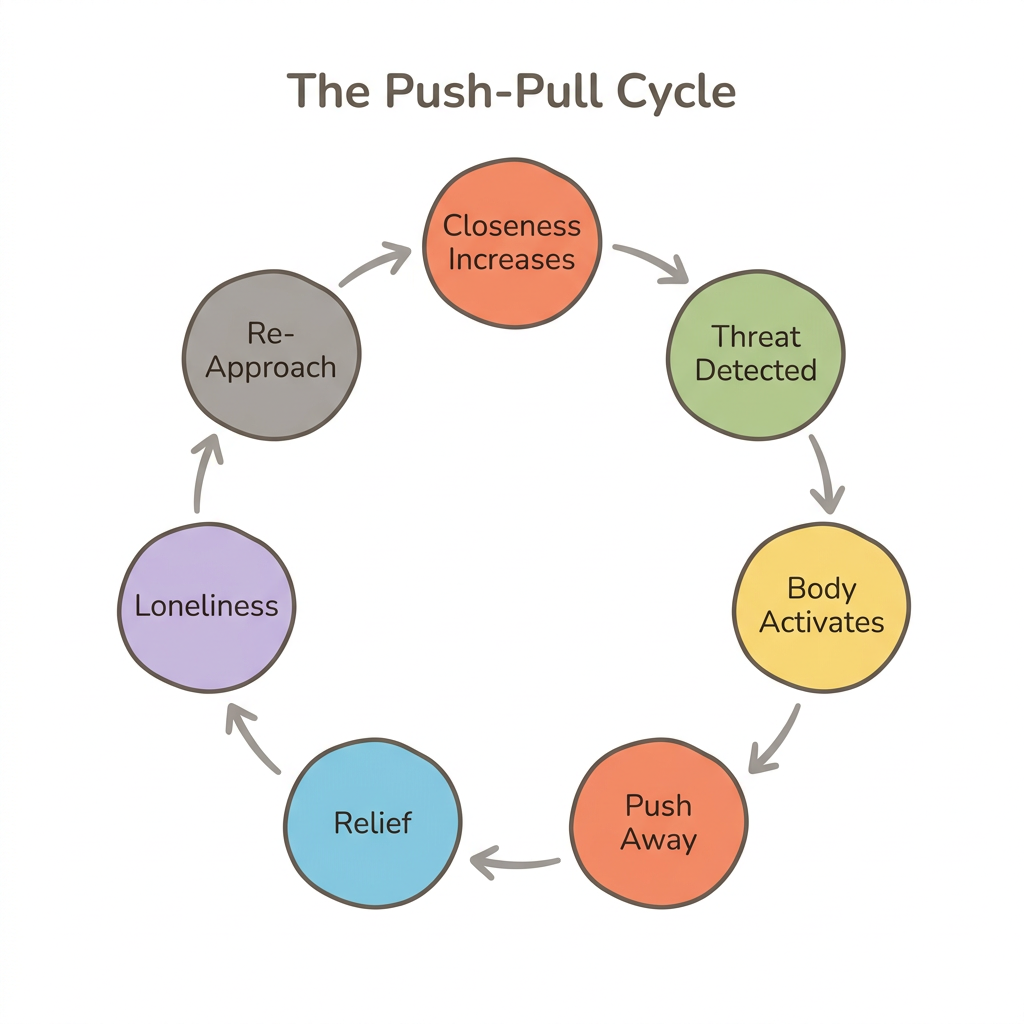
The Push-Pull Cycle in 7 Steps:
- Closeness increases — a bid for connection, a moment of vulnerability, or a step toward commitment
- Nervous system detects "threat" via neuroception — your body registers danger before your mind catches up
- Body activates — sympathetic nervous system fires fight or flight, or dorsal vagal triggers freeze and shutdown
- Protective strategy fires — you withdraw, pick a fight, find flaws, over-pursue, or go numb
- Distance is created — and with it, temporary relief as the nervous system's threat alarm quiets
- Loneliness and regret set in — the desire for closeness returns
- Re-approach — and the cycle begins again at step one
Sue Johnson's Emotionally Focused Therapy framework calls this a "negative interaction cycle" — a self-reinforcing loop where both partners' attachment strategies trigger each other. The critical insight is that the earlier you catch the cycle, the more choice you have about how to respond.
Cycle Interruption Point
- Look at the seven steps above
- Identify which step you usually become conscious of the pattern — this is your current awareness point
- Journal: "The moment I usually realize I'm pushing away is at step ___"
- Set an intention: "Next time, I want to catch it at step ___"
- Even catching the pattern one step earlier gives you significantly more room to choose differently
Is Pushing People Away a Trauma Response?
Yes — pushing people away is a trauma response rooted in what Bowlby (1969/1982) called internal working models. These are the unconscious blueprints your mind built from early caregiving experiences. When caregivers were inconsistent, frightening, or rejecting, the models encoded specific equations: "I am not worthy of reliable love" or "Others will hurt me if I let them close."
The Internal Family Systems framework, developed by Richard Schwartz, offers one of the most compassionate ways to understand this pattern. IFS reframes the part of you that pushes people away as a "protector part" — a part that learned early in life that closeness equals pain and has been doing its job ever since. The protector is not your enemy. It is the part that kept you safe when you had no other options.
Main and Hesse (2000) described how this plays out in disorganized attachment: when a caregiver is both the source of fear and the source of comfort, the child faces an irresolvable biological conflict. The nervous system says "move toward" and "move away" at the same time. This pattern does not resolve on its own — it carries into adulthood as the push-pull dynamic that brings you to articles like this one.
Your nervous system learned this response for good reason. It kept you safe. And now, with awareness and support, you can teach it something new.
Meeting Your Protector (IFS-informed, somatic)
- Close your eyes and think of a recent moment you pushed someone away
- Notice the part of you that initiated the distancing — where does it live in your body?
- Instead of fighting it, ask it: "What are you trying to protect me from?"
- Listen without judgment — it may answer with a feeling, an image, or a memory
- Say internally: "Thank you for trying to keep me safe. I see you."
- Notice if anything shifts in your body — even a small softening counts
This exercise takes about 60 seconds. You are not trying to eliminate the protector. You are building a relationship with it.
How Does Your Nervous System Keep You Stuck in This Pattern?
Your nervous system keeps you stuck through what Deb Dana calls the polyvagal ladder — three states your autonomic nervous system moves between, each shaping how you relate to closeness. Understanding this ladder is the key to recognizing why knowing better does not automatically mean doing better.
The three rungs of the polyvagal ladder:
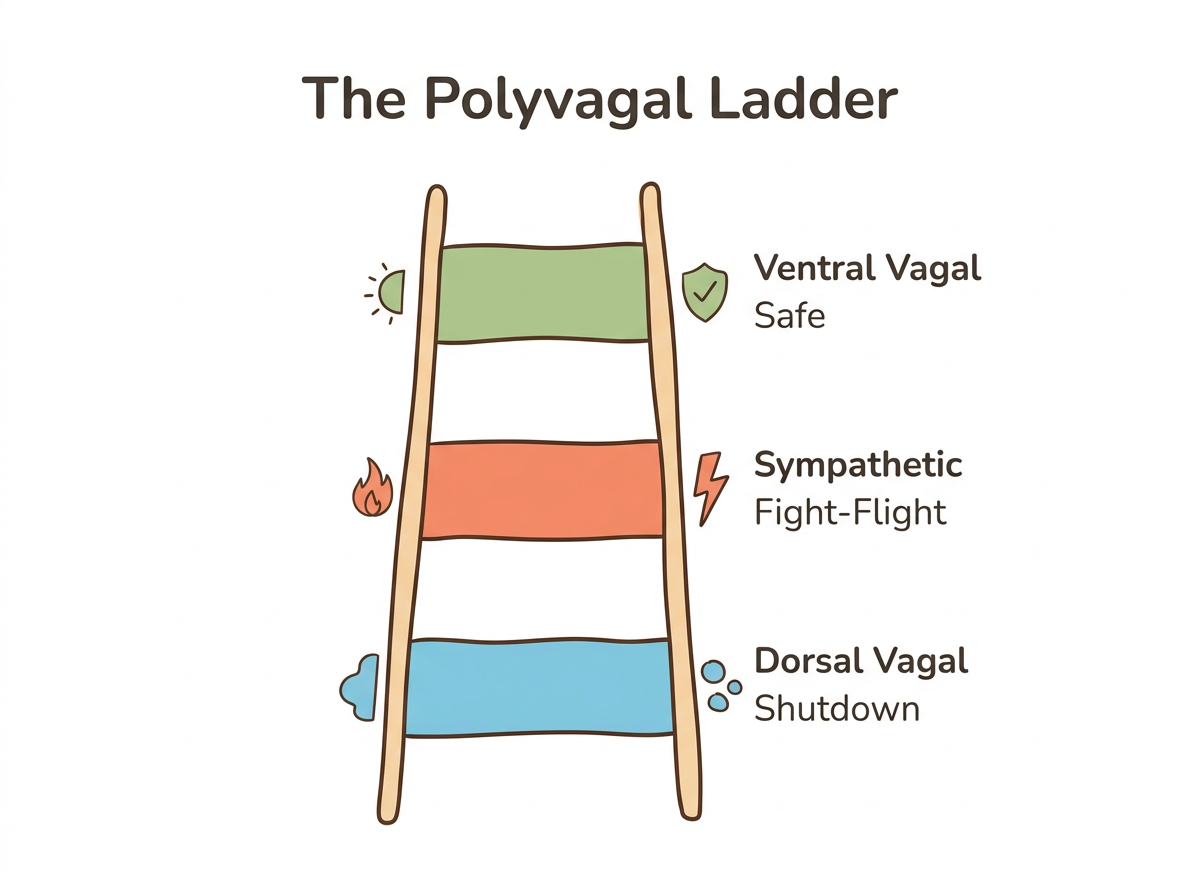
- Ventral vagal (top) — safe connection, social engagement, openness. This is where secure relating happens.
- Sympathetic (middle) — fight or flight. Pushing away through conflict, irritation, restlessness, or anxious over-pursuit.
- Dorsal vagal (bottom) — freeze and shutdown. Going numb, dissociating, feeling nothing, "I don't care anymore."
Avoidant individuals often default to dorsal vagal shutdown when intimacy is invited. The body reads closeness as danger via neuroception and drops into the lowest rung of the ladder — numbness, emotional flatness, the sudden disappearance of feeling for someone you cared about yesterday.
The cortisol research confirms this. Avoidant women show elevated cortisol before and during closeness, with a rapid drop after the interaction ends (Young & Kuchenbecker, 2021). Securely attached individuals, by contrast, show lower cortisol and higher oxytocin during connection. Your body is literally stressed by intimacy and relieved by distance — not because something is wrong with you, but because your nervous system learned this response.
The hopeful part: the nervous system is not fixed. Vagal tone can be strengthened through practice, gradually expanding your window of tolerance for closeness.
Vagal Toning for Safe Connection (somatic and body-based)
- Hum for 30 seconds — feel the vibration in your chest and throat, which stimulates the vagus nerve
- Splash cold water on your face or hold something cold — this activates the dive reflex and calms sympathetic activation
- Lengthen your exhale — breathe in for 4 counts, out for 8 counts. Extended exhales activate the ventral vagal system
- Orient to safety — slowly look around the room and name 5 things you can see
- Practice this before a difficult conversation or when you feel the urge to pull away
This entire sequence takes under two minutes. You are training your nervous system to stay on the top rung of the ladder.
Can You Actually Stop Pushing People Away?
Yes — and the research on earned security provides strong evidence. Earned security, first described by Roisman and colleagues (2002), refers to people who experienced insecure early attachment but developed a coherent, integrated narrative about those experiences and now function with secure attachment patterns. Longitudinal research shows that a significant proportion of people with insecure early attachment can shift toward secure functioning by adulthood through therapy, corrective relationships, and developing narrative coherence (Filosa et al., 2024).
Emotionally Focused Therapy provides additional evidence. EFT is effective in approximately 70 to 75 percent of couples, and 82 percent maintain those gains at two-year follow-up (Wiebe et al., 2017). EFT works by identifying the negative interaction cycle — the pursue-withdraw or push-pull pattern — and helping partners access the vulnerable emotions underneath the protective strategies.
A recent scoping review by Filosa and colleagues (2024) confirmed that earned security is achievable through multiple pathways: therapy, corrective relational experiences, self-awareness practices, and developing narrative coherence about your past.
A practical roadmap for change:
- Awareness — recognize your specific push-away pattern without self-blame
- Nervous system regulation — build your capacity to tolerate closeness through somatic practices
- Corrective relational experiences — therapy, safe friendships, or a partner who can hold steady when your protector fires
- Titrated exposure — gradual, small doses of the closeness you normally avoid
You do not rewire attachment in a single insight. You rewire it by noticing 10 percent earlier, responding 10 percent differently, 10 percent more often.
Titrated Closeness Practice
- Choose one safe relationship — a friend, partner, or therapist
- Identify one small closeness behavior you normally avoid — saying "I missed you," asking for help, or staying present instead of leaving the room
- Try it once this week
- Notice what your body does — do not fight the discomfort, just observe it
- After, journal: "I survived closeness. What actually happened versus what I feared would happen?"
- Gradually increase frequency — this is how you teach your nervous system a new equation
When Should You Seek Professional Help?
You should seek professional help when the push-away pattern is causing significant relationship loss, isolation, or distress that self-awareness alone cannot resolve. You deserve support — recognizing the pattern is the first step, and sometimes interrupting it requires a trained guide.
Signs it is time to work with a therapist:
- You recognize the cycle clearly but cannot interrupt it on your own
- The pattern has cost you multiple important relationships
- You are experiencing depression, chronic loneliness, or isolation as a result
- The push-away pattern connects to childhood experiences you have not fully processed
- You find yourself panicking when closeness is offered and shutting down when it is withdrawn
Specific therapy modalities that address attachment-driven pushing away:
- Emotionally Focused Therapy (EFT) — for couples caught in pursue-withdraw cycles. Identifies the negative interaction pattern and accesses the vulnerable emotions underneath.
- Internal Family Systems (IFS) — for individual work with the protector parts that drive distancing. Helps you build a relationship with the parts of you that push away rather than fighting them.
- Somatic Experiencing — for releasing trauma held in the body. Especially helpful when you understand the pattern intellectually but your body keeps firing the old responses.
Therapy and daily practices work together. A therapist provides the corrective relational experience and guided processing; daily practices like the somatic exercises in this article help you build new neural pathways between sessions.
Frequently Asked Questions
Why do I push people away when I like them?
Liking someone activates your attachment system, which triggers protective strategies learned in childhood. The closer someone gets, the more your nervous system perceives threat — even when your mind wants connection. This is especially common in avoidant and fearful-avoidant attachment styles, where interest itself becomes the trigger for distancing.
Is pushing people away a trauma response?
Yes. Pushing people away is a learned survival strategy from early relationships where closeness was paired with pain, unpredictability, or rejection. Your nervous system encoded "intimacy equals danger" and now fires protective responses automatically, even in safe relationships. Internal Family Systems therapy reframes this as a protector part doing its job.
Can you have anxious and avoidant attachment at the same time?
Yes — this is called fearful-avoidant or disorganized attachment. Bartholomew and Horowitz (1991) described it as having negative models of both self and others. You simultaneously crave closeness and fear it, creating a push-pull pattern. Research estimates 5 to 25 percent of adults have this style, with higher rates among young adults aged 18 to 24.
How do I stop pushing people away?
Start by recognizing your specific pattern without self-blame using the push-away inventory above. Practice nervous system regulation techniques like extended exhales and somatic tracking. Try small, titrated doses of closeness in safe relationships. Consider therapy modalities like EFT, IFS, or somatic experiencing. Research on earned security shows attachment styles can shift toward security over time.
Why do I push away the people I love the most?
The people closest to you activate your attachment system most intensely. Greater emotional investment means greater perceived risk to your nervous system. Your protective strategies fire hardest around the people who matter most because the stakes feel highest and the potential for pain feels greatest. This is activation, not weakness.
What triggers avoidant attachment?
Common deactivating triggers include a partner expressing strong emotions, conversations about commitment or the future, feeling needed or depended upon, loss of personal space or routine, and moments of vulnerability. These situations all signal "closeness increasing" to the nervous system, which responds with the distancing strategies it learned in childhood.
Am I avoidant or just not interested?
The key difference is that avoidant attachment involves wanting connection but feeling uncomfortable when it arrives. If you feel relief when someone pulls away but then miss them intensely, feel attracted to emotionally unavailable people, or consistently lose interest once someone reciprocates your feelings — that pattern points toward avoidance rather than genuine disinterest.
Why do I feel suffocated in relationships?
Feeling suffocated is a hallmark of deactivating strategies in avoidant attachment. Your nervous system interprets closeness as a loss of autonomy and activates a fight-or-flight response. Research shows avoidant individuals experience elevated cortisol during relational closeness (Young & Kuchenbecker, 2021). This is your body's learned response to intimacy — not a reflection of your partner doing anything wrong — and it can be gradually retrained.
Want to Go Deeper?
Meadow includes a structured assessment to help you understand your specific attachment patterns, followed by a 66-day program of daily practices designed to build earned security.
Start your free week →References
Foundational Attachment Theory
- Bowlby, J. (1969/1982). Attachment and Loss, Vol. 1: Attachment. Basic Books.
- Hazan, C. & Shaver, P. (1987). Romantic love conceptualized as an attachment process. Journal of Personality and Social Psychology, 52(3), 511-524.
- Bartholomew, K. & Horowitz, L.M. (1991). Attachment styles among young adults: A test of a four-category model. Journal of Personality and Social Psychology, 61(2), 226-244.
- Mikulincer, M. & Shaver, P.R. (2003). The attachment behavioral system in adulthood: Activation, psychodynamics, and interpersonal processes. Advances in Experimental Social Psychology, 35, 53-152.
- Mikulincer, M. & Shaver, P.R. (2007). Attachment in Adulthood: Structure, Dynamics, and Change. Guilford Press.
Disorganized and Fearful-Avoidant Attachment
- Main, M. & Hesse, E. (2000). Disorganized infant, child, and adult attachment: Collapse in behavioral and attentional strategies. Journal of the American Psychoanalytic Association, 48(4), 1097-1127.
- Bakermans-Kranenburg, M.J. & van IJzendoorn, M.H. (2009). The first 10,000 Adult Attachment Interviews: Distributions of adult attachment representations in clinical and non-clinical groups. Attachment & Human Development, 11(3), 223-263.
Neuroscience
- Vrticka, P. (2012). Social neuroscience and attachment style. Social Neuroscience.
- Vrticka, P. & Vuilleumier, P. (2012). Neuroscience of human social interactions and adult attachment style. Frontiers in Human Neuroscience, 6, 212.
- Young, E.S. & Kuchenbecker, S.Y. (2021). Cortisol and attachment in relational contexts. UCLA Stress Lab.
Therapeutic Approaches
- Johnson, S. Emotionally Focused Therapy. International Centre for Excellence in Emotionally Focused Therapy (ICEEFT).
- Wiebe, S.A. et al. (2017). Two-year follow-up outcomes in Emotionally Focused Couple Therapy. Journal of Marital and Family Therapy, 43(4), 635-650.
- Schwartz, R.C. Internal Family Systems Therapy.
- Levine, P.A. Somatic Experiencing.
- Porges, S.W. Polyvagal Theory.
- Dana, D. Polyvagal applications in clinical practice.
Earned Security and Change
- Roisman, G.I. et al. (2002). Earned-secure attachment status in retrospect and prospect. Child Development, 73(4), 1204-1219.
- Filosa, M. et al. (2024). Earned security: A scoping review. Psychological Reports.
Biological Mechanisms
- Attachment Project. Oxytocin and attachment styles.
- WifiTalents. Attachment style statistics compilation (2026).
This article is for educational purposes only and is not a substitute for professional mental health treatment. If you are experiencing significant distress related to your attachment patterns, please consult a licensed therapist or counselor. The exercises described here are informational and should not replace individualized clinical guidance.